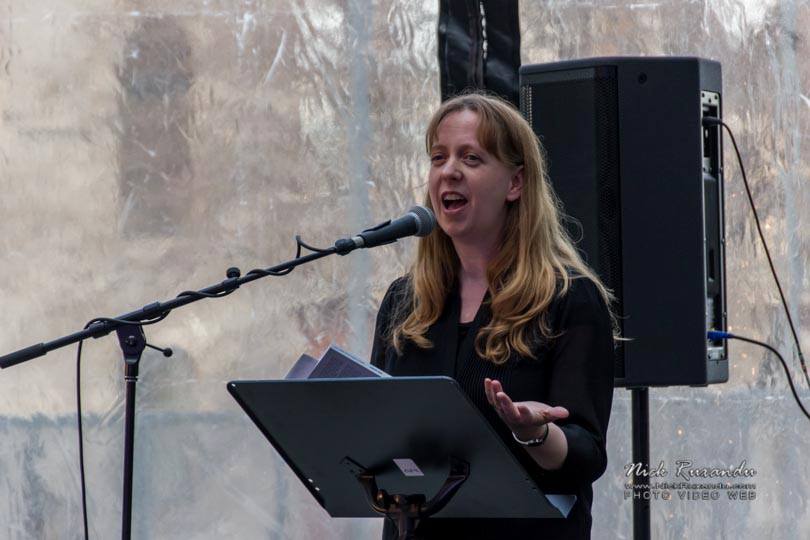
Morbid in the Mountains

April and Chris Demes’s guitar birdhouse in Hill Spring, Alberta as posted on canadiangardening.com

My May began with a literary festival in a world class city and ended with a book club in the village of Hill Spring, population not quite 200.

This book club was hosted by my friend and fellow writer April Demes.  Years ago, when we first met, April was an arty, precocious teenager and I was a newly married 21-year-old who knew EVERYTHING.  Now that we’re older, we have more in common: gardening, bird watching, CBC Radio, pretty blond children, and writing.

Despite their idyllic Rocky Mountain surroundings – a white house on the side of a green hill where a repurposed guitar is nailed to a tree as a birdhouse – April’s family hasn’t been luxuriating in a quiet simple life.  (Quiet simple life is a myth.  If we think we know someone living this way, it’s a sure sign we don’t know them very well at all.)  While still in his 30s, her husband was afflicted with cancer, right inside his skull. They nearly lost each other.  That my novel strikes any kind of chord with April is a great honour.

The Hill Spring book club was one of my favourites.  It was peopled with bright, interesting women of varied ages and backgrounds – some of whom may be distantly related to my well-connected husband.  They came prepared with questions and we had a great discussion about love and death and the writing process.  But it wasn’t because everyone unreservedly loved the book.

One of the ladies who enjoyed the book described her grownup daughter’s reaction to it.  They’d been reading aloud and the daughter stopped when the narrative got too “morbid.”  There is a fair bit of death and death paraphernalia in the novel.  It begins in the title and never really lets up.  It can be tough for some readers to see through it to the tenderness that is the real point of the book.  Sometimes, they dismiss it as “morbid.”

Strictly speaking the word “morbid” means sick, unhealthy.  I flinch when I hear this word used to describe my book.  Writing in frank, practical terms about loss is not something I consider unhealthy.  Not everything that’s uncomfortable – exercise, pelvic exams, insulin shots – is unhealthy.  Willfully ignoring the difficult and complicated process of dispatching our loved ones until we’re devastated by a crisis is what seems unhealthy to me.  As I wrote the book, “morbid” was not my aim – quite the contrary.

While I’m no longer surprised to hear “morbid” spoken at book clubs, I was surprised to hear which part of the book made the lady’s daughter squirm.  It was the chapter where the main female character is cutting up a grocery store chicken, making dinner.

I hate cooking more than most people.  I wrote about cutting chicken honestly, flaunting but not exaggerating my perceptions of it.  “Take that, cooking.  You’re gross.”  But even someone who abhors cooking as much as I do probably doesn’t find her own kitchen a morbid place.

Please enjoy this photo of a butchered chicken

Maybe death is the same.  Life on Earth means eating and it means dying.  Both are messy, inevitable, and natural.  It doesn’t matter how healthy or vibrant or “morbid” any of us is, we all have to eat and we all have to die.  It remains true even if we don’t want to know anything of the finer points of how either is done.

I don’t make money on book clubs but I did sell two books in Hill Spring.  One was to a lady who came to the meeting without finishing the book.  It was morbid, she said, but after hearing the rest of us talk about it she’d decided to give the book another chance and invest in her very own copy (personally defaced by me) instead of borrowing April’s.  She was willing to question her sense of what’s morbid and consider changing her mind.

It may have been the most gratifying book club comment ever.

Searching for Swag in Montreal

Me at the Blue Metropolis International Literary Festival in Montreal

Me at the Blue Metropolis International Literary Festival in Montreal

So my 17 year old son asked me, with all the irony he could muster, “Mom, which value is more important to you: YOLO or swag?”

If you’re over 25 and this question makes no sense, that’s exactly how it should be.  This is the current youth lexicon at work, reminding – or warning – us older people that we aren’t the sole proprietors of our language.  However, as the beloved parent of generous teenagers I’m given a pass in a few areas of youth culture including permission to know the meaning and social function of words like YOLO and swag.  Thanks, boys.

I won’t define YOLO here like the old sociologist dork I truly am (and as if there’s no Google).  It’s just a simple acronym anyways.  Swag is more complicated.  It’s concrete and ephemeral at the same time.  It can be stuff, but not stuff.  It arises from what’s inside and outside.  It comes and it goes.  What’s swag on one person may be sad or silly on another.  Sometimes the very best swag comes from the most humble sources.  There’s irony and self-consciousness in swag.  And it descends differently upon everyone.

Follow any of that?  I know, it reads like old theology – swag is invisible, uncreated.  It can be a bit of a riddle. Just ask my 35 year old friend Christi who’s been trying to use the word “swag” appropriately in conversation with teenagers since the New Year.  It’s a process of trial and error but don’t worry, she’s got swag enough to keep trying and will pull it off eventually.

I can use the word swag but that doesn’t mean I can command swag itself.  Sometimes I worry I’ve never had it — especially when I’m doing my writer-thing out in public.

If anyone wants to know what I mean when I talk about good writer swag, I recommend a look at the Blue Metropolis International Literary Festival in Montreal.  It’s a gathering of writers, publishers, media, and book lovers from all over the world held annually in one of the great cosmopolitan cities of my country.  The festival is peopled with top literary talent – and me.  Believe it or not, I was given spots at three of the festival’s venues this spring.

With a gig like that, it was time to stop being awe-struck and turn on the swag.

Rightly or wrongly, I believe my best hope for swag begins with boots.  I packed a couple pairs and headed off on a cross-country flight, alone.

My first impression of Montreal was that the city is serious about Canada’s second (or first, depending on who’s asked) official language: French.  I knew most people in Montreal can speak both English and French but I didn’t realize Montrealers’ default is French.  I also didn’t realize how profoundly my French has atrophied since I left eastern Canada twentysomething years ago.

My first Montreal venue: the Atwater Library

When I was a high school student in Nova Scotia, I spoke French all the time – horrible French.  I understood it was bad and did not care.  The badness was part of the sport.  What I lacked in ability I made up for with confidence, enthusiasm and – wait for it – swag.  That bad-French swag is now history and I’m left with my sheepish grownup French – stressing out over masculine and feminine nouns.  At least I still have the comprehension to tell the nice lady asking me to donate blood in the street “Non merci.”  And by the time I left the city I was comfortable enough to be using my natural Acadian quack for “oui” again.

No matter how stupid I sounded, I loved the city.  I went to galleries, cathedrals, museums, and got to debut by reading my novel to a crowd at an old library.  At my publisher’s festival event, I witnessed the gorgeous writer-swag of some of my fellow Linda Leith Publishing authors.  As always, they astounded me.  They’re multi-lingual, well-traveled, well-educated, and each of them writes like a house on fire.  Even the new non-fiction book all about the prostate gland sounded amazing when I heard the doctor who wrote it presenting it at the festival.  Set on a sheltered patio, our party was everything I fantasized it would be.

I was set to appear late in the English portion of the programme.

Want swag even in death? You want a saint’s burial in a French-Canadian Catholic Church.

“Come on, Jenny.  Think swag.  Last winter the Montreal Gazette called your novel the ‘stand-out’ of this company.  Swag!”

I still don’t know if it was swag or not but I got up on stage and nodded to my misfit-ness in the Linda Leith Publishing stable of writers.  Unlike the others, I speak one language, have one degree, and have lived my whole life on one continent.  “But I have the same heart as everyone else,” I said, “and my heart is in this book.”

It wasn’t a confession or an apology.  It was more like bragging.  To be at the Blue Metropolis International Literary Festival with Linda Leith Publishing, I have to punch above my weight class.  There’s no shame in that.  It’s as if something has triggered a special dispensation.  The rules have been waived and I’ve been let into something I would normally have no right to approach.  It’s as if there’s something intangible about me and my work that lets me get away with this beyond all reason.

Must be swag after all.

I don’t know this woman but I do adore her.

Down the Rabbit-hole, or, Jenny’s Adventures in the American-Mormon Book Scene

I’m churchy, okay.  I’m not even sorry.

I wrote a novel about people who quote the Bible at funerals, have a large family, and conspicuously don’t drink coffee.  I wrote a book with the words “Joseph Smith” printed in it.  In case anyone missed it, my characters are Mormons and so am I.

Like all writers, my goal is for everyone to read my book.  Everyone includes my fellow Mormons.  The Church is active throughout the world but its densest concentration of members is in the American state of Utah.  By the time my book was released, I had only been to Utah once.  It was when I was twelve years old and caught in one of my parents’ horrifically hot transcontinental summer road trips.

As a grownup author with a book to promote, I didn’t know how to begin to infiltrate the Utah market.  I picked through the Internet until I discovered the Whitney Awards.  They were invented to recognize fiction produced by Mormon writers.  It was a longshot but a few months later, a panel of judges selected my book as a Whitney finalist – one of the top five in the general fiction category.

And that’s when I tripped down the rabbit-hole.

I’m still a novice when it comes to understanding fiction considered “Mormon.”  I haven’t learned all its terminologies and talking points.  Please forgive any rookie misconceptions here.  As far as I can tell from outside the scene, “Mormon fiction” means several different things.  It has to since the Church is large and varied enough to include all kinds of people with all kinds of tastes and reading and writing levels.  Contrary to nasty, simple-minded fairy tales, there is no monolithic Mormon person.  Insisting there is would be calling on a stereotype and it’s as unfair to apply a stereotype to a religious group as it is to apply it to any other bunch of humans.whitneysepia

Far from being a unified movement, the Mormon book-scene is multi-faceted.  Within it there are writers who craft books intended solely for Mormon audiences.  They produce mainly historical fiction, kissing-only romance, inside jokes, and heartwarming lessons.

There are also Mormon authors – big commercial names like Brandon Sanderson and Stephanie Meyer – who write mass market speculative and young adult fiction.

When it comes to literary fiction, much of the book-length Mormon-y stuff is written from the negative perspectives of disaffected members – people who don’t like church anymore.  Some of these writers – no one famous or influential enough for me to spontaneously remember their names – loudly reject the idea that there can be a “Great Mormon Novel” that combines good literary fiction with Mormon orthodoxy.

I didn’t know this a year ago, but I’ve heard there comes a time in most Utah-Mormon writers’ careers when they must ask themselves if they’re going to work within the Mormon niche or in the mass market.  I have never asked myself this question.  Until recently, the Mormon book-scene hasn’t been part of my consciousness.  I’ve missed out on some good contacts and mentors because of that but I’ve also been spared some self-consciousness and second-guessing – the burden of a complicated, value-laden artistic and intellectual drama.

It was when my novel was named a Whitney finalist that it started to get traction in the Mormon book-scene.  At first, it was received with enthusiasm.  Kind reviews started to appear.  People were happy to read my book.  It unwittingly defied critics and filled a literary void in the 2013 Mormon publishing calendar.

What I didn’t understand was that all this goodwill was coming from just one corner of the book-scene.  I hadn’t counted on the larger, sometimes more petulant corner that prefers to have its heart warmed, flipped over, warmed again, flipped over, warmed again…  From that corner, literary work often seems risky and dangerous and pretentious.

I was about to learn this in an episode I’ll call “Off With Her Head.”

There’s a newspaper in Utah called Deseret News.  It’s not run by the Church but it is owned by the Church.  A freelance book reviewer assigned by Deseret News – a woman the same age as my mum — really, really hated my novel.  I can’t find a way to say this that doesn’t sound like bragging so I’ll just blurt it out.  I don’t have much experience with bad reviews.  The fact that this reviewer didn’t like the book was strange and disappointing.  But that wasn’t what made me sick about it.

The reviewer didn’t actually say much about the book – nothing that can be traced back to the text, anyways.  Instead of offering an analysis of the story, she chose to denounce it via the lowest road there is: the one that ploughs through my quality as member of the Church.  In this review, my book — and by extension myself — was pronounced “not the perspective of the Church.”

A complete stranger had called out my work in a Church-owned publication as bad Mormonism.  I don’t know how other churches work but in my Church, book reviewers aren’t supposed to have the authority to say what or who is or is not doctrinally orthodox.

Now, the last thing a novelist should do upon getting a bad review is challenge the reviewer and her editors about it.  Everyone knows that.  We are aloof artistes.  We ignore and move on.  But the reviewer had raised issues outside my book.  She’d attacked my integrity and fidelity.  It was so far offside I blew the whistle.

I complained first to her immediate editors.  They ignored me (though the reviewer showed some shocking hegemony when she wrote back telling me it is indeed her role to warn innocent readers when books “don’t match up” to good Mormon doctrine). Fuming, I wrote to the president of the newspaper.   Within half an hour of sending that email, Deseret News apologized, took the offensive comments out of the review, and asked me to forward the email where the reviewer voiced her absurd self-appointed mandate to judge my orthodoxy.

My novel had become controversial and polarizing.  When the controversy wasn’t terrible publicity, it was great publicity.  In the days after the review, people defended my work.  This included an old family friend who is actually an ecclesiastical leader in the Church. He likes the book, doesn’t find it doctrinally subversive, and when he read the review he wondered, “What book did she read?”

After all this, I decided to travel to Utah to attend the Whitney Award ceremony anyway.  I’d been tumbling down the rabbit-hole of the Mormon book-scene long enough to start to examine my surroundings and the other objects falling with me.  I was curious – perhaps morbidly so – and wanted to land in that world and move through it in the physical universe for a little while.

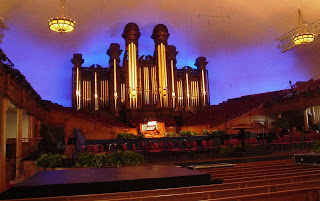
Once again, my parents were my traveling companions in Utah.  We had the good fortune to be in Salt Lake City’s Temple Square during a quick, free concert played on the massive pipe organ inside the big church that puts the “Tabernacle” in the “Mormon Tabernacle Choir.”  We all agreed this was the highlight of the trip.  Instead of indulging himself with a fussy highbrow organ piece, the organist played accessible songs – organ pop-songs with swelling choruses and big finishes like sonic tsunamis.  They were loud and fancy – songs meant to show us what the old pipe organ could do, sounds that vibrated through our chest cavities as if we were part of the instrument ourselves.  The organist was playing to the hearts and souls of musical Philistines like my parents and me – and we loved it.  It was exactly what we wanted.  There are times and places to play to more subtle and discriminating tastes but this was not one of them.
Back at the Whitney Awards, things weren’t going so well.  I’d brought books to sell and in an entire day, I’d sold one.  Sure, it was to the fiction editor of Sunstone magazine but – come on.  At the banquet I accidentally flung my tough cut of sirloin into the front of my dress and, of course, I did not win a Whitney Award.  I’d been nominated alongside three romances and a buddy-road-trip novel.  The best and most literary of the three romances won.  For the overall best book award, another romance – self-described as Bronte inspired — was the winner.  I was a little offended when, in her acceptance speech, the winner made comments that could have been construed as her claiming to have won because she had prayed harder over her book than the rest of us (again with the beside-the-point piety rankings) but other than that, the award made sense.

See, the final round of the Whitney competition is a popular vote.  It’s like a free, quick concert on an ostentatious pipe organ.  It’s got to be a crowd-pleaser, an easy, emotionally satisfying romp.  That’s just what it is.

What I do appreciate is that someone in the previous selection round, one or more of the Whitney judges, had stuck their necks out and brought my novel – a literary piece, a critic-pleaser by an obscure foreigner – to the Mormon book-scene’s attention.  The Whitneys aren’t really the time or the place to celebrate a novel like that – not yet, anyways.  But someday they might be.  This year, maybe they came a little closer.  Maybe someday that mythical “Great Mormon Novel” will appear on the scene and by then even the most guarded reviewers in the Deseret News will have learned not to be angry and afraid of it.

Until then, take my novel, Mormon book-scene.  Take it into your Wonderland and let it wear away some of the harshness of the hegemony still lurking there.  Grind it up, add its few small grains to the foundation being built for something better than what’s there now.
If Looks Could Kill: Why My Characters Have No Eye Colours

In preparation for an upcoming multi-author book event, I’ve been reading novels outside my usual range of Can-lit and literary fiction.  The atypical reading choices I’ve been making have been eye-opening – literally.  So far, what’s struck me most in my venture into crowd-pleasing commercial fiction is the diligent reporting of characters’ eye-colours.

Maybe everything I know is wrong but for me, all on its own, the colour of a person’s eyes determines nothing about how they experience life.  Okay, I admit my blue-eyed family may do more than the average amount of squinting in bright light.  And if I ever produce a brown-eyed child while married to my fellow blue-eyed husband, it would add some horrible drama to our home-life.  But most of the time, iris pigment is not the crucial narrative factor a random sample of Western pop-fiction might lead us to believe it must be.

Mentioning eye colour in literature can be a nice touch — like writing at length about a sunset or the ocean or whatever. (Writers can get away with a lot in the name of world-building.)  And in the right context, eye colours can be important story elements.  In Irving Berlin’s Easter Parade, Judy Garland closes her eyes and tests Fred Astaire’s devotion by challenging him to remember her eye colour.  Even as a kid watching the old movie on TV with my mum, I knew this was an important moment.  It advances the plot, reveals something about each of the characters, and it’s hecka sweet.  Well done, 1940s film-makers.  Look at you, making eye color genuinely relevant and letting it arise organically from the narrative.  That’s how it’s done.

The same could be said for any detailed description of characters’ looks.  Descriptions can work to propel the story, motivate actions, explain character traits.  But sometimes they’re dumped into a story apropos of nothing.  It’s as if we’re driving along an icy street and someone yanks up the parking brake and we’re flying in a circle for a moment, calling out eye and hair colours, spinning out of the true direction we’d been traveling.  Or it’s like the story has deteriorated into a junior high school Language Arts lesson and we’re now outside the narrative reading a “character sketch.”  At their best, character sketches are just exercises meant for the writer’s purposes.  They’re notebook scribbles, not even first drafts, and certainly not good reading.

I hope all of that sounds technical and reasonable.  Here’s a personal reason why I write without bothering to explain the minutiae what everyone looks like: I don’t care.  I honestly do not care what people look like.  That’s not to say I’m any less shallow than anyone else – I care far too much about how people smell – but it is to say that when I’m choosing what to pay attention to, a person’s looks aren’t all that compelling.

When I’m acting as creator of a book-world, I let everyone look the way readers want to imagine them.  That’s done by forgoing physical descriptions I don’t need for plot and thematic reasons.  Giving up the creative control that comes with dictating everyone’s colour palette is worth the sacrifice if that’s what it takes to keep physical traits from interfering with everything else I’m trying to say.

Describing a human being’s looks – even a fictitious human being’s – is actually not like describing a sunset.  It might feel idle and innocuous but it’s not.  Sunsets don’t come with politics.  People do.  Spelling out physical descriptions can introduce prejudices and tropes that distance readers.  If that’s what an author wants (and sometimes it is), carry on, I guess.  Descriptions also run the risk of fueling male gazes and other sources of negative stereotypes. They can end up assuring readers certain appearance-based prejudices are right and fair.  I have a revulsion to abetting that.

In the novel Eleanor Rigby, Douglas Coupland deliberately withholds the information that the narrator, a woman, is overweight.  He allows the reader to discover her through what she does and says and only later introduces what she looks like.  The delayed fat-reveal is brilliant.  I was surprised at how it affected me.  I am not a fat-shamer.  I’m not fat myself (she rushed to say) but during my most intensive baby-raising years I was a bit of a chubby-chick.  It runs in my family.  I love fat people.  I understand on a deeply personal level that they are not lazy or greedy or bad.  And it meant I was shocked at how my vision of Coupland’s character unwittingly changed for the worse after I read she was fat.

To add another layer of complexity, Coupland’s narrator challenges the reader, saying we must have been able to tell she was fat before the reveal, as if something so fundamental must have been visible all along.  Of course, it wasn’t.  Her looks don’t make her any less human or relatable as a character.  But it’s only through withholding a physical description and showing us our own reactions to it that Coupland demonstrates the depths of our appearance-based prejudices and how easy it is for writers to be complicit in maintaining them.

By the way, Judy Garland’s eyes – they were brown.


Getting Ready for the Blue Met

I’ve booked my ticket and my cheap but not inexpensive hotel room and I’m all set to fly to Montreal in four weeks for the Blue Metropolis International Literary Festival.  It’ll be my first time in Montreal outside the airport or the freeway and my first visit to a literary festival in any capacity.  In keeping with my out-of-step career path, at my first literary festival I’ll be appearing as an author with three spots on the programme.  As always, I’m humble and happy to be included in such a great event — and glad everyone’s cool with me performing only in English.

Link to the festival programme 

What Do Anime Heroines and Scottish-Canadian Arts Chicks Have in Common?

While eavesdropping on a Twitter conversation, I wound up reading an article denouncing white women who take up belly dancing.  The author says it’s an ignorant appropriation of Arab culture and the equivalent of white people performing in “brownface.”

The article took me by surprise.  I’d never thought about the racial politics of belly dancing.  That says something about the privileged position from which I experience the array of cultures in the pluralistic Canadian society in which I’ve always lived.  I’m someone who — despite my gender, low artsy income, and, strangely enough, my height — scores fairly high on privilege-o-meters.  I know that and I don’t argue when someone with an ethnicity other than my own tells me what looks to me like a well-meant tribute is actually unfair cultural appropriation.  I defer to them completely.  There’s been a lot of huffy Internet backlash against the article.  I will not add anything to that.  The role of humble, awestruck observer of diversity suits me just fine.

I felt a little chastened by the article anyway.  To insulate myself from my white imperialist self-loathing I went to my closet and reached for something colourful from my own culture.

Don’t be fooled by the Swedish surname I use now.  Quist is my husband’s family name.  I like it.  It works well for me.  The Q is distinctive, the name is short and Google-friendly.  Though, when people ask me how it’s pronounced I have got to stop answering, “Phonetically.”

My real name, my ethnic name, my blood name is MacKenzie.  It’s a name so Scottish it verges on caricature.  In my genealogy, I can trace my roots back to this clan three different ways.  No matter how generic it is, I love my family name.

IMG_7502

MacKenzie tartan – not just for kawaii school girls, not just for Scottish chicks

My Mister loves it too.  His dad lived in Scotland for two years before he raised a family of Anglo-Swedish Mc-wannabe Canadians (love that pluralism).  Some of my siblings-in-law can highland fling and play a few bagpipe tunes.  Maybe it’s because I’ve got nothing to prove that I never learned to do either of those things.  I don’t do things because they’re Scottish.  Things are Scottish because I do them.

I was touched anyway when my husband gave me the gift of a kilted skirt (a “kilt” is strictly menswear) in my family’s tartan.  It’s beautiful, dark green, heavy with pleats, handmade in Cape Breton, a symbol of my ancestors’ passion for ticking off and freaking out the English.

Even before I had a sweetie-pie to bring me authentic tartans, I’d been wearing cheap, chain store versions of dark green kilted skirts my whole life. They’re not hard to find.  Unlike belly dancer outfits, kilted skirts are everywhere.  Right now there are probably thousands and thousands of non-Scottish girls wearing them as school uniforms all over the world.  And that makes my relationship with my skirt a little complicated.

I wore it yesterday.  I wore it even though I was a little nervous someone might assume I was wearing it not as a grown up Scottish woman but as an old otaku tart making a pathetic attempt to appropriate the culture of East Asian school girls.  When my friends’ 15-year-old anime loving daughter saw my skirt she admired it — a lot.  It didn’t matter that it’s a stodgy knee-length and closed with a pin bearing my oh-so-Euro family crest.  The unintended connection to kawaii Asian students was not lost on her.

Wait.  Here is where I do not descend into a snarky denouncement of non-Scots wearing tartans and transforming an emblem of my culture into something vaguely awkward for me.  Here is where I will not complain the way I used to groan and barely restrain myself from going all highlander on my father-in-law when he’d strut around bawling in that horrible fake brogue of his.  My culture created this situation ourselves.  We can’t colonize – both literally and figuratively – other nations and then complain when their use of our artifacts makes us look silly.

South Korean schoolgirls used to wear han bok – flowing, bell-shaped, colourful dresses — to school until their region got entangled with the West and they eventually wound up dressed in the tartan skirts of our schools uniforms.  If white belly dancers got dressed up and performed out of a desperate sense that the only way to prosper and find a voice in the world was to do so, their position would be different.  It wouldn’t be so privileged.  It would be more like the position of the people who first brought my skirt into their schools in the last half of the twentieth century, trying to emulate the global power and wealth of the empires bearing down on them at the time.

It’s probably fitting that, woven within my lovely kilted skirt, there’s a bit of a hairshirt – a bit of mortification for me to bear in behalf of my imperialist ancestors, a bit of ambivalence about a culture that is flawed but still precious enough to its heirs to be worth remembering and preserving.  Fortunately for all of us, love and shame have never been mutually exclusive.

So scoff at me and my apparent lack of self-awareness, walking around at my age posing as a Japanese high schooler.  There’s a bit of me that knows I deserve the scorn, and another piece of me that can still enjoy what’s beautiful about the only people I can call my own.

Anthologies Are the Friendliest Literary Form

My Name — Among Way Cooler People’s — on the Back Cover of “40 Below”

Last year, a piece of my short non-fiction was included in 40 Below: Edmonton’s Anthology of Winter.  As always, I was thrilled to get the gig.  The book was released three months after my novel’s debut and it turns out to be the gig that keeps on giving.  It helped introduce me — a little hick in the sticks — to the big city Edmonton literary scene.  It got me invited to some cool events (most of which I couldn’t attend because of the winter weather — is that irony?) and also got me a slot in the podcast series produced to accompany the anthology.  Here’s a link to me and editor/writer/nice guy Jason Lee Norman celebrating the book writer-style — locked in a little room.

Jennifer Quist’s 40 Below Interview and Reading

Love and the Library

My husband got me chocolates just like I ordered for Valentines Day today. And, by playing muse to my novel’s “Brigs,” he also indirectly got me this: a recommendation from the Edmonton Public Library’s “Great Stuff” curator, Diego Ibarra. See?

Really needed that today.  Thanks, fellas.

Nothing Comes from Nothing: Reading Eric Freeze’s “Dominant Traits”

Dominant Traits, by fellow “Ridgeview” High School Alumnus, Eric Freeze

I never read faster than when I’ve found a short book written by someone I know.  It’s especially true when that short book by someone I know is also a good book.

That’s the experience I had blazing through Dominant Traits, a collection of short stories by Eric Freeze.  Eric and I went to the same high school – the one I came to in grade eleven and into which I never became fully socially integrated.  He was in the show-choir/theatre scene and I was an egghead poor-girl whose only extra-curricular pursuit was a part-time job.  We were not close.  But in a small school where everyone had some knowledge and experience with each other, Eric and I had good will between us.

This good will, our high school, writing fiction, and seeing it published aren’t the only things Eric and I share.  We have both set stories in the same southern Alberta town where we went to school, the place that inspires his “Ridgeview.”  We both write fiction deeply rooted in real life.  I read his collected stories out of sequence and noticed real life first in “A Prayer for the Cosmos” when the narrator refers to an infamous pep rally where dear old Ridgeview High School made a casual racial slur against an exchange student basketball star playing for a rival school.  Something like that really happened.

Then there was the story about the awkward white rural kid who thought of himself as a rapper.  When I first came to Ridgeview, I assumed this kid must have been playing a character, trying to be funny.  He wasn’t.  It was excruciatingly embarrassing.  I tried to ignore him.  I guess it worked.  I hadn’t thought about him for decades.  He’s probably grown up and put his rapper days behind him.  But then, in Eric’s “Francis the Giant” story, there he is again, not grown up at all, falling down on-stage in this MC Hammer act, and I can’t look away from him.  Eric’s fiction folded the kid’s story into the accordion fan I hadn’t realized it had always been for me.  There was the real kid, his act, my initial confusion about the act, the fictional character arising from the kid, and then the hallucinated transformation the character makes within the story, changing from a scrawny teenager to a giant, leech-flinging monster.  We are everyone around us.  We’re folded into accordion fans with everyone we know.  Their stories are rightfully ours, the opposite sides of our own folded surfaces.

“He’s doing it,” I thought as Eric’s stories started to bend into my own experiences.

I do it too.  Last night, at a literary event in Edmonton, I read one of the chapters from my novel that is crafted very much like an event from my family’s real story.  Afterwards, as I signed her book, a nice lady asked if the book was fiction or not.  I grinned, “Yeah, it’s fiction.  But it cheats.”  She seemed pleased.  Readers love cheating.

Though I’ve been on the giving end – force-feeding my family, friends, and high school classmates doses of our histories, fictionalized, printed, bound between the brittle, narrow margins of my perspective — I don’t think I’d ever been on the receiving end of this kind of storytelling in so direct a way until I read Eric’s book.  Seeing it from the other side had a much greater impact on me than I expected.  I didn’t just smirk knowingly and say, “Ah, yes, it’s this.”  Instead, my heart lurched inside me when I realized Eric’s “Torched” – a piece about a roofing crew grappling with the tenuous mortality of men early in adulthood — includes the story of a boy from our school who suffered an oddball head injury riding a bike in the dark.  Even though he seemed to recover from the accident, he suddenly died from the injury a few years later.  It’s weird but true.  There’s a monument to it in Eric’s book.

It was good for me to read Dominant Traits.  It ambushed me even after a mutual friend, the eye on the cover, and my cursory grasp of ancient Ridgeview gossip warned me the book was closely connected to things I had seen and heard for myself.  Reading it helped me consider my own writing in a new way, with greater empathy, with more tenderness and patience for what I demand of everyone.

Here was another writer not only playing my game but playing much of it on the same field – the same place and time.  Sure, his “Ridgeview” is different from mine.  He lived there as an insider (compared to me, anyways) and as a boy.  Unlike Eric, I would probably never attempt a story about cattle castration.  That is not my Ridgeview.  But I knew the convenience store, the comically wide roads, even the squeak of the gym floor, though I usually only heard it through closed doors.

Closed doors – that brings me to the point where I prove I don’t give old high school classmates free passes in book reviews.  The collection, in many ways, is men’s fiction — if the prevailing literary privilege will allow me to talk of such a thing.  It’s smitten with the male problem of imagining erections and ejaculations are far more salient in the world outside their own pants than they actually are.  The other half of humanity rolls its eyes, scoots to the cold side of the bed, and tells those Very Important erections to just go to sleep, for crying out loud.  I’d like to see a man my age write a meaningful, earnest, literary love story without any penises in it.  I’m not protesting out of stodginess.  I’m protesting because I’m tired and disappointed with male (and often female) writers taking the slimy, easy shortcut to writing about intimacy.  Work at sex and intimacy in a different medium once in a while, fellas.  Feel free to prove me wrong with examples in the comments.

In the age of “post-fiction,” writing from life is accepted and understood, sometimes preferred.  Maybe it’s not considered cheating anymore.  I don’t believe in creation ex nihilo – that everything we know must have been created by some kind of magic out of emptiness.  I don’t believe in it physically or artistically.  Ex nihilo nihil fit.  I’d wager Eric Freeze doesn’t believe in it either.  Everything created is organized out of pieces of things that are here already – Big Bangs exploding whenever someone or something comes crashing through us.