
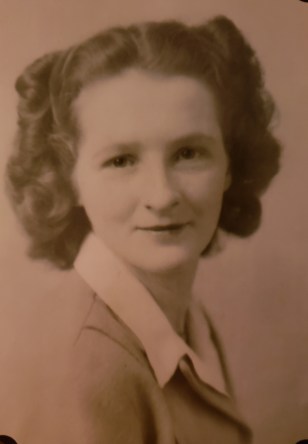
 My maternal grandmother, Meta McCarthy–born between the 1st and 2nd World Wars, dead as of yesterday–had a favourite passage in the Old Testament. She said if a girl found the verse in the last chapter of the book of Proverbs with the same number as the day of the month when she was born, the Bible would say something nice about her—a gyno-zodiac, a little Bibliomancy I learned from my good Christian Grammie.
The magic doesn’t start until verse ten, so my two sisters and two cousins born too soon in their birth months don’t get a fortune, which is awfully unfair. But the rest of us can play.
“Who can find a virtuous woman?” our King James translation begins.
My fortune is in verse 24: “She maketh fine linen, and selleth it; and delivereth girdles unto the merchant.” Sounds like code words for having to do the laundry AND go to work. True enough.
My mother, verse ten tells me, has a price far above rubies. Accurate.
Grammie’s other daughter, my auntie, has a candle that “goeth not out by night” which I am sorry to hear.
My middle sister “bringeth her food from afar” which makes no sense because her kids can come home from school for lunch, and my baby sister’s verse is about spindles and distaffs. More ornate iron-age messages about laundry.
Grammie’s verse is 28: “Her children arise up, and call her blessed.” Prophecy fulfilled, many times before and again now.
I knew my grandmother well, before she disappeared into Alzheimer’s disease when my children were babies.
She wouldn’t resist swimming at cold Atlantic beaches even if it meant going in fully clothed. Her favourite swimming move was the side stroke.
She taught us how to respectfully track a house cat around the yard, how to gather seeds from the hollyhocks and nasturtiums at the end of the season, how to knit, but not how to avoid getting busted by conservation officers for hauling away 5 gallon buckets of beach sand for the grandkids’ sandbox.
She was a pioneer meme-maker, overlaying our baby pictures with goofy captions. Her sense of humor was mostly fart jokes and that story about the drunk cousin who thought he’d made it outside and peed on the Christmas tree when she was a kid.
All summer, she drove us into “barrens” and woods to pick berries as though we wouldn’t survive the winter without them, and then brought them home to put up in reused pickle jars sealed with paraffin wax.
She used old-fashion Scottish words for things sometimes—especially us lads and lasses–and spoke in a drawn out sing-song cadence, complete with an inhaled “yeah-YEAH-yeah.” Her laugh was a cackle that I hear in my own.
Grammie chose a spiritual path for me decades before I was born. I’ve kept to it all this time. In its service, she took me with her on visits to the old, sick and lonely. When we went to see the lady with the coffee table made out of a Ouija board, the only comment Grammie made about it was a pleasant, “Well, will ya look at that.”
She took me to her 90-year-old parents’ house to spend entire days cleaning it, telling me to just graciously accept it as a compliment when Great-Grammie called me Dawn, after one of her other daughters.
When I got married at age 21 while living from one student loan disbursement to the next, she cheered me on anyway, giving me the wedding gift of enough money to buy my broke young husband the gold ring he still wears.
I don’t know what it would take to make a loved one’s death a welcome event. If anything could make it so, the almost-decade of profound Alzheimer’s dementia that was the conclusion of Grammie’s life before she died at age 97 might be it. It’s true, this is probably the least traumatic death of a family member I’ve ever experienced. But it is not nothing. And I arise up and call down her blessing.
 The world of book marketing is fairly straightforward: the more money a book has behind it, the better it tends to sell. Does that sound cynical? Maybe, but it’s also evident in industry practices like giveaways for newly released books on the Amazon-acquired mega social network for readers, Goodreads.com. Not that long ago, during the heavy marketing phases of my first two novels, anyone could post a book giveaway on Goodreads and hundreds—hundreds—of people would see that book, look at its cover and title, read its synopsis, maybe even the author’s name, and add the book to their to-be-read list in exchange for getting a chance to win a free copy. All it cost publishers and authors, big or small, was the wholesale price of the book, and postage. But by the time my third novel was published, Goodreads was charging hundreds of dollars to give away books on the site. Isn’t that nice? It’s great to see big, well-funded enterprises sticking together.
 Earlier this year, Sistering was awarded Best Novel by the Association for Mormon Letters, an international community that’s been very kind and supportive of my work. They sent one of their best and brightest, Michael Austin, to do an email interview with me–the most Mormon and, interestingly, the least gender role fixated one I’ve ever done. The link to read it is



 Outside the Honolulu airport, Hawaii is just as delightful as everyone says it is. Thanks to our Mormon ties we didn’t have to go full-tourist. Friends of ours–fellow Mormon-foreigners, a couple where the wife is South Korean and the husband is Japanese—have been living in Hawaii for years and showed us local favourites like a huge old banyan tree hidden off the side of the road, and a strip-mall restaurant serving massive “Hawaiian-sized” slabs of sushi. On Sunday, we wound up at a church service singing from a hymnal written all in Samoan and witnessing a congregation sending off a woman named Celestial to be a missionary abroad.

 Jennifer Quist, PhD