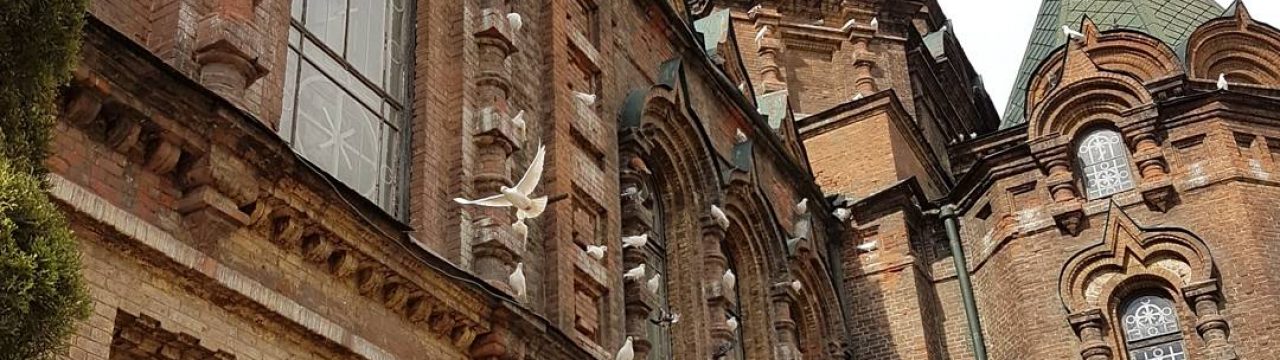
I know two things about cleaning gravestones:
- Don’t use bleach
- Don’t use a big freaky gas-powered pressure washer
I learned this watching grave restoration clips on YouTube—an activity that’s turned out to be my preferred mental break during a summer spent in a very strange headspace, fighting to finish reading the 61 books and articles I will be tested on in November to see if I can continue in my doctoral studies. Ideally, I’d be done reading in two weeks, but as of right now, I still have ten partly finished books and one I haven’t even started. I love everything about grad student life except this and funding applications so it’s been a rough summer of paying my dues and trying to get paid for my dues.
Clearly, gravestone restoration videos were the answer.
Most of the videos are narrated by biocide salesmen (the crud on gravestones is generally biological–algae, moss, lichen, all of it alive), earnest professional conservators, or amateur genealogists who are just so disappointed. They use soft-bristled brushes, approved cleaners with PH levels matched to the stones, and rinse it all down with a gentle slosh of plain water out of a bucket.
“That’s not tap water is it?” a heckler calls from off screen. “There’s chlorine in that!”
Welcome to Gravestone-Restoration-Tube.
But then there’s Bill.
From what I can gather, Bill is a senior groundskeeper-handyman working for a municipality in eastern Ontario. His personal YouTube thumbnail image is a John Deere themed open casket and his YouTube channel chronicles the maintenance he does in around the town cemetery (at least, it did until a board of directors banned him from filming anything past the cemetery’s front gate).
He’s like a goth Red Green (something for non-Canadians to Google), letting a slightly affected Canada-hick accent fly as he welds an old tank still full of diesel fumes without blowing himself to bits, and, yes, pressure washes the “friggin crap” out of gravestones, even a soft white marble one he begins the video by showing us that it’s a good exfoliant for his dirty thumbprint, improvising a tripod function out of the bucket of his skid-steer. He likes puns, mocks Nazis, gets distracted by interesting bird calls, and works the graveyard humor with quips like, “K, we’re here, live on location—well, least I’m live on location.”
And I can’t help thinking, but for a few decisions, maybe if I wasn’t so chicken when it came to the welding unit of my junior high industrial arts class, I could have been Bill. It’s a good life—creative, inquisitive, self-aware, brilliant in its Jack/Jenny-of-all-trades makeshift-ery. Dang, for all the lives we don’t get to live, languages we don’t learn to speak, people we never have “coffee” with, books we write that might never be read, books other people write that we might never finish reading.
I need these exams to be over. Until then, rock on, Bill.
 The world of book marketing is fairly straightforward: the more money a book has behind it, the better it tends to sell. Does that sound cynical? Maybe, but it’s also evident in industry practices like giveaways for newly released books on the Amazon-acquired mega social network for readers, Goodreads.com. Not that long ago, during the heavy marketing phases of my first two novels, anyone could post a book giveaway on Goodreads and hundreds—hundreds—of people would see that book, look at its cover and title, read its synopsis, maybe even the author’s name, and add the book to their to-be-read list in exchange for getting a chance to win a free copy. All it cost publishers and authors, big or small, was the wholesale price of the book, and postage. But by the time my third novel was published, Goodreads was charging hundreds of dollars to give away books on the site. Isn’t that nice? It’s great to see big, well-funded enterprises sticking together.
 I am not going to post a photo of someone else’s writing today.
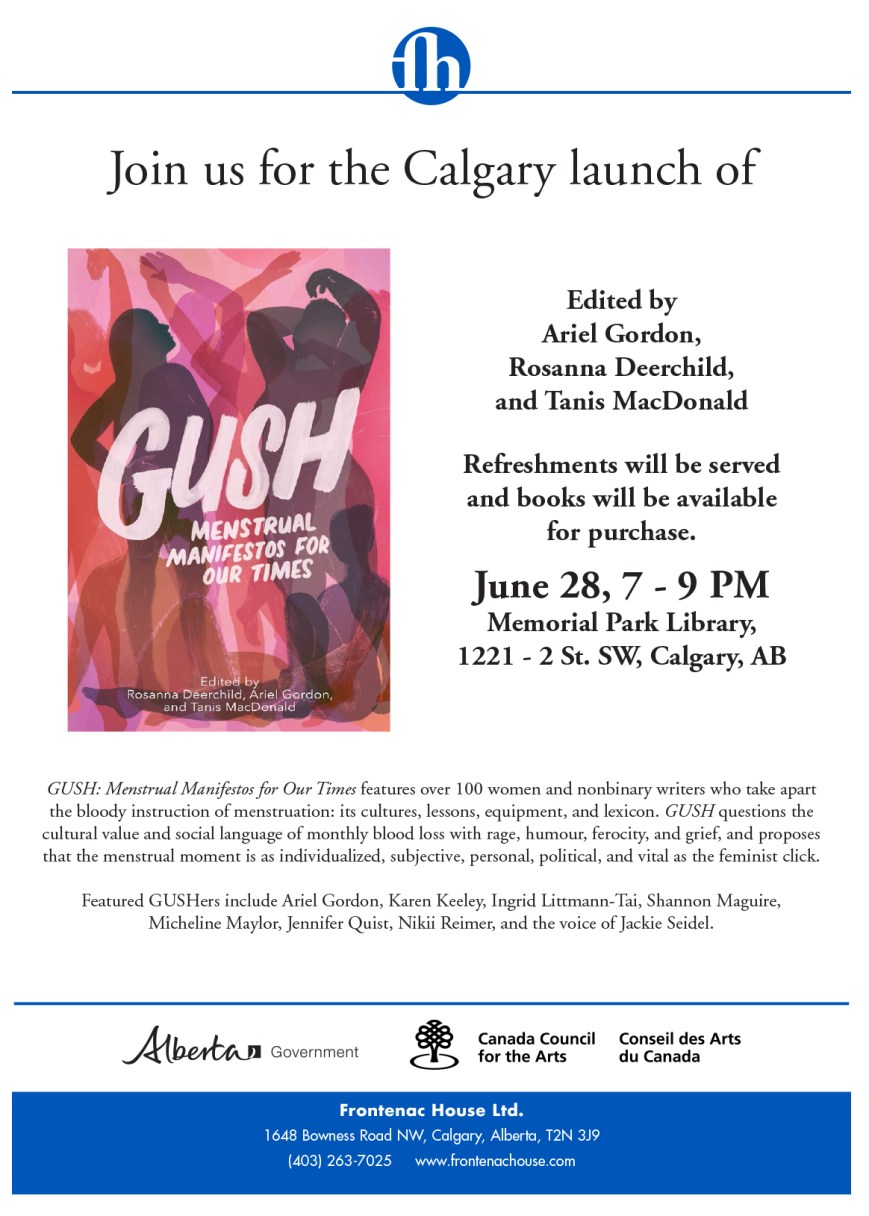 Catch me in Calgary on Thursday 28 June as I help launch Gush: Menstrual Manifestos for Our Times. It’s a new anthology from Frontenac House edited by Rosanna Deerchild, Tanis MacDonald, and Ariel Gordon. My contribution has a laugh at how I can answer the old timey cliched question of whether I thought I was dying the first time I got my period with “No, I thought I was getting my period the first time I was dying.” Trust me, it’s funny.
 One of the nicest compliments I have ever received was from a friend I saw every day, for hours at a time, for an entire month, who told me I was the happiest person she knew. Great compliment. Hearing it made me even happier. That’s what compliments are for. That’s how it’s done.
 personal about me than mere gender. I inherited my grandfather’s face, a certain kind of Irish face which I love on him, on my baby brother, on my ginger nephew and on my middle son to whom I passed it along, but which doesn’t play so well on a woman’s head. On me, Granddad’s wise and trustworthy expression plays as nasty and not trying hard enough. Ever since my grade six teacher first complained about it to my mother, men and women who do not know me will sometimes stop me to let me know my sad-looking-not-sad face is a problem for them. There is always something of an assertion of power in these comments but I do allow that they are usually also meant as a sort of overbearing kindness—as if their special insight will liberate me.


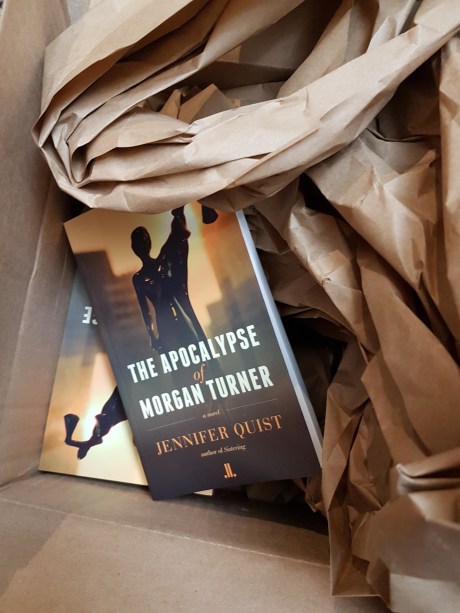
 Maybe you don’t feel like reading a book right now. I understand completely. Fortunately, reading isn’t the only way to experience a story, especially if it’s full of music and pictures. And so we bring you a bit of a playlist from my newly released novel,


 As a tiny girl still not able to read much in my native English, I was taught a little French by the short films pasted into the Canadian version of the Sesame Street program my mother dialed us into to give herself an hour of time for something other than childcare every day. This French was mostly just counting to twelve and “Mon ami, mon ami, mon ami pour la vie…”, but it was not nothing.
 Jennifer Quist, PhD