Woke Up This Morning a Published Novelist

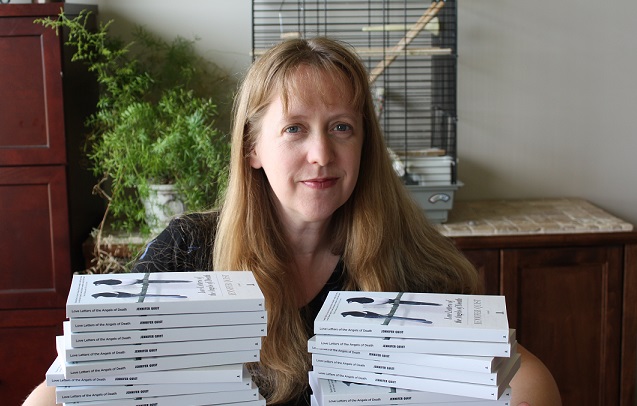
See, it's real.  Here I am with stacks of beautiful, traditionally published books I wrote myself

See, it’s real. Here I am with stacks of beautiful, traditionally published books I wrote myself

This morning when I woke up, my publisher was messaging to congratulate me on the release of my debut novel and my five-year-old son was throwing up in the hallway.  Way to keep it real, Sweetie-Boy.

My good mood is holding up well anyway.  If you’d rather not come get a signed copy of Love Letters of the Angels of Death at my house, the book is available from the publisher, in online stores, and is making its way into fine bookstores (coming soon to my local, Sunworks in Red Deer, Alberta).

Woohoo!

Amazon.ca Jumps the Gun

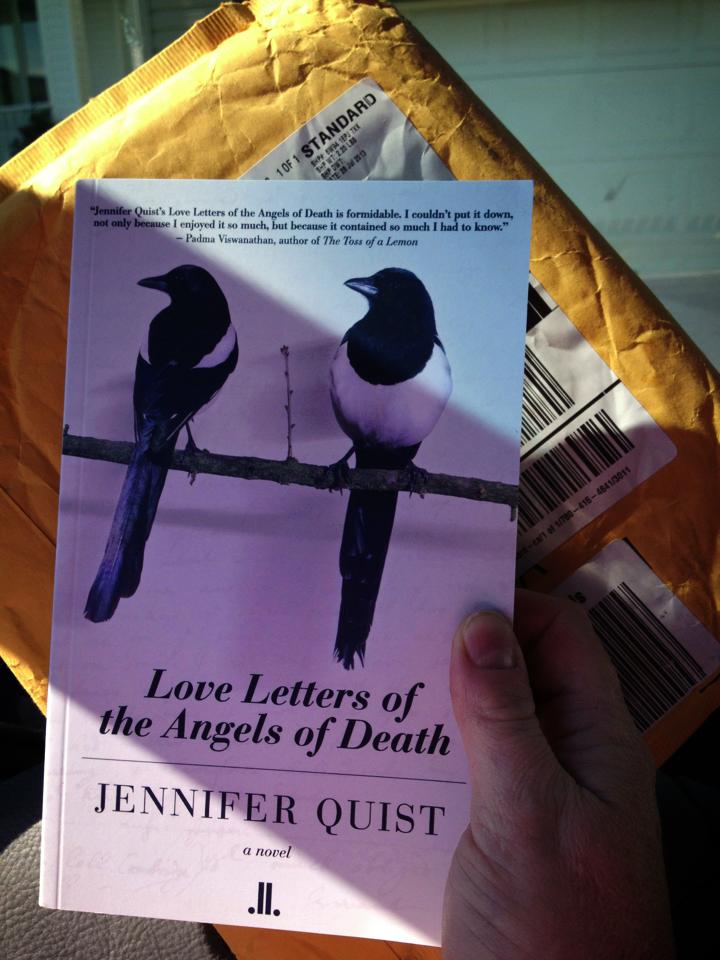
Even though the official release date isn’t until Saturday — about 36 hours from now — a friend of mine has already received her copy of my book.  Couldn’t have happened to a cooler person!  Thanks for sending me this picture, Janine.

j9mail

Schwester, Seour, Eonni, Jiejie, and Other Ways I Can Say “Sister”

My German textbook.

I love the English language.  I was an early English talker, an average English reader, and have made writing in English my profession.  Sometimes, I imagine English loves me back.  Even if it doesn’t, I can usually coax it to stand up on its hind legs and help me say whatever I want.

No matter how much I love it, English is only one language.  I don’t know how many other languages there are in this world – maybe no one knows for certain.  It’s debatable and ill-defined.  At any rate, there are hundreds.  Maybe I’m greedy and faithless but it makes me sad to have full use of only one of them.

It’s not that I haven’t tried to learn more.

Just about every English-speaking Canadian reaches adulthood with some ability in French.  Our country has two official languages.  Like most of my comrades, I sat through daily French classes in public school.  On the east coast of Canada, most of my teachers were Francophones – Acadians with an accent different from the one in Quebec and definitely different from the Continental chit-chat on the cassette tapes that came with our textbooks.  When my parents moved us back to western Canada, I was taught French by an Anglophone who spoke like a computer simulation of a human being talking French.  Whatever their quirks, I’m glad for those lessons.  They were not a waste of time.  The proof is that I can hold my own in my sons’ elementary school French immersion classes – for now.

In university, I needed credit in a language other than English in order to qualify for my degree.  I was tired of speaking badly only in a Romance language so I enrolled in German.  The vocabulary was a blast.  German pronunciation was fun and I found myself reading it aloud even without comprehension simply because the sound of it made me so happy.  The grammar, however, was cruel.  I took my introductory course and was surprised to receive a letter from the German department offering me a spot in their honours programme.  It was sweet but the fact was (and is) that the German phrase I used most often was, “Wiederholen Sie das, bitte?”  It means, “Can you repeat that please?”  I used it to stall conversations while I slowly and painfully tried to decode the language.

I discovered Asian languages outside of school when my kids became fascinated with east Asian pop culture.  Currently, most of the television we watch comes from Japan, South Korea, or Taiwan.  I know about twenty words in Japanese, slightly fewer than that in Mandarin Chinese, and about 90 words in Korean.  But my Asian vocabularies are not very useful in normal, daily conversation.  The phrases I know tend to be the kind of thing someone might shout in dramatic dialogue – things like, “How can this be?” or, “There’s no time!” or, “Do you want to die?” or, for really special occasions, “Don’t go!  I’m sorry!  I love you!  Come back!”  Yes, my conversations with the nice Korean guys who own my favourite gas station have to be kept short or things might get a bit melodramatic.

Tallied up, that’s 4+ languages attempted and only one mastered.  It’s not an impressive record.  But I can’t quit now.  This summer, I’ve started seeking out a new second language.  It’s different again from anything I’ve ever studied.  For once, pronunciation isn’t a concern.  This language is not in my mouth.  It’s in my hands.  I need to learn American Sign Language.

A family member – the wife of one of my brothers – is losing her hearing.  It’s her story and I won’t try to tell it for her.  She’s a writer and can share it without any help from me.  My sister-in-law is a smart, pragmatic, optimistic person – a problem solver – and I’m sure she’ll figure out how to cope in a world where not enough people know how to talk directly to her.  She’s losing her hearing, not her speech so she’ll remain able to tell us whatever she wants.  No doubt, the person doing the heaviest lifting with my sister-in-law’s new communication strategies will always be her.  But maybe I can help in my tiny way.  And maybe language study will be different for me this time.  It will come with an urgency, a purpose, and a focus it’s never had before.  I’m not learning for grades or entertainment or curiosity or even in the interest of fostering Canadian national unity.  Instead, I’m learning in order to stay connected to someone I love.  It’s a language study aid I’ve never tried before.  It’s more compelling than any of the  impressive cultural, political, commercial, or neurological arguments that can be made for studying a new language.

Whatever it is, “Sister” is one of the first signs I’ve learned.

The Art of the Happy Family: Review of Padma Viswanathan’s “The Toss of a Lemon”

A gorgeous novel by Padma Viswanathan, an author who kindly provided a “blurb” for the cover of my own novel.

A few weeks ago, I did my first interview leading up to the launch of my novel.  It should appear in the Summer issue of Montreal Review of Books.

One of the questions I was asked began by acknowledging that books about happy family situations – like the high-functioning marriage central to my novel — are scarce.  I’ve thought about this a lot since the interview.  I’ve tried to make a mental list of memorable, happy literary relationships.  Maybe another reader could do better, but for me, it’s a short list – one full of characters who usually end up dead within the first quarter of their books.  Most often, a happy relationship is a preamble for a story – a cheap tableaux meant to be quickly dismantled.  Otherwise, it’s the pat-ending of a story – the trite song-and-dance finale.  The interviewer who posed the question is right.  Seldom does a happy relationship make up the balance of a story, especially in literary fiction.

When most readers want to know how to behave and be happy in a family, we reach for the self-help shelves of the bookstore, not the literary fiction section.  I think the reasons we’re not interested in seeing happy families in fiction are fairly simple.  Happy relationships are typically written as uneventful.  They’re boring.  Their sweetness is cloying.  It’s mapped out in cliches and feels contrived.

And that’s a mistake.  It’s not the relationships that are boring but the way writers approach them. Happy families come with their own difficulties and complexities – ones I find fascinating.  They’re surprising, interesting and, obviously, I believe they ought to be explored in literature.

I recently came across an example of a novel that portrays a generally happy family in a way that’s both believable and compelling.  It’s Padma Viswanathan’s The Toss of a Lemon.  Set in the final decades of colonial India, spanning two world wars, and sweeping changes to the traditional Hindu way of life, the book comments on the intricacies of religion, class, and politics without the tedium of a history or the tiresomeness of a polemic.

It also presents a picture of a large, mulit-generational family that manages to function and produce healthy, happy members in spite of inevitable adversity.  The central character is a matriarch, a child-bride widowed and left with two children by the age of eighteen.  She manages to maneuvre within the strict limitations of her caste, her gender, and a crushing notion of fate to shield her grandchildren from the self-destruction of the family’s patriarchs.  There’s an amazing irony at work in the book: the place where the matriarch seems to be weakest – her utter servitude to oppressive customs that keep her marginalized and invisible to the world outside her family – is also the focal point of her greatest strengths.

The rest of the cast of characters is large and complicated and badly flawed in places. Like any story meant to deal with realistic ups and downs of daily life, the books has its share of illnesses, untimely deaths, and family spats that drag on for years.  Yet the tone of the book is not dark or dour.  It’s sun-lit and warm.  The book’s heart is like a real heart – one that is much more than the sum of its parts.  Its warmth is at once miraculous yet credible with a bittersweetness that only comes with honesty.

I really enjoyed this book. It was strange to find myself feeling so at home in a novel set in a Brahmin household.  Maybe the familiarity springs from the lines Viswanathan drops into the narrative expressing sentiments exactly like ones I’ve felt in my own family life.  For instance, when she says that certain burdens only become heavier when we share them, I know just what she means.  Sometimes, even in a close family, the best way to handle suffering is privately.  For me, Viswanathan is not only a story-teller.  She’s someone who seems to understand family in much the same way I do.

A large part of being happy in a family – or maybe in anything – is understanding and accepting the limitations of what it can make possible and forgiving and forgetting the absence of what it was never meant to provide.  That’s what the women in The Toss of a Lemon do.  As Viswanathan writes of them in the aftermath of a disaster, “We were not shattered.”

In writing the book, Viswanathan drew on her own family history.  Maybe that’s what gives the story its organic, authentic, universally relatable feel.  Reality — even an unseen, faraway reality — comes with a badge of truth.

Thanks to my family history, writing about a happy family came naturally for me.  That’s what I told the reporter when she asked me if writing a good marriage was difficult.  I don’t know why, but it’s my excellent fortune to have only ever lived in happy families.  It may be a rare way to live but it’s real and it’s worth the work it takes to give it a voice.

Lost in the Post: My Silly Ambivalence for Epistolary Novels

The first epistolary book I ever disliked.

At one point during the painful process of compressing my novel into a tiny synopsis to print on the back of the book, we ended up with a paragraph that described the book as a series of letters.  Letters — I guess the connection between the book’s back cover copy and the title, Love Letters of the Angels of Death, on its front should have been obvious, especially to me.  So it must have seemed pretty strange to everyone else involved when I objected to seeing “letters” mentioned in the synopsis.

I blame L.M. Montgomery for my aversion to the epistolary novel — a work of fiction imagined as a bundle of personal correspondence.  Yes, I said Lucy Maude Montgomery, the Canadian author of the Anne of Green Gables series – the woman I hold personally responsible every time I cringe at a fellow Canadian using “delicious” to describe something that cannot fit into a mouth.  She’s also prone to portraying fat people as bad and birch bark as important enough to interrupt everything with a lengthy description of it.  She might be onto something with the birch bark but she’s definitely wrong about the fat people.

Naturally, after our visit to Prince Edward Island when I was nine, my mum bought me the first book in the Anne series.  Maybe because we moved so much, we were often without many books to read and I was stuck with Anne.  Then came the rest of the series.  I enjoyed the books well enough that I started adding to the collection myself.  They were great resources for soaking up vocabulary and learning to discern the sublime in domestic life.

The worst of the Anne books is Anne of Windy Poplars.  It does nothing to advance the larger story arc.  It’s like a long detour.  And it’s the volume of the series written as a collection of letters.  I must have balked at the idea of the novel I’ve written getting filed in the same letter-book category.  The little girl reader still working somewhere inside my consciousness didn’t want our work to bear any similarities to the book we remember as one of the most boring reads of our adolescence.  Readers accumulate some strange, complicated baggage.

It’s true that my book’s title does contain the word “letters.”  But my book lacks the form and lexicon of letter writing – or even diary writing or any of the other gimmicks that flag a book as epistolary.  There is no “Dear,” no “To Whom it May Concern,” no “Yours Truly” with a signature at the end — not even a token date dashed beside the chapter headings.

The reason I put “letters” in the title is to orient readers to the book’s second person narrator.  Most of the writing we produce and read – all of our emails and texts – is written in the second person.  Poetry and song lyrics are typically written this way too.  A second person narrator speaks as “I” but he doesn’t just ramble to himself.  He’s talking to “you, you, you.”  With all our experience reading short pieces in the second person, it didn’t seem like much of a stretch to ask readers to follow this familiar point of view throughout a book-length piece.  An introduction to a second person narrator, along with an informal, intimate tone was all I wanted out of the epistolary form.

I was about to say Anne of Windy Poplars made such an enduring, negative impression on me because it was the first epistolary novel I ever read but then I remembered Judy Blume’s Are You There God? It’s Me, Margaret.  (This one counts as epistolary even though its second person messages are sent through prayers.)  I read this book during the same time period (ahem) as the offending Anne book but I’m fairly certain it didn’t bore me.

With more thought, I realized there were other fictitious diaries and letters I had forgotten on my bookcase.  There’s Bram Stoker’s Dracula, Anne Brontё’s The Tenant of Wildfell Hall, Douglas Coupland’s Hey Nostradamus!, my husband’s copy of C.S. Lewis’ The Screwtape Letters, and Christopher Priest’s The Prestige – a novel I’ve been meaning to return half-read to my brother-in-law for ages.

I enjoyed some of these books – but not all of them.  When I was enjoying them most, their letter-writing form slipped past my notice.  While I didn’t remember that Dracula was epistolary, I do remember getting up at night to quiet my baby while I was reading it and being idiotically afraid of running into undead Lucy in the hallway.  I felt many things for all of these books but I never felt confused or alienated by their narrative styles.  It works.

I’ve over-generalized my dislike for the epistolary form.  Rejecting it was silly – the result of a tenacious childhood prejudice.  I wrote an epistolary novel.  And that’s okay.  It’s not the kind of thing that should amount to a scrap with an editor — though I did feel a little lighter when I flipped my advance reading copy onto its back to read the synopsis and saw the word “letter” had disappeared.

Reconnaisance at Someone Else’s Book Launch

Here’s one more insultingly obvious pro-tip from a newbie novelist: the first book launch event you ever attend should not be your own.  For once, I didn’t wait to learn this bit of wisdom the hard way.  My novel’s release date is Aug 3, 2013 – just 86 days from now.  There isn’t much time left for me to get familiar with promotional literary events before the author in the fabulous arts-chick shoes standing behind the microphone winds up being me.

Fortunately, the closest publisher to me geographically – Edmonton’s NeWest Press – held a “spring spectacular” this week.  They collected three of their authors and one poet and brought them into the city for readings and signings of their newly released books.  It was a perfect opportunity for me to sneak into the literary scene and do some reconnaissance.

I started by plotting.  What I needed was a pair of wing-people.  I convinced these two.

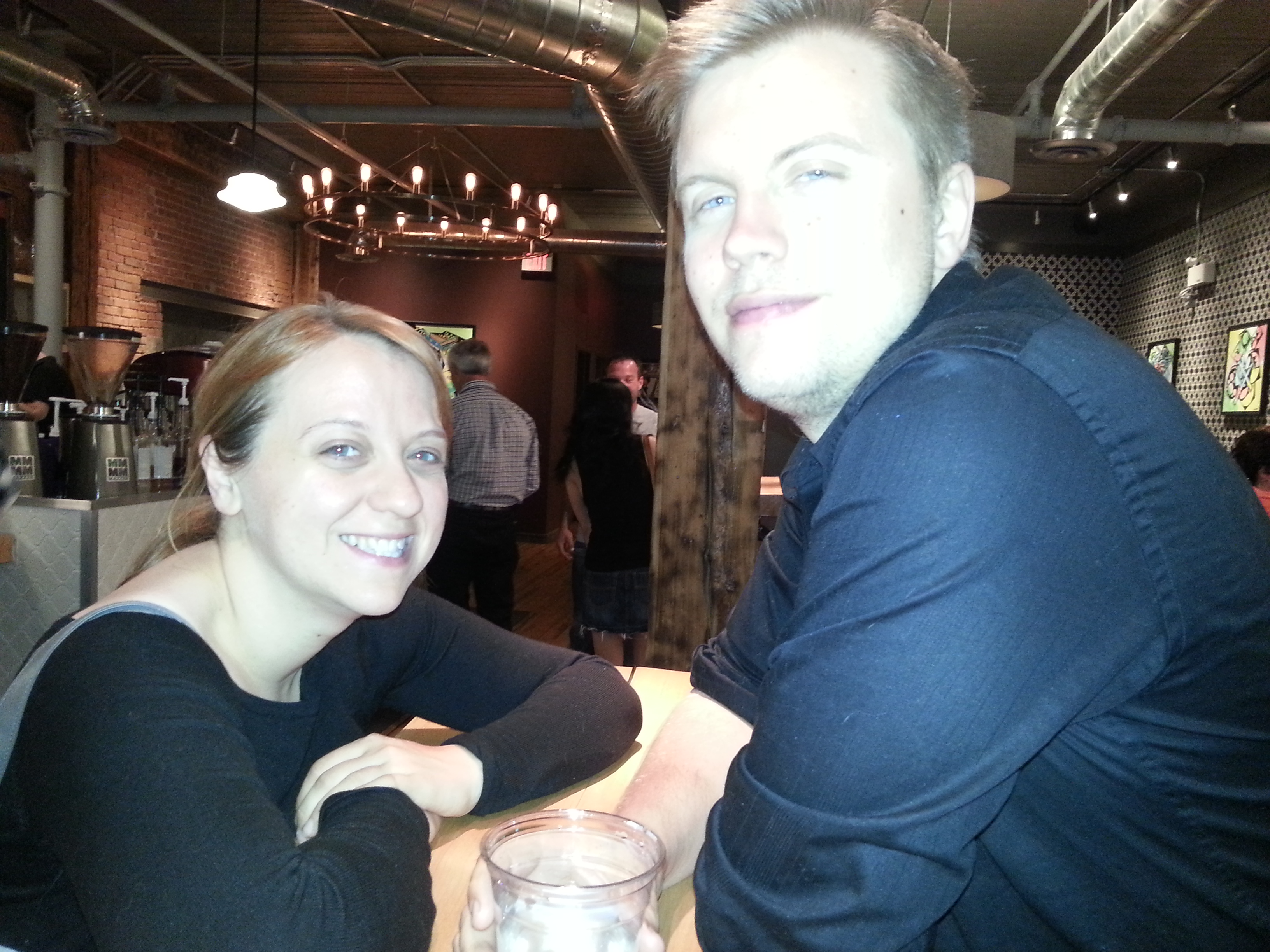
Emily MacKenzie and Allan Taylor -- you know, from the Hunt and Gather blog

Emily MacKenzie and Allan Taylor — you know, from the Hunt and Gather blog

This is my extremely helpful and supportive brother-in-law and my baby sister.

[You mean the nursing professor sister? No.  The millionaire business tycoon sister? No.  The ultra-marathon runner sister? No.  The Edmonton slow-food lady sister?  Yes, that’s the one.  I am gifted with lots of gifted sisters.]

NeWest was holding the launch in a downtown coffee house housed in a restored brick building.  By the time we arrived, it was humid-warm and crammed with people and hot beverages.  Its name – Roast – couldn’t have been more apt.

The only place left to sit was in a dim, empty corner.  This was exactly how I had pictured myself here – dark and peripheral.

As we waited for the readings to start, I kept accidentally making eye contact with a lady sitting along the wall perpendicular to me.  I’m awkward and silly so I kept making sure I politely turned away every time we looked at each other.  But if I’d checked my Twitter feed at that moment I would have found this:

@JennQuistAuthor hi, I’m sitting at the next table over #creepytweets

The message was from one of my Twitter/blogger buddies, Laura Frey.  She was the woman I kept looking at across the crowded room.  I’d never met her in person and I was too stupid to recognize her until later when I overheard her name.  This is fairly typical.  Sometimes we joke (because brain injuries are hilarious, I guess) that I have prosopagnosia – brain damage that makes it hard to recognize faces.  I probably don’t.  It’s the kind of disorder that usually only comes on in survivors of horrendous no-helmet motorcycle accidents.

The time came for us to stop whispering in our corner and start listening to the readings.  The first was poetry from Jenna Butler’s Seldom Seen Road.  Her work is set on the central Alberta prairie but it isn’t the usual  western Canadiana.  In the selections she read, there was a longing and loneliness that didn’t just arise from the physical struggle to subdue a harsh landscape while maintaining human relationships.  It rose instead from the decline of the communities that had originally been built on the land.  The first wave of prairie settlers is ebbing away as their posterity rejects their way of life.  And the second wave of settlers, like Butler and her family, is arriving without a script for how to connect themselves to the crumbling social and physical landscapes left behind.

I hadn’t heard of Butler before the launch but the second reader was someone I’d already been admiring on the Internet.  She’s Rebecca Campbell, author of The Paradise Engine.  I know it’s sexist and vapid to comment on a woman artist’s appearance but I have to mention how impressed I was by Campbell’s height.  There’s nothing I’ve seen on her website to reveal the fact she’s at least six feet tall once she puts on shoes (yes, I asked her).  Her book was the one I used my launch party budget to bring home.  The section she read – a gorgeous picture of a Cold War kid’s night frights over nuclear war – could have been a narration of my own childhood.  Campbell writes about crows and Apocalypses – things I love.

Marguerite Pigeon – yet another author I’ve stalked on the Internet – read from her central American thriller Open Pit.  It’s about a hostage taking and a fictitious open pit gold mine.  This was the book Emily brought home after Pigeon tantalized us with a crafty cliff-hanger ending.  Em and I are going to trade books once we’re finished reading – which, knowing me, will not happen soon.

The fourth reader was novelist Corrina Chong.  I’ve quoted her insightful ideas about the influence of authors’ realities in their fiction in an earlier post.  Any girlie-ness that might have been implied by her pinkish book cover is offset by pencil sketches of squid in all their tentacled loveliness.  The selections she read from her book, Belinda’s Rings, felt a lot like real family life to me – especially real life with a demanding little boy who needs his caregivers to be everything and nothing to him all at the same time.  She nailed it – nailed it right to my Goodreads to-read list.

Roast was roasting and my home was over 100km away so we didn’t stay very late into the night after the readings were finished.  I got to meet a few people but not as many as I wanted before my wing-people and I stepped out into the fresh-enough inner-city air.

On the sidewalk, with Emily and Allan, I indulged in lamenting my missteps.  When I groaned at myself for demanding to know how tall Rebecca Campbell is Emily said, “It’s okay.  I figure as long as you’re still talking, it’s all good.”

And for my first outing, maybe she’s right.  The mix-and-mingle concept is not a big part of my current skill set.  Maybe it never will be.  Under the high wooden beams of the old coffee house, maybe we were all just a bunch of bookish writer-types lurching out of our comfort zones, trying to recognize each other’s faces from tiny Twitter and blogger head-shots, forgiving each other for not being as smart and shiny in person as we are in print.

Linda Leith Publishing, Montreal QC

A Note from JQ:  I admit I’m jealous this blogger, Erinne, has met my publisher, Linda, in person while I have not — jealous of her and grateful to her for the look inside the far away company. Hooray for the interwebs!

esevi's avatarThe Great Canadian Publishing Tour

(April 21)

The drive to Montreal from Toronto, at five hours, seems quite short after northern Ontario. For the first few hours, things are great. The sun is out (dare I call it… spring?), the tunes are blaring, and I just snagged one of the last Roll-Up-The-Rim cups from the Tim’s.  (Please Play Again…sigh.)

But as soon as I drive past the Quebec border sign I’m hit with a wave of anxiety.  I’m in Quebec. I’m probably going to have to speak French. Here’s the deal: I’m an editor. I HATE making mistakes. In French, I KNOW I’m making mistakes.

And my vehicle, oh my vehicle. I’m not good at cars, but I can feel something wrong. I place both my feet on the floor (cruise control) and can feel grindy vibrations through my flats. I’m terrified that at some point a seam beneath the car will…

View original post 648 more words

Crybaby Reads Her Book

Me and my advance reading copy, taken from my good side.

Me and my advance reading copy, taken from my good side.

The sight of a thick, yellow envelope postmarked from Montreal usually means a happy day for me.  It’s mail from my publisher, Linda Leith.  The most recent envelope was closed around an advance reading copy of my unreleased novel,  Love Letters of the Angels of Death.  I was as happy to see it as I can get without crying.

The same week, my brand new writers’ group had its first meeting.  Each of the members was invited to bring “one or two pages” of work to read aloud.  The timing was perfect.  Here was a small, low stakes environment where I could make an early attempt at reading my novel in public.

It sounded easy.  As long as it’s all talk — no singing or yodeling involved — I’m comfortable with my own vocal performance skills.  I already had the chops I needed to do a reading from my novel.  All that was left for me to do was pick a short section out of the book, read through it once, jam the pretty new book into my purse, and show up at the meeting as if I do this kind of thing every day.

The first step — choosing a selection — was harder than I thought it would be.  I’m ginger with other people’s time so I wanted to be sure I read something I could end neatly when I reached the equivalent of the roughly two 8.5×11” sized pages I’d been invited to share.  It meant simply reading the first chapter of the book wasn’t an option.  I also wanted to avoid spoilers, which meant the last third of the book was off limits and I had to be careful about what I chose from the middle.

And then there was one more consideration.  I wanted to read something gripping.  But it also had to be something that would not make me cry.  If you know me, you know that’s asking a lot of myself.

I may have held it together the day I found the ARC of my book in the mail, but I can still call myself an easy crier.  It’s awful.  I hate it.  Everyone hates it (especially my teenaged sons).  I am such an easy crier that my own novel – a story I wrote myself – still makes me sniffle two years after I’ve finished writing it.  The last sentence in it is only two words long and it makes me choke into tears almost every time I look at it.

Don’t misunderstand.  I am not emotionally delicate.  I react with appropriate sorrow when something terrible happens but I’ve never struggled with enduring feelings of depression or anything crippling or frightening.  Alarming as it may be, I simply relieve tension best by crying.  And it’s not just negative tension.  It’s the positive too.  When a stranger stopped on the Alberta Autobahn and helped me change my flat tire last month, I was so touched by his kindness I could hardly speak to him.  I knew if I loosened up, I’d start crying.  Stupid crying – or even just the dread of ending up crying — it taints most of my best moments.

I guess I should be grateful my emotional depressurization system isn’t any more complicated than simply opening the valves of my tear ducts.  It’s a fine mechanism in private but in public it’s an embarrassing mess.

Back to the book: chapter nine was where I found what I was looking for.  I chose a main character’s quick flashback to a bad teenaged romance.  That was my selection – the very first part of my novel I would ever read aloud in public.  I’ve always thought the passage was strong.  It has everything except something to cry about.

Still, when the time came to read it to a room full of friendly, un-threatening writers, I felt shaky and unnecessarily emotional anyway.  And when I was finished, I was a little mad at myself for being too high strung to read it exactly the way I had wanted to.  I’m experienced in speaking about many things.  But my novel isn’t one of them – not yet.  I’m still cagey and protective when it comes to my book and the secret well inside me that it sprang from in the beginning.

Here is yet another aspect of this career as a novelist that I hadn’t anticipated.  Once again, writing the book wasn’t enough.  I guess I need to become slick, smooth, and professional at reading my novel out loud.  Even though its opening chapter is a little long and a lot emotional, I need be able to chew up it until I can recite it with a fluent, steady voice.  I need to hone my reading until those two tight passages where it’s easy for me to get overwhelmed don’t squeeze me anymore.  I will transform myself into a flesh and blood book-on-tape.  There – I’ve decided.

“No,” one of the nice Nancies (there are two of them) from the writing group gently protested, “the fact that your book means so much to you made it mean more to me.”

And with that, I’m weeping all the way back to where I started.  Dang it, Nancy.

How I (Almost) Botched My Writing Career

IMG_7226

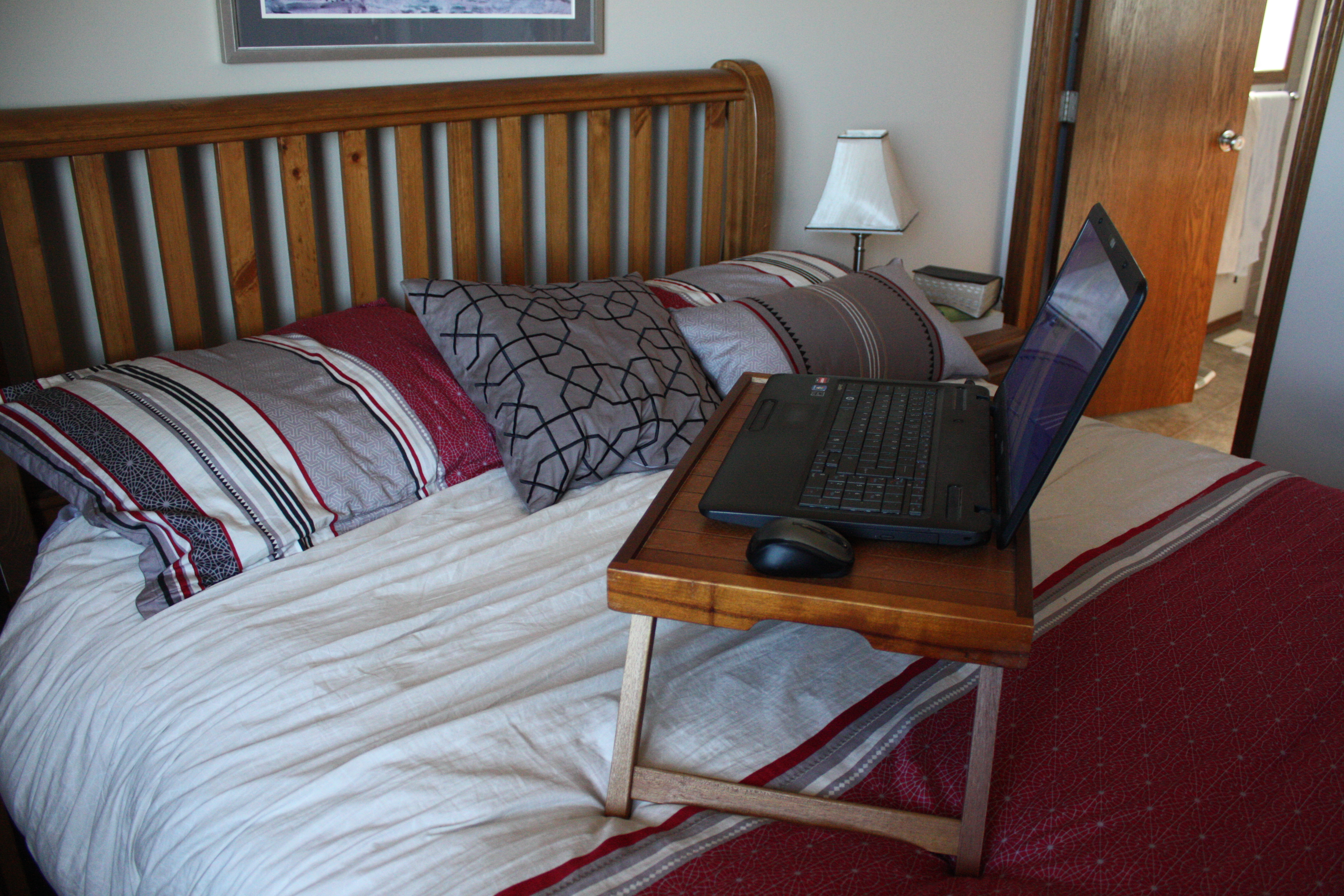
Writing in bed on a tea tray — like a boss

Last night I attended my very first writers’ group meeting – a “writers’ salon” at the home of a local wire-tap-transcriptionist turned edgy poet.  And I’m realizing now that my late entry into a writing group is yet more evidence that I have gone about my writing career the wrong way – the hard way, the backwards way.

Let me explain exactly how I’ve botched it – so far.

1)      I should have joined a writers’ group years and years and years ago.  All you kids at home, don’t wait until the advance reading copy of your first novel arrives in the mail before joining a writers’ group.

I’m in the habit of not showing my serious writing to anyone – not my husband, not my sisters, no one.  My utter lack of writing colleagues meant I mistook my work-in-progress manuscript for a finished book, started submitting it too early, and inadvertently ended up work-shopping it with the few gatekeepers at literary agencies and publishing houses who were thoughtful enough to jot a line or two (never any more) about why they were rejecting it.  It was a traumatic, slow, costly, and stupid way to get feedback.

Don’t be like me.  Before anyone in the business reads your work, make friends with writers with similar interests and better abilities than your own.  Read each other’s work and offer feedback.  Share contacts and news.  Learn to be gracious.

2)      I’ve never taken a creative writing course.  When my publisher and I were looking for a “blurb” for my book, Linda suggested I consider my former creative writing teachers.  It would have been a good suggestion if I’d had any.  It’s not that I didn’t take university-level literature classes.  I took them and I did well.  But I never took any courses dedicated to creative writing.  I’ve never had my work assessed and graded in an academic setting.

It’s not a fatal mistake.  Many writers spring up outside post-secondary creative writing programs — but not as many as I used to think.  So far, most of the people I’ve met in the working writing community have some past or present connection to writing as an academic field.  They don’t talk about writing as a vocation merely in a romantic, figurative sense.  They mean it the same way plumbers talk about their vocations – as papered credentials and regular, paying gigs.  There is middle ground between an institution-centred career in writing and never enrolling in a class.  And I should have spent some time there.

3)      I haven’t read much of the current literature in my field.  Instead of keeping up with the industry, I’ve used my precious reading time to polish off classics and to survey the YA books my kids are reading.  By now, I’m pretty well-versed in Dostoevsky and Dickens.  And I know my way around J.K. Rowling and Daniel Handler.  But I don’t know much about – whoever the heck has been important in literary fiction since the 1990s.

This was a bad move.  Stay tuned to the tone and the content of the industry.  Don’t raise your head only to when the mainstream media starts clamouring about yet another wave of erotica.  And don’t worry about being unduly influenced by other artists.  It’s the post-modern age – a time when humans have been reading and writing long enough for all of us to be a little derivative.  There’s no way to avoid it and the best we can hope for is to be able to admit it when our work looks like a freaky chimera of Carol Shields, Emily Brontё, and Napoleon Dynamite.

4)      I don’t have a physical space set aside especially for writing.  I write on my lap, sitting on my pillow, leaning against the head-board of the bed where I sleep at night.  It started as a desperate play for peace and quiet in a large, busy household.  I guess that’s still what it is.  It’s bad for my mattress, my spine, my wrists, and my temper.  Get a desk – or at least a chair.

That’s a short list of a few of my most obvious missteps.  I won’t repeat them during my next project — except for the bed-desk.

But there’s something like irony at work here.  I failed in all these ways yet I continued to publish anyway.  All my stumbling around with an unsuitable manuscript served to match my timing up with Linda’s and we found each other at just the right moment.  There’s no fail-safe formula for good fortune.

And on top of all these errors, I did do something right – something vital.  I finished the dang book.  I took good advice when I was finally given it.  I kept revising and submitting.  I kept fighting.  Of all the things I’ve heard people name as the undoing of their literary ambitions, not finishing their projects has got to be the most common.

Maybe that’s the biggest, most valuable lesson of all the ones I’ve learned so far — the one I’d leave with everyone, the one I kept repeating like a holy mantra at the writers’ group last night.  Finish it.  Keep going.

Carbon Copying Vulcan – Shreds of Reality in Fiction

The Roman God Vulcan, smashing stuff

If my youngest brother-in-law was a Roman god, he’d be Vulcan.  Wait — let’s not let Star Trek confuse us.  I’m not trying to say he’s cold and hyper-rational and his sleeves are too short.  He’s like the original, Classical Vulcan — fiery and powerful and smart.  Like Vulcan, he makes his living building things out of metal with torches and hammers.  When he’s having fun, he still likes to yell and hit things.  I adore him.  And if I was a goddess, I’d be Juno, the shrill but scary wife of the boss-god Jupiter (Zeus, to all you Greek fans).  I also like to yell and hit things.  It’s a sign of enthusiasm and love.  Both Vulcan and I understand that very well.

In the years and years I’ve known him, Vulcan has not been a voracious reader of contemporary Canadian literary fiction.  It’d be out of character for him to rush out and buy my novel when it’s released this August.  But I hope he will.  In order to encourage him, I did what Juno would do: I got up in his face and bullied him about it.

“Hey, are you going to buy my book when it comes out?”

He paused.  “Uh — how much money will you get from each one?”

It wasn’t the response I expected.  “I don’t know,” I said.  “About two dollars maybe?”

He reached into his pocket.  He said, “How about I just give you two dollars right now?”

“What?”

The Roman goddess Juno

He was laughing at me.

“You have to read it!” I bawled at him.  “You have to.  Because…”

This is where my Juno started to lose her nerve.  Even with my loved ones, I am a shy, apologetic promoter of my work.  I tell my friends and family where to find it and then I leave them alone.  There’s no follow-up – no awkward audit of their patronage of my art.  My loud, bossy questioning of Vulcan was not about getting him to cough up a twoonie.  It was about something much more delicate.

He was standing in front of me, towering over me, one hand still in his pocket.  He was looking down with his big brown face, waiting for me to finish.

I began again.  This was important – something between a warning and a gift and a confession.  “There’s this character in the book – and – he might seem like he’s kind of like you.”

Vulcan’s eyes got a little bit bigger.

“But he’s not you,” I hurried.  I explained there’s a scene in my novel where a woman meets her in-laws for the first time.  That meeting is written a lot like the time I first met Vulcan, when I was twenty-one and he was not quite ten years old.

“They’re not us.” I said again.  “They just look like us for a minute.  The little boy grows up and does things you don’t do.  He’s not you.”

“But someone might think he’s me.”

“Yeah.”

“Would he be in the book if you didn’t know me?”

Strictly speaking, it’s an impossible question.  How can I say whether I could have imagined someone so much like my brother-in-law ex nihilo now that I already know him?

What I could say was this.  “If I hadn’t lived the life I’ve lived, I wouldn’t have written the book the way I have.”

This was honest and fair to both of us.  The fact is I could have this same conversation (hopefully without the offer to pre-emptively buy me off) with dozens of people.  There are sparks and shreds and sometimes even long swaths of all sorts of real people in my work.  It feels inevitable.  Even if I switched genres and started writing hardcore science fiction, the spaceships and alien planets would still be full of traces of my friends, family, neighbours – everyone.

I’m certainly not the only writer who’ll admit this.  In an excellent essay, novelist Corrina Chong reflects on “writing as thievery.”  She says, “here’s the truth behind the fiction: as a writer, I am a thief…My writing is a collage of the bits and pieces I’ve stolen.  Once your piece is glued on, it’s no longer yours.  Finders keepers, I say.”

She sounds flippant but writing real life into fiction isn’t something done lightly.  We agonize over it.  We weigh the benefits of doing it against the risk.  And we understand the people unwittingly serving as our literary models might not agree we’ve struck the balance right.  Frankly, it’s scary.

Chong goes on to acknowledge that this theft is actually more like an exchange – a swap.  She says, “the very act of writing a story and releasing it out into the world assumes that readers will be able to see something of themselves in the characters, thereby stealing their own little pieces as keepsakes…any idea that rings true in your universe becomes your own.”

Maybe that’s what makes it possible for my self-consciousness at my own thieving audacity to be outweighed by my sense that it’s important for my reluctant, metal smashing baby-brother-in-law to read my novel – the one with a scene rooted in our shared history.  It’s not about the two dollars.  It’s about us.  Maybe that’s why I want all of the poor souls I’ve pilfered to read it.  I want to complete the second half of the exchange.  I want them to take something from me now – something bigger than my thanks for the inspiration.  Take yourself back, I say, and with it, take a piece of me.