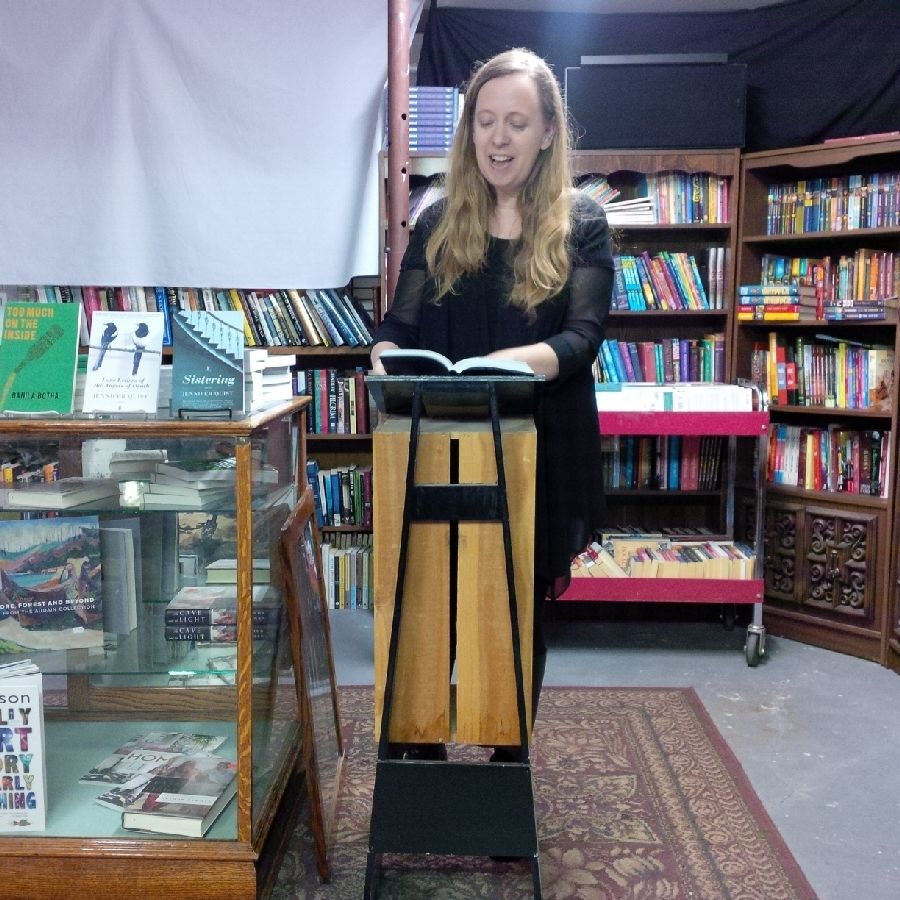
 If anyone thinks Calgary is all pancake breakfasts, politicians in Stetsons, and dubious animal handling ethics, they don’t know Calgary. It’s home to a great literary arts scene–poets, writers, literary mags, university programs, the whole package. It’s a pleasure to get to travel there as part of my own book tour. Last night, I was part of filling Station magazine’s Flywheel Reading Series along with fellow writers Erin Emily Ann Vance and Bren Simmers. It was the first time this tour I wasn’t either sick or late, making the event a triumph. I had a great time, was the subject of some horrible photos as I hammed my way through my reading, went back to the hotel, ordered room service with my sponsor (my husby), and crashed. Thanks, YYC!
Category Archives: Reading
A National “Must-Read Books of the Season” List Featuring Our Own “Sistering”
 Oh, how I love the Canadian Broadcasting Corporation, especially when it does stuff like this. The CBC has a healthy, powerful books department in a world thin on books departments. They just made a “Fall 2015 Reading List” suggesting fifteen “must-read books of the season.” They’ve included new fiction from international writers like Salman Rushdie and Franzen, Canadian names like Lawrence Hill and Marina Endicott — oh yeah, and my latest novel.
Wha?! I mean, “Yay, for Sistering!” See the list here.
Great way to end a day of spit-washing spaghetti sauce off people’s faces.
“Love Letters…” Live on Calgary Radio
Last winter, I traveled to Calgary to do a live radio interview at CJSW about my debut novel. My hosts were Paul Kennett and Emily Ursuliak, a writer deservedly known as one of the most generous and hardest working people in the Calgary literary scene.
Since it was live, I didn’t get to hear the interview anywhere but in my headphones and I was pleased this week when Emily sent me a link to a podcast of our talk.
Here I am talking about the Catholic Church, my bff, and commenting on technical elements of the book that I’d never had a chance to speak about in public until this smart interviewer raised them.
Enough Envy for Everybody

Big stage for big literary celebrity
Maybe there comes a time in every writing career when quiet, solitary writer-person gets curious about the literary world’s version of hype — popular, public, celebrity hype.
It’s true for me, anyways. So before they were sold out, I bought a ticket to see a celebrity author passing through my city. He’s a Canadian now living in the United States who appeared before a crowd of 500 people a few blocks from my house.
The author and I are strangers. I haven’t read his books. I didn’t go to see him as a fan or as a friend. Maybe I was falling back into my social science habits – acting the clinical outsider, coolly observing the phenomenon of celebrity enacted literary-style. There’s something nobly aloof about telling it that way. It lifts my delicate, fretting artist’s heart out of the story.
I arrived at the theatre just as “please find your seats” was announced. Arriving late at a sold-out event means making a rough, rude spectacle, crawling over people to lone seats in the centres of rows. I hadn’t dressed up and I arrived smelling like the onion I’d diced making dinner. That was me — rude, sloppy, late-coming, envious spectacle.
Goodwill and admiration don’t negate envy. Envy, my dad taught me, is different from jealousy. Envy is simply wanting the same thing other people have. Jealousy is wanting to get it by taking it away from them. Jealousy is hating them for having it. Those were the semantics I was raised on.
I knew sitting in a crowd gawking at a celebrity author wouldn’t get all the people who read and talk about his books to read and talk about my book too. Still, reading seems to work on a positive feedback cycle (social science!). The more people read, the more they keep reading. Reading is always good for writers.We lose nothing in supporting our colleagues — even when we’re just a tiny, anonymous faces on the far side of the footlights. There’s something slightly less noble about telling it that way.
Onstage, he read from his latest work. It was masterful and when I applauded, I felt like I meant it more than anyone else in the theatre. Then he talked. He talked about choices he’d made in his career that I wish I’d known to make in mine. He talked about disadvantages I don’t have that make his work rich and stirring and advantages I don’t have that make his work rich and stirring. He has more sisters than me. That stung. He must’ve mentioned his sisters three times — just like I would have.
Near the end, a book club leader from the audience asked him what he’s been reading lately. This isn’t the kind of amazing story where he answers, “Love Letters of the Angels of Death by Jennifer Quist. Check it out.”
That’s not what he said. He answered he doesn’t read other writers’ fiction very often. Especially when talking to a book club member, it’s a claim that demands defending. The author explained, “You read it and it’s like, ‘ah, they’re so good, why do I even bother?’”
That’s what a celebrity author looks like, lit onstage with his delicate, fretting artist’s heart. He looks a lot like the rest of us – rough and envious, unsure. I hadn’t known when I left my house that night, but this was what I’d come hoping to see for myself. There might not be much that’s noble about telling it this way.
Fan-girling: Why You Should Go to Book Events

On the front cover of my book — above the title, my name, my magpies – is a blurb. Yes, that’s the technical term for pithy reviews printed on books to help readers judge them by their covers.
Thanks to my resourceful publisher, my book’s blurb is written by internationally published Canadian novelist Padma Viswanathan. Blurbs are usually written by people from an author’s network – teachers, editors, classmates. But Padma read my book and wrote the blurb without knowing me from anywhere. It was extremely generous of her and I am very grateful.
Simple reciprocity isn’t the only reason I’m Padma’s fan. Reading her first novel, I had the impression she understands family much the same way I do. She writes about families that are close, more or less content with each other, and LARGE without making them seem maudlin, boring, or trite. It’s rare in literary fiction.
She writes about people of faith too. She doesn’t do it with the heavy sermonizing of “inspirational” fiction but she also doesn’t soundly denounce faith the way a lot of literary fiction does. She acknowledges the existence and the salience of faith. She writes about it like any powerful, abstract human motivation – like love or hope or fear. This is also rare. This is also me.
After seeing my work called “strange” over and over again (which I love) it’s gratifying to recognize something like my own strangeness in someone else’s stories. It’s validating. It transforms me from lone weirdo to the ultimate form of joiner: the fan-girl. 
And fan-girl I was when I finally met Padma. This summer, the tour for her new book The Ever After of Ashwin Rao brought her back to Audreys Books in Edmonton. I was so there.
If you’ve never been to an event where an author is reading from her own book, go. I won’t say the difference between reading a book and hearing the author read it is the same as listening to the radio and hearing a song performed live. But it is significantly different enough to be worth brushing your teeth and driving downtown.
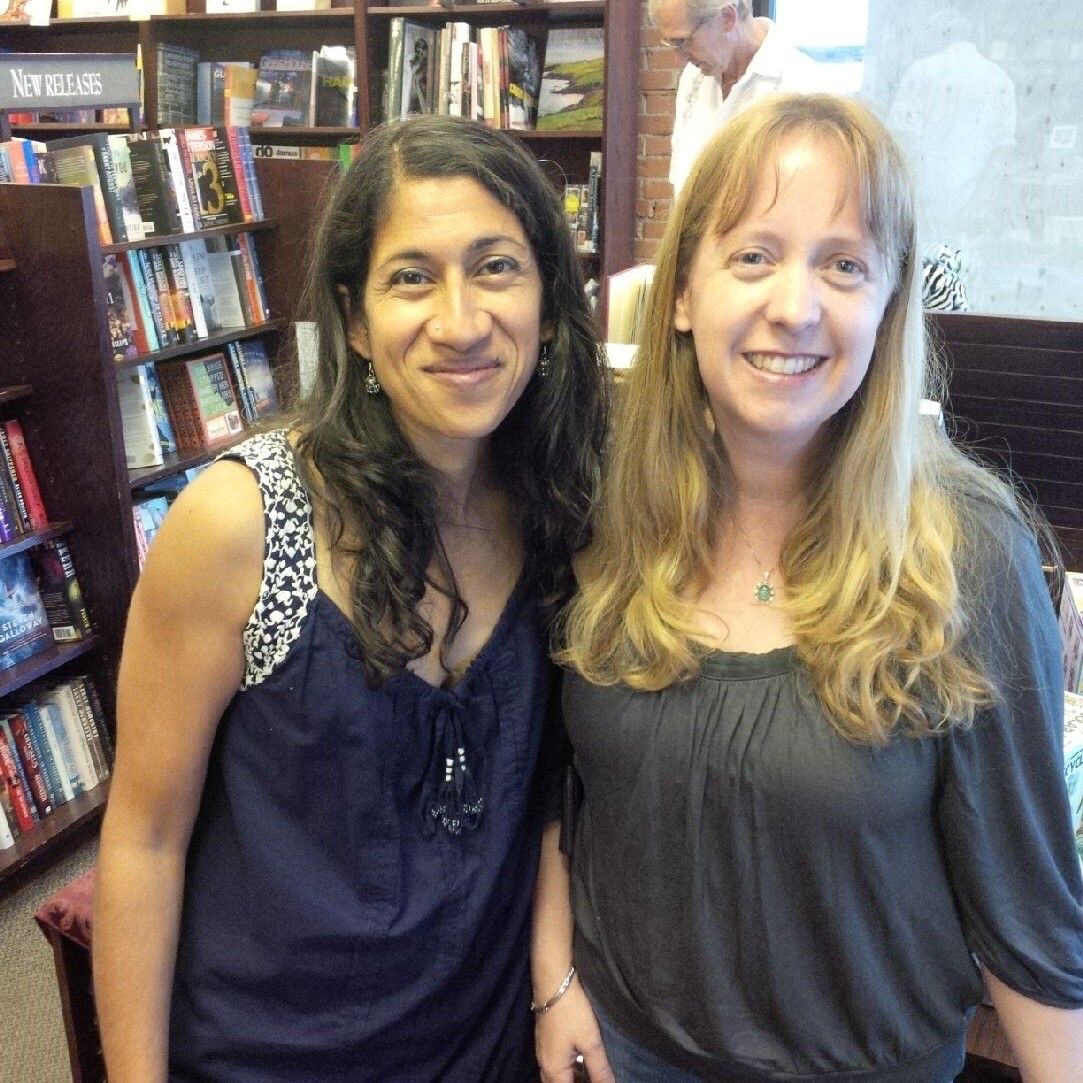
Padma Viswanathan and me at Audreys Books, Edmonton
I’m happy to say that, by now, when I go to local book events I can usually be recognized without having to make a spectacle of myself. In the crowded room, I met Padma and got to thank her in person for the boost she gave my career. I met her dad too. He was greeting people at the foot of the stairs.
Padma’s new novel revolves around the Air India bombing of 1985. The scene she read aloud describes people coping with sudden, violent loss. It’s beautiful and, once again, familiar.
Within the passage she read, Padma included the Gayatri Mantra, a chant her characters use to comfort themselves. If I’d been reading the book alone, in my head, my mental shorthand would have read it as “okay, some Sanskrit” and rushed on to the English translation. But in the bookstore, Padma pronounced all of it. She sang it. And I cried.
I cried because I was surprised and touched by her commitment to the reading – the risk of it, the gift of it. I cried because the sound of scripture being sung by one female voice in that place was strange and out of place enough to feel a little like a miracle. I cried because I already knew, in my own words and feelings, the things she would read next:
The sound did not hide the void, but it filled it with a kind of light: nothing that would stop you from falling, but maybe stop you from being so afraid.
“Award-winning” at the Last Minute: I Am No Paul Henderson But…
 My dad has shown me enough inspirational sports movies and documentaries for me to know it’s best to wait until right before the buzzer sounds at the end of the game to score a big goal.
That’s the way the literary awards season for my debut novel has unfolded. The book was released in August 2013 and I sat here quietly and morosely ticking off each of the season’s awards as their short-lists were announced without my name on them. I got to watch kind well-wishers saying it was too bad I was overlooked and while that went a long way in buoying my spirits, it didn’t give me and my novel any grounds to be called “award-winning.”
Near the end of the season, I was named on one shortlist but, while I appreciated the honour, the award was a bad fit for me and I didn’t win it.
Since it’s Fathers Day this week, I’ll tell the rest of the story with a Canadian hockey history analogy. Let’s just say it was the final seconds of the third period of the literary award season…
“Henderson made a wild stab for it and fell”
… when I got a phone call…
“Here’s another shot right in front of the…”
…congratulating me on winning the 2014 Lieutenant Governor of Alberta’s Emerging Artist Award.
“Score! Henderson!”
It finally happened. I won the last award I was a contender for this year – scored on my last chance to claim the “award-winning” designation, right before the final whistle. Along with the rights to “award-winning” it comes with a prize, a medal, media coverage, and a fancy ceremony with His Honor. I’m one of eight recipients chosen from a wide range of artistic fields to get the award. I’ll find out who the rest of them are at 10am today at Government House in Edmonton.
I couldn’t be more pleased or more grateful to the board for selecting me. Yay!
[Thanks (and apologies) to hockey legends Paul Henderson and Foster Hewitt.]
Morbid in the Mountains

April and Chris Demes’s guitar birdhouse in Hill Spring, Alberta as posted on canadiangardening.com
My May began with a literary festival in a world class city and ended with a book club in the village of Hill Spring, population not quite 200.
This book club was hosted by my friend and fellow writer April Demes. Years ago, when we first met, April was an arty, precocious teenager and I was a newly married 21-year-old who knew EVERYTHING. Now that we’re older, we have more in common: gardening, bird watching, CBC Radio, pretty blond children, and writing.
Despite their idyllic Rocky Mountain surroundings – a white house on the side of a green hill where a repurposed guitar is nailed to a tree as a birdhouse – April’s family hasn’t been luxuriating in a quiet simple life. (Quiet simple life is a myth. If we think we know someone living this way, it’s a sure sign we don’t know them very well at all.) While still in his 30s, her husband was afflicted with cancer, right inside his skull. They nearly lost each other. That my novel strikes any kind of chord with April is a great honour.
The Hill Spring book club was one of my favourites. It was peopled with bright, interesting women of varied ages and backgrounds – some of whom may be distantly related to my well-connected husband. They came prepared with questions and we had a great discussion about love and death and the writing process. But it wasn’t because everyone unreservedly loved the book.
One of the ladies who enjoyed the book described her grownup daughter’s reaction to it. They’d been reading aloud and the daughter stopped when the narrative got too “morbid.” There is a fair bit of death and death paraphernalia in the novel. It begins in the title and never really lets up. It can be tough for some readers to see through it to the tenderness that is the real point of the book. Sometimes, they dismiss it as “morbid.”
Strictly speaking the word “morbid” means sick, unhealthy. I flinch when I hear this word used to describe my book. Writing in frank, practical terms about loss is not something I consider unhealthy. Not everything that’s uncomfortable – exercise, pelvic exams, insulin shots – is unhealthy. Willfully ignoring the difficult and complicated process of dispatching our loved ones until we’re devastated by a crisis is what seems unhealthy to me. As I wrote the book, “morbid” was not my aim – quite the contrary.
While I’m no longer surprised to hear “morbid” spoken at book clubs, I was surprised to hear which part of the book made the lady’s daughter squirm. It was the chapter where the main female character is cutting up a grocery store chicken, making dinner.
I hate cooking more than most people. I wrote about cutting chicken honestly, flaunting but not exaggerating my perceptions of it. “Take that, cooking. You’re gross.” But even someone who abhors cooking as much as I do probably doesn’t find her own kitchen a morbid place.
Please enjoy this photo of a butchered chicken
Maybe death is the same. Life on Earth means eating and it means dying. Both are messy, inevitable, and natural. It doesn’t matter how healthy or vibrant or “morbid” any of us is, we all have to eat and we all have to die. It remains true even if we don’t want to know anything of the finer points of how either is done.
I don’t make money on book clubs but I did sell two books in Hill Spring. One was to a lady who came to the meeting without finishing the book. It was morbid, she said, but after hearing the rest of us talk about it she’d decided to give the book another chance and invest in her very own copy (personally defaced by me) instead of borrowing April’s. She was willing to question her sense of what’s morbid and consider changing her mind.
It may have been the most gratifying book club comment ever.
The Reviewed Are the Reviewers

The Rusty Toque, Issue 6
Here I am again, reviewing some very interesting Can-Lit in literary journal The Rusty Toque. Just realized I’m covering yet another book about the end of the world — or, a world, this world.
If Looks Could Kill: Why My Characters Have No Eye Colours
 In preparation for an upcoming multi-author book event, I’ve been reading novels outside my usual range of Can-lit and literary fiction. The atypical reading choices I’ve been making have been eye-opening – literally. So far, what’s struck me most in my venture into crowd-pleasing commercial fiction is the diligent reporting of characters’ eye-colours.
Maybe everything I know is wrong but for me, all on its own, the colour of a person’s eyes determines nothing about how they experience life. Okay, I admit my blue-eyed family may do more than the average amount of squinting in bright light. And if I ever produce a brown-eyed child while married to my fellow blue-eyed husband, it would add some horrible drama to our home-life. But most of the time, iris pigment is not the crucial narrative factor a random sample of Western pop-fiction might lead us to believe it must be.
Mentioning eye colour in literature can be a nice touch — like writing at length about a sunset or the ocean or whatever. (Writers can get away with a lot in the name of world-building.) And in the right context, eye colours can be important story elements. In Irving Berlin’s Easter Parade, Judy Garland closes her eyes and tests Fred Astaire’s devotion by challenging him to remember her eye colour. Even as a kid watching the old movie on TV with my mum, I knew this was an important moment. It advances the plot, reveals something about each of the characters, and it’s hecka sweet. Well done, 1940s film-makers. Look at you, making eye color genuinely relevant and letting it arise organically from the narrative. That’s how it’s done.
The same could be said for any detailed description of characters’ looks. Descriptions can work to propel the story, motivate actions, explain character traits. But sometimes they’re dumped into a story apropos of nothing. It’s as if we’re driving along an icy street and someone yanks up the parking brake and we’re flying in a circle for a moment, calling out eye and hair colours, spinning out of the true direction we’d been traveling. Or it’s like the story has deteriorated into a junior high school Language Arts lesson and we’re now outside the narrative reading a “character sketch.” At their best, character sketches are just exercises meant for the writer’s purposes. They’re notebook scribbles, not even first drafts, and certainly not good reading.
I hope all of that sounds technical and reasonable. Here’s a personal reason why I write without bothering to explain the minutiae what everyone looks like: I don’t care. I honestly do not care what people look like. That’s not to say I’m any less shallow than anyone else – I care far too much about how people smell – but it is to say that when I’m choosing what to pay attention to, a person’s looks aren’t all that compelling.
When I’m acting as creator of a book-world, I let everyone look the way readers want to imagine them. That’s done by forgoing physical descriptions I don’t need for plot and thematic reasons. Giving up the creative control that comes with dictating everyone’s colour palette is worth the sacrifice if that’s what it takes to keep physical traits from interfering with everything else I’m trying to say.
Describing a human being’s looks – even a fictitious human being’s – is actually not like describing a sunset. It might feel idle and innocuous but it’s not. Sunsets don’t come with politics. People do. Spelling out physical descriptions can introduce prejudices and tropes that distance readers. If that’s what an author wants (and sometimes it is), carry on, I guess. Descriptions also run the risk of fueling male gazes and other sources of negative stereotypes. They can end up assuring readers certain appearance-based prejudices are right and fair. I have a revulsion to abetting that.
In the novel Eleanor Rigby, Douglas Coupland deliberately withholds the information that the narrator, a woman, is overweight. He allows the reader to discover her through what she does and says and only later introduces what she looks like. The delayed fat-reveal is brilliant. I was surprised at how it affected me. I am not a fat-shamer. I’m not fat myself (she rushed to say) but during my most intensive baby-raising years I was a bit of a chubby-chick. It runs in my family. I love fat people. I understand on a deeply personal level that they are not lazy or greedy or bad. And it meant I was shocked at how my vision of Coupland’s character unwittingly changed for the worse after I read she was fat.
To add another layer of complexity, Coupland’s narrator challenges the reader, saying we must have been able to tell she was fat before the reveal, as if something so fundamental must have been visible all along. Of course, it wasn’t. Her looks don’t make her any less human or relatable as a character. But it’s only through withholding a physical description and showing us our own reactions to it that Coupland demonstrates the depths of our appearance-based prejudices and how easy it is for writers to be complicit in maintaining them.
By the way, Judy Garland’s eyes – they were brown.
Getting Ready for the Blue Met
 I’ve booked my ticket and my cheap but not inexpensive hotel room and I’m all set to fly to Montreal in four weeks for the Blue Metropolis International Literary Festival. It’ll be my first time in Montreal outside the airport or the freeway and my first visit to a literary festival in any capacity. In keeping with my out-of-step career path, at my first literary festival I’ll be appearing as an author with three spots on the programme. As always, I’m humble and happy to be included in such a great event — and glad everyone’s cool with me performing only in English.
 Jennifer Quist, PhD