It’s Not You, It’s Me – The Post-Fiction Movement and My Novel

A gravestone of a real great-great aunt at the real Butcher Hill Cemetery

A gravestone of a real great-great aunt at the real Butcher Hill Cemetery

There were cupcakes, pink tissue paper flowers bigger than my head, cupcakes, a sunny backyard full of people I love, and cupcakes. It was a family party – a birthday bash for one of my nieces.

Eventually, the conversation turned to the book I wrote that had been published exactly one week earlier.  My sister-in-law, who hadn’t read a word of the novel yet, was not quite kidding when she asked me, “So, which character am I?”

I could answer with confidence.  “None of them.  None of the characters in the book is anyone here.”  I glanced around the yard to make sure it was true.  It was.  None of the real people at this particular gathering cast any shadow on my fiction (except, I recall on rereading this, a few of my little sons).

“Doesn’t matter.  When I’m reading it I’ll think one of them’s me anyway,” my sister-in-law warned, because she’s funny and she’s self-aware enough to know how hard it is not to see ourselves in everything.

The conversation jostled my latent social science senses awake.  What would I find if I did a good old “content analysis” of my novel, chapter by chapter, looking for traces of real life?

Here’s what I found.  The chapters of my book roughly fell into three categories of reality/unreality:

  1. Chapters almost completely ripped from real life:   7 out of 23

This proportion is smaller than I feared.  These are the chapters where a few identifying features are changed, the sequence of events is streamlined, but most of the action and reaction unfold almost exactly like events from my personal and family histories.

2.  Chapters I Made Up Almost Completely — Almost:  6 out of 23

Hey, there’s real fiction in here!  What a relief!  I was gratified when my mum’s BFF wanted to know who in our real lives a certain character from the book was and I could answer with a resounding, “He’s no one!  I made him up!”

3.  Chapters Made from Conglomerations of Fictional and Real Elements: 10 out of 23

Not surprisingly, this mixed category is the largest one.  What’s odd about these chapters is that it’s the reality in them that strains the hardest against plausibility.  If a reader ever looks up from the book and says, “Nah, I can’t buy that” he’s probably rejecting something I lifted from real life and then toned down with fiction to make it less jarring.  An old lady who sleeps on a saw bench?  No way.  A cemetery called Butcher Hill?  That’s too much.  An exhumation? Get right out, that never really happens.  It does.  It did.  As they say, I can’t make this stuff up.  Maybe I don’t have the guts.

Since before I was born, it’s been a Beatles cliché that it’s hard for artists to come up with anything new.  The world is old and full of people and stories.  Part of the art-imitates-life problem is genuinely accidental, especially for people from large families like mine. The more people a writer knows with the intimacy of family, the more difficult it is for her to avoid treading on real life situations in her work.

For instance, I have an unpublished novel currently circulating with my agent about a group of five sisters.  Not coincidentally, I am one of five sisters.  When it came to writing sisterhood, a group of five was the size that made the most sense to me.  I make no apologies for that.  However, I started to squirm when I saw that, in order to advance the plot, I needed one of the sisters to have a professional medical background.  Fine.  But in my real sister-group, one of us works as a nursing instructor.  Medicine is full of women and this alone could be dismissed as chance.  But then the story needed one of the sisters to have a husband who’s adopted.  One of my brothers-in-law fits this description.  Another sister in the novel needed access to the justice system.  That’s me.  And the plot was going nowhere without a sister with lots of money – enter another fact from one of my sisters’ lives.  I finished the novel, looked at all the parallels, and wondered what really happened.  Did the plot arise first and demand all these real life details or did real life tumble around in my imagination until it formed into the plot?  And was the same kind of thing happening in my published novel?

There’s a literary movement hatching out of this chicken-and-egg fiction conundrum.  It questions whether recounting real life is actually a problem.  It’s been called “post-fiction” and refers to writing that obscures boundaries between fiction and fact.  As critic Michael H. Miller of New York Observer explains,

This writing represents a chiasmus between the real and the made-up, blurring the two into nonrecognition, confronting the reader with all those issues one is trained by the Western academy not to look for: namely, the author herself, hiding behind the words.

Recently, there’s been a spell of writers – like Sheila Heti and Tao Lin – producing novels with real people from their lives cast as characters.  Those real people include themselves.  Sometimes, not even the names are changed.  These narratives have been called tedious by some critics.  They state the obvious, deal in the mundane, they can be repetitive.  Some readers dislike them.  Some think they’re brilliant.

Whatever they are, they make me feel a little more confident in my own post-fiction inclinations.  I’m so comfortable with it I’ve made this digital “scrapbook” where I collect images, quotations, and music that inspired or emulate my book.  In true post-fiction style, I borrowed the idea from fellow writer, Rebecca Campbell.  You can see it here:

http://lovelettersoftheangelsofdeath.tumblr.com/

Readers might be getting used to seeing the author standing in front of the lens, in the foreground.  Maybe I’m cheating them if they don’t see me.  And I’m hard not to recognize.  Like me, the main female character in my novel is a mother of a group of sons, raising them under the influence of her solid marriage and her rather jaunty death fixation.  She goes where I’ve gone and seen much of what I’ve seen.  We have matching root canals in one of our teeth.  We both said the same thing to our husbands when we saw they’d cut their throats shaving the morning before we married them.  But even after all this, she is not really me.  The very act of creating her made her different from me.  She’s a story I tell.

And in the same way, regardless of any likenesses, I promise, none of the characters in my book is you.

So, What’s It About, Anyways?

What’s this book about and where does it fit?

Ever since I got my book deal last autumn, I’ve been fumbling with the inevitable, perfectly natural question of, “So what’s your book about?”  Maybe I’m over-thinking it but I find this question difficult.

The first thing that makes my book hard to explain is the fact that it doesn’t fall neatly into a genre — and I’m not just saying that to try to sound cool and transcendent and stuff.  If the book was about sorceresses with magic necklaces and metal undies I could say it was fantasy.  If it was peopled with smoochy vampires it would be paranormal romance.  If it was about stabby psychopaths I could call it a crime novel.  If it prattled on about dating and shopping it would be chick-lit.  But it’s none of those things.  It’s kind of lovey-dovey, a bit creepy in parts.  It’s a little otherworldly yet it’s realistic and earthy.

When I was still submitting the manuscript, still ticking boxes in search engines of databases listing publishers’ interests, the box that fit best was called “literary fiction.”  And it’s the classification now stamped on the back cover of the book.  However, it’s also a term that gets sneered at for its elitist implications.  Who’s to say what’s of literary merit, and on and on and on… Still, if for no other reason than its acknowledgement that a flashy, racing story-line can come second to arty, thematic prose, literary fiction is the category that suits the novel best (she said, cringing, hoping not to sound elitist).

Another category fits simply because of my geography.  It’s “Can-Lit” — Canadian literature.  I am Canadian so, in some ways, I can’t help but write Canadian literature.  I’ve fallen back on this description a few times.  But Can-Lit has gained a character of its own over the years and when I offer it as an answer, I need to be prepared to embrace that character.  I need to be able to wave my hand and believe myself when I say, “It’s CanLit — you know, bad weather and complicated relationships.”

Nothing I say is very precise or descriptive or satisfying for nice people asking about my book.  So here’s a short Q&A with me about my novel.  It appears in my publisher’s online literary mag, Salon .ll., and hopefully it will shed some light on what I’m writing and why someone might want to read it.  Go ahead and click the link below.

http://www.lindaleith.com/posts/view/280

Woke Up This Morning a Published Novelist

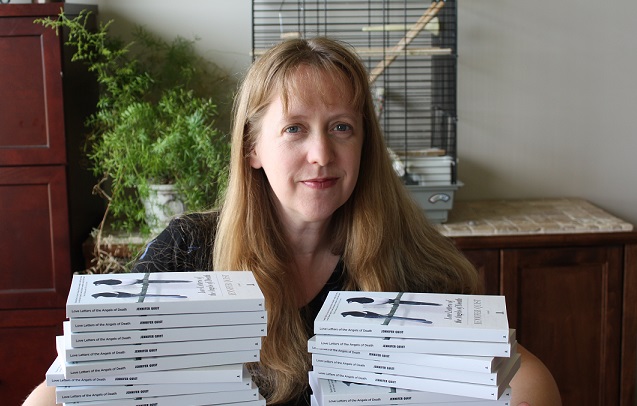
See, it's real.  Here I am with stacks of beautiful, traditionally published books I wrote myself

See, it’s real. Here I am with stacks of beautiful, traditionally published books I wrote myself

This morning when I woke up, my publisher was messaging to congratulate me on the release of my debut novel and my five-year-old son was throwing up in the hallway.  Way to keep it real, Sweetie-Boy.

My good mood is holding up well anyway.  If you’d rather not come get a signed copy of Love Letters of the Angels of Death at my house, the book is available from the publisher, in online stores, and is making its way into fine bookstores (coming soon to my local, Sunworks in Red Deer, Alberta).

Woohoo!

Amazon.ca Jumps the Gun

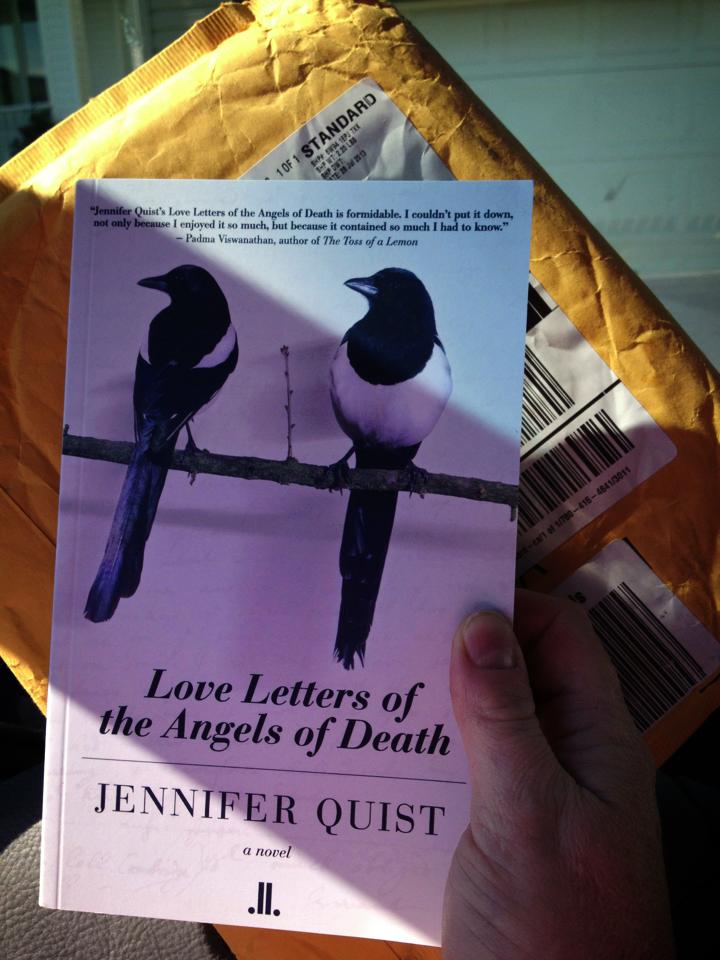
Even though the official release date isn’t until Saturday — about 36 hours from now — a friend of mine has already received her copy of my book.  Couldn’t have happened to a cooler person!  Thanks for sending me this picture, Janine.

j9mail

“Bring it On” — A Sexist Challenge on Childbirth

“I had a lady friend years ago… who was a mother of several children. She had a bout of shingles. She told me she would rather give birth. I have had shingles. Bring it on.”  — A male friend of a friend on Facebook.com, July 26, 2013

mumjoe

My mother and her first grandchild

Facebook is a hurt-feelings-machine.  It’s an Offense-O-Matic.  It’s a Jerk-A-Tron.  It can make ordinary strangers sound like idiotic, sexist monsters.  We all know this.  However, Facebook is also the only place I can reliably see pictures of my nieces and nephews so, like most users, I have reasons to put up with the website that outweigh the heaps of garbage I find there.  But the comment quoted above – one made in response to a comedy sketch about a bogus medical device that transfers the pain of childbirth contractions from mothers to fathers — reads as particularly loathsome to me, even by Facebook standards.

When it comes to empathy for the ordeal of childbirth, I prefer quotations like this one:

“I’m sorry.  I didn’t know it could be like this or I would have told you.”

That’s what my mother said to me moments after my first son was born.  She didn’t say it because she was ignorant of childbirth and hadn’t worked hard enough to prepare me for it.  She had borne seven children herself and been frank with me about her experiences.  She knows much more about childbirth than most people will ever know.

But my mum was still shocked at how differently childbirth unfolded for me.  Unlike Facebook-Shingles-Man, there’s no bravado, nothing dismissive or smug in her response to my very personal passage to motherhood.  Standing at my hospital bedside, Mum knew my labour had been twice as long as any she’d ever had.  She had watched me struggle with the second stage – the pushing part where things usually developed quickly and fruitfully for her.  For me, it went on for hours, until the whole debacle finally ended in a traumatic, complicated delivery of a baby whose size was so out of proportion with mine that the doctor had said, “I can’t believe he was in there.”  My mum knew if we hadn’t been in a modern hospital that night, it would have been the night that I died.

Shingles.

My son’s birth was not what my mother had expected – and that was something I hadn’t expected.

Birthing a child is different for everyone, even closely related people like mothers and daughters.  And every time I had a new baby, his delivery was different from the other ones I’d weathered.  I don’t know why.  Maybe it had something to do with my age, the babies’ sizes, the tides, the placement of the pins in some Voo Doo doll – I don’t know.

Apart from physical differences, childbirth medical interventions also vary based on where we are, who attends us, and our personal choices.  My boys were delivered by four different doctors plus a boomtown nurse left alone with me while a fifth doctor was on lunch.  Even though I asked, none of my deliveries worked out so I could have much pharmaceutical pain relief.  Every time my children were born, I was right there for all of it – mind, body, and soul.  That’s certainly not the case for every mother.

Our bodies are different.  Our surroundings are different.  Our babies are different.  In addition to concrete factors like these there are innumerable emotional, social, cultural and other issues colouring our childbirths – enough factors to keep the experience infinitely variable.

I think the case of shingles is actually a good example of how social and psychological factors exacerbate suffering.  My mum taught me this too.  Only for her, it wasn’t shingles.  When I was an elementary school kid, she was hospitalized for kidney stones.  She said it hurt a lot, like having a baby, only there was nothing to hope for at the end of it.  There was no mounting sense of love to convince her that the pain was meaningful and worthwhile.  In light of that, I’m sure she, like Facebook-Shingles-Man’s “lady friend,” would have said she’d rather give birth than pass her stones.  Birth is hard but, unlike disease, it isn’t a bad thing.  Heck, I’ve been mired in arguments so painful I would have rather given birth than listened to another word of them.  But that doesn’t mean the experiences of birth and disease, or birth and a nasty argument, are equivalent.  What it does reveal is that the meaning of suffering affects our perceptions of it.

And there’s far more to withstand in childbirth than just pain.  There’s also fear and panic.  Birth is scary.  For some of us, the fear grows worse every time.  I was nervous when I was admitted to the hospital the morning of my first labour.  But by the time I arrived in an ambulance for my fifth labour, I was terrified – phobic and crazed.  No one in the comedy sketch that started me on this tirade had any comic device for transferring the fear of childbirth from the mother to the father.  Maybe even they know there’s nothing funny about that.

Yes, I get punchy when I hear people talking about birth as if it’s some kind of syndrome – a universal experience we all live through in exactly the same way.  I get especially punchy when that person is a man out to appropriate the most powerful and sublime of female powers for himself by equating it with a disease he’s suffered.  Clearly, what Facebook-Shingles-Man said was sexist – disgustingly so.

And then it’s more than sexist.  It would have been offensive even if it hadn’t been a man who’d said it.  What arises from the bad assumption that birth is the same for everyone is the worse assumption that we’re qualified to evaluate and pass judgment on each other’s reactions to childbirth – or anything else we suffer.  Looking at somebody’s suffering and joking about it or daring them to “bring it on” is never a decent thing to do.  It’s a perversion of empathy.  It’s a mistake my mum – someone wise and acquainted with the breadth of human experience called motherhood – taught me never to commit.

First Review of My Book!

Montreal Review of Books looks at my novel in the Summer 2013 Issue

Montreal Review of Books looks at my novel in the Summer 2013 Issue

The summer issue of Montreal Review of Books is out today.  And I am thrilled to report it includes Elise Moser’s review of my soon-to-be-released novel.  It’s a feature review complete with quotations from emails Elise and I exchanged.  Read it here:

http://mtlreviewofbooks.ca/reviews/love-letters-angels-death/

Here’s the first paragraph:

“I think Babies “R” Us is one of the saddest places there is – everyone looking to buy something that will make a very traumatic and life changing experience into something more manageable.” Like her main characters, Jennifer Quist does not hesitate to express firmly held, intelligent opinions. That’s her talking about birth. You should hear what she has to say about death…


Schwester, Seour, Eonni, Jiejie, and Other Ways I Can Say “Sister”

My German textbook.

I love the English language.  I was an early English talker, an average English reader, and have made writing in English my profession.  Sometimes, I imagine English loves me back.  Even if it doesn’t, I can usually coax it to stand up on its hind legs and help me say whatever I want.

No matter how much I love it, English is only one language.  I don’t know how many other languages there are in this world – maybe no one knows for certain.  It’s debatable and ill-defined.  At any rate, there are hundreds.  Maybe I’m greedy and faithless but it makes me sad to have full use of only one of them.

It’s not that I haven’t tried to learn more.

Just about every English-speaking Canadian reaches adulthood with some ability in French.  Our country has two official languages.  Like most of my comrades, I sat through daily French classes in public school.  On the east coast of Canada, most of my teachers were Francophones – Acadians with an accent different from the one in Quebec and definitely different from the Continental chit-chat on the cassette tapes that came with our textbooks.  When my parents moved us back to western Canada, I was taught French by an Anglophone who spoke like a computer simulation of a human being talking French.  Whatever their quirks, I’m glad for those lessons.  They were not a waste of time.  The proof is that I can hold my own in my sons’ elementary school French immersion classes – for now.

In university, I needed credit in a language other than English in order to qualify for my degree.  I was tired of speaking badly only in a Romance language so I enrolled in German.  The vocabulary was a blast.  German pronunciation was fun and I found myself reading it aloud even without comprehension simply because the sound of it made me so happy.  The grammar, however, was cruel.  I took my introductory course and was surprised to receive a letter from the German department offering me a spot in their honours programme.  It was sweet but the fact was (and is) that the German phrase I used most often was, “Wiederholen Sie das, bitte?”  It means, “Can you repeat that please?”  I used it to stall conversations while I slowly and painfully tried to decode the language.

I discovered Asian languages outside of school when my kids became fascinated with east Asian pop culture.  Currently, most of the television we watch comes from Japan, South Korea, or Taiwan.  I know about twenty words in Japanese, slightly fewer than that in Mandarin Chinese, and about 90 words in Korean.  But my Asian vocabularies are not very useful in normal, daily conversation.  The phrases I know tend to be the kind of thing someone might shout in dramatic dialogue – things like, “How can this be?” or, “There’s no time!” or, “Do you want to die?” or, for really special occasions, “Don’t go!  I’m sorry!  I love you!  Come back!”  Yes, my conversations with the nice Korean guys who own my favourite gas station have to be kept short or things might get a bit melodramatic.

Tallied up, that’s 4+ languages attempted and only one mastered.  It’s not an impressive record.  But I can’t quit now.  This summer, I’ve started seeking out a new second language.  It’s different again from anything I’ve ever studied.  For once, pronunciation isn’t a concern.  This language is not in my mouth.  It’s in my hands.  I need to learn American Sign Language.

A family member – the wife of one of my brothers – is losing her hearing.  It’s her story and I won’t try to tell it for her.  She’s a writer and can share it without any help from me.  My sister-in-law is a smart, pragmatic, optimistic person – a problem solver – and I’m sure she’ll figure out how to cope in a world where not enough people know how to talk directly to her.  She’s losing her hearing, not her speech so she’ll remain able to tell us whatever she wants.  No doubt, the person doing the heaviest lifting with my sister-in-law’s new communication strategies will always be her.  But maybe I can help in my tiny way.  And maybe language study will be different for me this time.  It will come with an urgency, a purpose, and a focus it’s never had before.  I’m not learning for grades or entertainment or curiosity or even in the interest of fostering Canadian national unity.  Instead, I’m learning in order to stay connected to someone I love.  It’s a language study aid I’ve never tried before.  It’s more compelling than any of the  impressive cultural, political, commercial, or neurological arguments that can be made for studying a new language.

Whatever it is, “Sister” is one of the first signs I’ve learned.

Commencing Countdown, Jewelry On

The countdown to the release date of my novel, Love Letters of the Angels of Death, has passed the point where the time is measured in months and moved to where it’s measured in days.  Look, it’s right there in the column of widgets beside this post.  The moment has come to start opening the windows on my advent calendar.  The book’s release date is practically here.

Sometime I feel like dressing up like someone who wrote an artsy, Gothic love story because, well...

Sometime I feel like dressing up like someone who wrote an artsy, Gothic love story because, well…

In preparation, my literary fairy-god-sister, author Fran Kimmel, came along last week and held my hand as I booked a venue for the novel’s launch event.  It’ll be happening here, in the small-ish town where I live, on August 29.  The timing – a Thursday night right before the last long weekend of summer – is terrible.  I know that.  It won’t be convenient for anybody.  In my head, I’m already composing the passive-aggressive email I will send to all my first degree relatives living within a 100km radius of my house.  The message will explain that, while I will try my best to act like a grownup, if any of my nearest and dearest skip my launch party, I might be stuck thinking very, very hard about their absences for a very, very, very long time.

Yes, I’m fighting against an inclination to take the book’s release and launch far too seriously.  I keep coming back to that line from the sappy radio follow-your-dreams pop song that made me cry in the car on the way home from the venue last week: “I don’t want to waste this.”

In what was probably not a great moment in Feminism, I spent an hour in my closet trying to figure out what to wear to the launch.  My closet is usually a happy place.  It has everything from thrift shop finds to fancy satin bridesmaid dresses.  But nothing seemed quite right.

I thumbed through the hangers and thought about Trish – one of the many weekend editors I freelanced for at a car-crash of a boomtown newspaper during our years in the north.  She was tall and what someone writing a romance novel might call “willowy” – burgundy lipstick and dark, Morticia Addams hair.  She wasn’t satisfied with the mug-shot the last editor had been printing beside my columns and called me down to the office so she could take a better one.  When we met, she pulled her elegant spider-leg eyebrows together and tried to imagine my face in her new, fabulous arts-chick vision of the newspaper.  All she said was, “Oh, you’re such a mom.”

At the time, I hadn’t yet turned thirty and I had three children under the age six.  I hadn’t slept through the night in years.  I didn’t own any clothes that couldn’t be tossed into a washing machine.  The lipstick I’d put on in the rear view mirror minutes before had a distinct rouge-on-the-dead look to it.  I typified the shabby, faded waste of talent this lady (who did become a friend of mine) called “a mom.”

There are a host of arguments I could make for why she was wrong and why she was right and why looking like a mom can be glorious.  But in the closet, a month before my book release, none of that mattered very much.  I was mired in one of the shallower depths of my consciousness – one that dreads anyone seeing me at a podium with my novel and thinking, “Look at her.  Oh, she’s such a mom.”

In passing, I mentioned my wardrobe silliness to my publisher.  I think a part of me wanted her to send me a uniform – a matching Linda Leith Publishing t-shirt and cap, maybe even an apron and hairnet.  Instead of sending me a kit, Linda’s advice was simply to wear something that made me feel terrific.

Something terrific would be something I could forget about – something that could fade into the tone and rhythm of the reading and talking and celebrating I’d be doing during the launch.  And I was beginning to form a vague, shadowy notion of what that might be.  Ever since I signed the publishing contract last winter, I’ve been slowly dressing more and more like someone who’s written an artsy, Gothic love story because – dangit — that’s who I am.  I knew the spirit of what I wanted to wear but couldn’t yet read the letter of it.

My glamorous sister-in-law understood.  We’ve been together for over eighteen years.  That’s her entire adolescence and adult life.  She sees me from an angle similar to the one her brother, my husband, uses to look at me – one that somehow makes me appear genuine and beautiful and at the same time, one I hardly recognize when she describes it to me.  She took me to her favourite jewelry shop – the place where a nice old hippie guy once diagnosed me as psychic – and helped me choose a pendant I could use to anchor my launch-day wardrobe.

It’s set in silver and shaped like an eye – a blue eye like my eyes, my husband’s eyes, and the ten blue eyes I assembled from the atoms of my own body as the mother of our sons.  There — that’s me.

Misogynizing Modesty and the Male Brain

Jessica Rey is also a Power Ranger

Here it is: my first blog-post to begin with a disclaimer.  I love my friends.  It doesn’t matter if I haven’t seen them in years and I’m mostly just a part of their facebook landscapes.  I find them smart and good and kind.  In my horribly flawed way, I want to reflect the same qualities back at them.  And with that, I hope what I write below will, as my wise friend Debbie says, “be taken in the spirit in which it was intended.”  I don’t mean any harm. I don’t think any less of anyone. I’d just like to share a different perspective.

Now I’ll blurt it out: I can’t take much more of this recent, popular video clip.

It’s a speech given by Jessica Rey (yes, the actress who plays the White Power Ranger on the kids’ TV show).  She heads a company selling swimsuits to women who want a bit more fabric in their swimwear than most mainstream clothing manufacturers offer.  It’s not the sales pitch in her speech that bothers me.  And I take no issue with Rey’s personal desire to dress modestly or her efforts to make modest clothing more available to consumers.  For many reasons, I also prefer clothes that cover my torso and I know how limited my options are when it comes to shopping for clothes, especially swimsuits.  I’ll even take it a step further and say I believe we’d all enjoy a healthier, happier, more egalitarian world if we’d reserve some of our loveliness for home use only.  Rey and I and all my friends who re-posted this video clip are on the same team.  Go Go Modesty Rangers!

But I still do not like this speech.  Rey does manage to make some good points.  However, she spends much of her time on stage mentioning (I won’t say “citing” because no attempts at citation except dropping the name of an Ivy League university are ever made) conclusions she’s derived from studies done on men’s neurological reactions to viewing images of women in scanty clothing.  She says researchers found that viewing these images lit up the same areas of the male brain used when looking at objects like tools.  The men appear to be relating to the women as objects rather than connecting with them as human beings.

Let’s set aside controversies over these kinds of studies and take the research and Rey’s analysis at face value.  It looks like men have a problem. Men dehumanize women when prompted by immodest clothing.  The suggestion that women and girls could help men deal with this problem is a good suggestion.  After all, there’s not really any such thing as a male problem or a female problem.  Every problem is a HUMAN problem.  And in light of that, the solution to the human problem of men objectifying women cannot be simply to keep women’s bodies covered.  It must also be to change the way men think about us.  Women can’t fix this for men.  We can help.  But men need to work at it too instead of denying their part in favour of blaming us.

Another thing that bothers me about arguments like Rey’s is the implication that if something can be registered on a brain scan, then we’re dealing with a “natural,” inescapable fact of life and we’re all powerless to change it.  We’re stuck with it.  We’re helpless and the best we can do is to lower our expectations of each other.  It astonishes me, over and over again, how often these “natural” neurological effects appear to excuse bad male behaviours.  It’s plain old neurosexism.

In reality, the physical and electrical landscapes of our brains can change and develop over our lifespans in response to the behaviours in which we choose – choo-choo-choose – to indulge.  In other words, it’s impossible to tell if men’s brains react to women in scanty clothing as objects because men are born that way or if they have this reaction because, over time, men have trained their brains to file us in the same mental drawer as screwdrivers.  Maybe they’ve permitted this to happen.  They may have even nurtured it into being.  The mere fact that a phenomenon is visible in a scan doesn’t tell us nearly as much about its source as some of us would like to believe.

Immodest clothing may be muttered as an excuse for disrespecting or even assaulting women.  But I challenge anyone to name a time in history when men have not objectified women and reduced them to sexual props.  It doesn’t matter what the clothing customs of the day were, every culture has struggled to keep women safe from abuse and assault.  It’s more evidence that what makes objectification such an enduring problem aren’t the clothes women choose but the terrible choices made by the men around them.  In our imperfect world, clothing may be a factor but it is not a cause.  Male will is the cause.

I’m currently raising a family of boys.  I don’t have a daughter to take swimsuit shopping.  However, I do have sons who need to be schooled in how to see women and girls.  They live in a home where their baby brothers were breastfed, demonstrating the true purpose of breasts.  They need to be taught about equality and their personal responsibility to meet every other human with respect.  They need to be decisively corrected when they do or say something sexist. They need a loving but socially subordinate relationship with a woman to whom they can have no sexual connection at all — that’s me.

Any efforts women make to dress modestly are helpful as I try to teach my kids to see women as more than sexual objects.  But it’s all secondary to the real solution.  The change needed to correct problems like the ones Rey talks about must happen at the source of the issue: in the socially moulded minds of boys and men.

Maybe Jessica Rey meant to say all of this but got distracted promoting her business and ran out of time.  I sure hope so.  Here’s what I want instead of speeches like hers:  I WANT US TO STOP TALKING ABOUT MODESTY ONLY IN TERMS OF MALE SEXUAL RESPONSE.

Yes, this includes slogans like “Modest is Hottest!” whether it’s used as a cheeky catchphrase or as the trade-name of merchants admonishing us to “show you are hot, but don’t show a lot!”  As I understand it, using the adjective “hot” to describe a person’s physical appearance originally referred to specific physiological responses including raised heart-rate and increased blood-flow in another person.  Increased blood-flow – there’s an eight-letter “e” word for that and it’s not always a good thing to elicit in someone else.  It seems even the backlash against scanty women’s clothing hasn’t extricated itself from a fixation with male arousal.  Whether it’s done by showing skin or not, emphasizing how important it is for women to be “hot” is part of the problem.

Modesty has benefits other than “hotness” and these are the ones we ought to be teaching girls.  We can still talk about male responses but we ought to present them as male problems, not the results of shortcomings of women.  We can present modest dressing as something generous that helps men improve themselves instead of making it into a responsibility we bear alone.  Modesty is a good choice because it can be a sign of a woman’s confidence in her mind, strength, and character.  It throws down the crutch of physical allurement and meets men on their own terms.  It can be a sign of the respect we feel for ourselves and demand from others.  It’s comfortable.  And it makes the sight of the parts we keep hidden more scarce and, thereby, more valuable and meaningful when we do choose to expose them.  Modesty preserves our social power including – but not only – our sexual power.