Eight Scary Things You Might Not Know About Studying Chinese

jaychou

This is Jay Chou. He sings and plays piano and cello for me while I study.

I really should be studying for the grammar exam and the oral presentation I need to perform in finely articulated Chinese tomorrow. I have, I will. But first, some completely unproductive catharsis. I give you eight scary things you might not know about studying Chinese:

  • Reading fancy Chinese characters – that’s the easy part. It’s a task of rote memorization which, while grueling, isn’t actually complicated and can be achieved to perfection. Who gets full marks on vocabulary tests? In my class, we all do.
  • The hardest part of learning Chinese is understanding ANYTHING people are saying out loud. Even if we had ears perfectly tuned to “tones” — the prescribed accents Chinese speakers use, changing the pitches of their voices while pronouncing vowels — Chinese might still seem like a handful of short words that all sound pretty much the same. The language has an abundance of homophones. English has them too – words like meet, meat, and mete—but Chinese has many, many more. It’s a language with a “limited sound palette” which is a pretty way of saying that without a sound understanding of context, it’s impossible to tell one word from another without being able to see their written characters (though some of the characters look the same but are pronounced differently and have different meanings because even the easiest things are not easy here).
  • It takes twice as many hours of instruction in Chinese than it does in ANY OTHER LANGUAGE offered at my large, world-class university to be considered an “intermediate” level student. And judging from myself, by “intermediate” level they must mean someone who still bursts into tears when being spoken to at normal conversational speed.
  • There is no “It” as we Anglophones know it in Chinese. Yup, unless we’re talking about a pronoun for animals or other specific objects under certain circumstances only, there is no “It.” We can’t say “It’s raining” in Chinese. We can’t say “It seems like you’re frustrated.” Speaking Chinese is like a Monty Python skit that way. You know Monty Python, the quintessential ENGLISH sketch comedy troupe, who imagined nothing could be more linguistically nonsensical than speaking without ever saying “It.” Haha, welcome to China, ignorant old Pythons.
  • The absence of “It” is just the beginning. Chinese also has no plurals as we know them, no capitalization, no verb declension. In all the materials I’ve ever seen meant to encourage students to choose Chinese, “simple grammar” is touted as a benefit. It’s faulty reasoning. English grammar isn’t simple. We don’t like simple grammar. We don’t trust it. We can’t handle it. We overthink it, tacking on superfluous prepositions and pronouns, getting hung up on details Chinese doesn’t care about while ignoring things it cares deeply about. For instance, if we’re using Chinese to describe someone in the middle of doing a task that can’t last for very long, we use different grammar than if we’re talking about someone in the middle of a task that can last a long time. Simple, right? Maybe, but the Anglos are all back at the beginning arguing about what the concept of “can’t last for very long” might actually mean. And the Chinese grammar that stands somewhere near the place of our dear English past tense – well, it seems scattered and piecemeal to us, chaotic, and as one professor famously says, just plain “evil.” So I don’t want to hear ONE MORE WORD about how Chinese grammar is simple.
  • Studying Chinese brings a sense of contempt for the idea of studying other, less punishing languages. I admit it was not one of my finest hours when I scoffed at a bilingual friend, telling him that, especially here in Canada, “Reading French is like

    mynah

    Mynah birds, alien experts in mimicking human speech

    grocery shopping. Reading Chinese is a super power.” Nice one, Jenny. Still, the idea that a foreign language could be spoken with some recognition just by sounding it out in letters we’ve known since we were babies, the idea that two languages might share cognates or at least words with the same roots that can be decoded if one is clever and knowledgeable of one’s mother tongue – all that comes completely apart for English speakers studying Chinese. We approach it like we’re mynah birds.

  • It takes a whole community to learn Chinese. It’s not a task for Google Image searching tattoo enthusiasts or loners in dark basements watching Kung Fu movies with the subtitles turned off. Learning Chinese demands a mortification of the ego in every way. Lay down that pride. We sound like toddlers but we speak out loud in a crowded room anyway. We cry for help, rely on everyone, all our linguistic brothers and sisters at arms. Sure, all language classes include group work and partnerships. But in my many years of school, I’ve never seen anything like the camaraderie of a Chinese class.
  • Chinese students – especially people from my Western and girlie demographic – need to be prepared to explain themselves. After all this ranting and venting we need to have answers for obvious questions about why we’re studying this language when there are more attainable languages much closer to home. What’s our problem? What happened to us? 怎么了?My reasons for choosing Chinese are complicated and idealistic. I still believe in them. But lately, I’ve taken to replying with, “What? Why’d I pick Chinese? Uh, who knows? It seems like a long time ago now…”

Anyways, sorry about the shouting. Thanks for reading. Enjoy your day. Listen to some Jay Chou music. As for me, as one of my fellow English-people says, “Once more unto the breach, dear friends…”


The 2016 Alberta Readers’ Choice Awards Long-List

ARCpic

Libraries are good for books and authors. Not only do they buy, circulate, and promote our work, they’re involved in the ever-more delicate process of cultivating readers so the pursuit of professional writing can continue to mean something. In my area, libraries also trouble themselves to run the annual Alberta Readers’ Choice Awards. Our Sistering has been included on this year’s ARC long-list. I am delighted.

Thanks again, libraries.

The Association for Mormon Letters Best Novel of 2015

20160305_123344

The AML’s Andrew Hall and me in our kukui nut leis

My career as a novelist is still fairly new but I’ve already been on both the loved up and the snubbed up sides of literary prizes. Awards are a bittersweet fact of life in contemporary publishing. For an essay that says everything I’d like to about literary prizes, I highly recommend this, by poet Kimmy Beach.

Sitting alone, secretly and miserably refreshing Twitter as award long-lists and short-lists are announced without any of our own work on them has got to be a universal experience for writers. It’s certainly been mine. However, I’m grateful to have also stood and bowed my head as winners’ medals have been hung around my neck. For my first novel, it was a weighty pewter disc on a blue ribbon. For my second novel, it was a lei made of kukui nuts. Yes, Sistering was awarded Best Novel of 2015 by the Association for Mormon Letters at their conference in Laie, Hawaii.

In a book-world full of so much good material, it’s hard to stand out. Being part of a group outside the deep, swift mainstream can help. I’m a white Anglophone woman but there’s no P in my WASP. Instead, I am the granddaughter of women who raised their families in post-World War II, post traumatic stressed New Brunswick, both of them seeking new spiritual compasses. Independently of each other, they found Mormonism. It was passed down to me, and while most of my family has let go of my grandmothers’ spiritual legacies, I’ve held onto them. The reasons are personal and religious—which means they don’t have much to do with reason at all. My faith is based in transcendent experiences that began in my childhood and continue today. I don’t usually talk about them in detail, not in public, and especially not on the Internet. But they are real, not the kinds of things I would deny or abandon.

Religious codes that include direction on how to live face criticism. It’s unpleasant but I suppose it does move adherents to keep examining our praxis and to focus on prevailing ideals like love and compassion. Differences of beliefs and lifestyles don’t have to mean discord. For instance, according to my religious beliefs, people shouldn’t be drinking coffee. That’s how I live, but I can still sit at a table and watch anyone drink coffee without feeling the slightest bit of bigotry or enmity between us. This example can be extended to any behaviour contrary to my religious ideals. Regardless of how I believe people should live, my strictest principles are leveled at my own heart. They’re based on the first laws of Christianity which are all about love—love to the point of the losing of the self, which, with typical religious irony, is actually the finding of the self. No matter how differently someone may live from me, I can love them. I do love them. It’s something I’ve learned to do because of my religion rather than in spite of it.20160306_165902

The Association for Mormon Letters “is a nonprofit founded in 1976 to promote quality writing ‘by, for, and about Mormons.’“ It’s not the only organization set up to serve and promote Mormon writing but it is the best fit for quirky Can-lit like mine which tends to get a rough ride in heartwarming “inspirational” fiction circles. The judges were kind enough to call me “one of the most talented” Mormon novelists writing today. The AML are my people. I’d be happy to join them even if they didn’t hand out their awards on the north shore of Oahu.

My husband and I were only out of the country for three and a half days. We left our kids here in Canada, in the care of their oldest brothers. One them is legally an adult, and the other has a driver’s license. Between the two of them, they’re enough man to run our household for a few days—but just a few days.

20160305_154555Outside the Honolulu airport, Hawaii is just as delightful as everyone says it is. Thanks to our Mormon ties we didn’t have to go full-tourist. Friends of ours–fellow Mormon-foreigners, a couple where the wife is South Korean and the husband is Japanese—have been living in Hawaii for years and showed us local favourites like a huge old banyan tree hidden off the side of the road, and a strip-mall restaurant serving massive “Hawaiian-sized” slabs of sushi. On Sunday, we wound up at a church service singing from a hymnal written all in Samoan and witnessing a congregation sending off a woman named Celestial to be a missionary abroad.
Our religious ties were a source of diversity and authenticity. It was our Mormonism—something often thought of as a parochial American backwater—that made this weekend of thoughtful, artful validation of my work possible. It was our Mormonism that spared us a spending frenzy in crowded, urban Waikiki and provided us with a walk through idyllic daily life in small-town Hawaii. It was our Mormonism that gave me something to say as I stood —so low and so small—in the Pacific Ocean, pitching in the currents, my back to continents I’ve never seen, calling out psalms to my husband and the sea and everything above it.

I shouted what, in one form or another, I always shout. “What is man, that thou are mindful of him?”


On My Mother’s Knee-Replacement Surgery

Mummould

My mother took this picture. It’s mould she found growing in the refrigerator, on the surface of a long leftover batch of homemade pea soup, when she came home from a vacation. It’s beautiful and she needed to show us all before she threw it away.

mumteeth

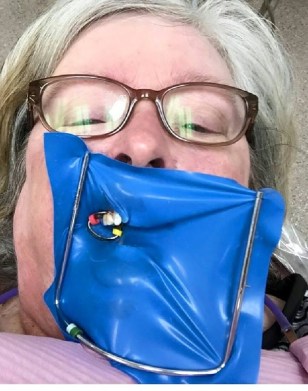
This is a picture she took of herself this winter, when she was propped open, clamped, half-gagged, left alone to wait for anesthetic to set in before root canal surgery. It captures the dehumanization of dentistry with blithely understated honesty where there could be shrill drama.

When I was learning to be a person, the eyes that framed these pictures framed much of my world for me. It’s not that my mother trailed along after me, doting, driving, fussing over making sure I’d grow up to be an artist. Actually, it’s kind of a joke in our family that when I was born, she still wasn’t quite finished babying my 13 month old big brother so she lobbed me at my father with, “Here, this one’s for you.” I’ve never been sorry for that and the truth is, I was never far from her anyway. My father had my ear but my mother had my eye. I saw what she showed me—mould and teeth, pineapple weed in the cracks of sidewalks, clam holes in the sand at the beach.

My aunties said no one finds four-leaf clovers as easily as my mother does. She’d press them in books—thick, heavy, green books by men like Dante and Plato and Milton. She didn’t care for those stories but the books were kept through thousands of miles of moving house for our sake—that is, for my sake, and maybe the clovers’ too.

Get well, Mum.

Finalist Status in the 2015 Association for Mormon Letters Awards

aml

Sistering has been named a finalist in the novel category of the 2015 Association for Mormon Letters Awards. It’s the first time any of my work has been included in the annual awards and I am very pleased.

Here’s the link to the announcement. The winner is going to be announced in Hawaii the same day I’ll be making a mid-term presentation on the grammatical intricacies of the Chinese 把 construction in Edmonton. Ha!

Here’s the link the to announcement.

Angry Grizzly Bear on This Generation

grizzly


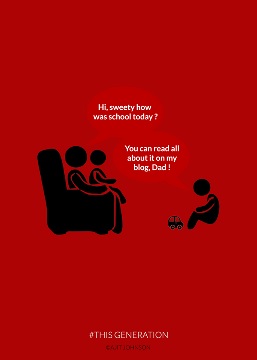
Seen the #THISGENERATION graphics yet? The generation referred to in this series of red posters isn’t mine—the awkward demographic between Generation X and the Millennials. thisgeneration3The generation in question isn’t the artist’s own cohort either. From what I can tell, he’s a salty old fella from the beginning of the Millennial spectrum. #THISGENERATION—the one harpooned in his simple red graphics—is that of my kids and current classmates.

I spend almost all of my time with #THISGENERATION. Like the artist, I am part of a university community filled with people who get younger and younger than me every semester. In my growing family and in my volunteer activities, most of the faces I see and voices I hear are those of #THISGENERATION. By my own choice, I move through their sphere, outnumbered by them, and perfectly content to be so. What have I found in their sphere? I’ve found the full breadth and depth of human character, intelligence, and kindness. It exists there just as it does among people my own age and among people much older than me. Humanity isn’t something we age into or out of. We’re all equally a part of it.

Of course, I have a huge problem with the way these red posters fail so utterly in representing how or why my children and my friends live the way they do. It’s part of my general revulsion for any sweeping statement made about an entire category of people, especially when those statements appear to be based on fanciful anecdotes unsubstantiated by any proper data and, frankly, smack of the petty mean-spiritedness.

thisgeneration1Let’s pursue a methodical close reading of a few of the posters. In this one, #THISGENERATION is hassled for going somewhere private to take pictures of themselves to post in public. Sure, this is a situation that has and will continue to showcase a whole lot of terrible youthful judgment. But let’s hold our noses, take a page out of the gun lobby’s script, and remind ourselves that cameras don’t exploit people, people exploit people.

When I was in university, my bestie had a cheap, nasty film-camera and pestered me into appearing in ridiculous pictures. She was a genius, I guess. We were taking selfies before there were selfies. I wish two things about those pictures were different: that they weren’t so blurry and that there were many, many more of them. I no longer look like I did when I was twenty. And I certainly don’t blame anyone who is twenty right now for

oldselfie

An Aunthentic, Antique Selfie ca. 1994

understanding they will never be more beautiful and wanting to use the slick, cheap technology they have to document and revel in it. Heck, go ahead and pose in the bathroom if that’s the best place to relax and get a natural expression. Yes, some of today’s selfies will cause regret. That’s awful. But all those picture we don’t have from back in our day cause us a kind of regret too.

This one has more text so the weak points of its underlying assumptions are more glaring. First, the Candy Crush posts on my Facebook feed aren’t from #THISGENERATIONthisgeneration4 but from older people. Most of us won’t commit  to long, challenging gamer-ism so we play simple, free, throw-away games like Candy Crush. It’s mostly an old people game.

Beyond this sloppy misrepresentation, the larger problem with the comic is that it sets up a false dichotomy between online social contact and face-to-face contact. No one has to choose between these two options. Young people’s relationships span both social media and face-to-face life, just as they do for older people. The centre of young people’s social lives has shifted, moving toward a social space that didn’t exist in the past, the same way people’s relationships expanded to include phone calls during the twentieth century. However, the locus of new social contact points isn’t that different from what’s gone before it. My 19-year-old son observed that my 1990s social life required “a lot of legwork.” That’s true. But it wasn’t all about hoofing around, trying to find each other. We tied up our parents’ landlines, wrote notes to each other in class, wore earbuds and ignored our seatmates on public transit, sat together silently watching television because we had to share the same screen, bullied, and gossiped. Our social interactions weren’t always the rich, face-to-face encounters romanticized by “if you remember this your childhood was awesome” memes. My awkward generation also bored each other, hurt each other, wasted time, didn’t go outside enough, and let opportunities to enrich each other’s lives pass by.

In many ways, #THISGENERATION is more connected to their friends and acquaintances than young people have ever been. That can include being more connected to their parents. “So are you more of a friend-mom?” one of my classmates recently asked me. I do my fair-share of nagging and bossing but I do enjoy my kids. All those excruciating baby-years are paying off with these fantastic friends I made myself. That was the point of this parenting project all along— making people with whom to share my life. It’s come to include my online life.

I haven’t even mentioned the safety benefits of having kids in #THISGENERATION. When I was sixteen, my girls and I would get on a MetroTransit bus, leave Cole Harbour, and stay out until the last ferry brought us back from Halifax. We did this without any way for my parents to check on me, without anything in my pocket that could summon rescuers if something went wrong. My husband grew up in a rural area where he’d take a car and disappear into dark, icy prairies, unreachable for hours. I don’t know how our parents could stand it, and I’m glad I don’t have to.

How about this one?

thisgeneration5I was amused recently to read a twenty-year-old paper warning scholars they ought to take spoken literature (orature) more seriously since it was all #THISGENERATION was going to abide. In the early days of texting, a prominent Canadian author wrote a novel including a vision of the future where both written and spoken communication had morphed into flip-phone era texting shorthand. Of course, that hasn’t happened. #THISGENERATION doesn’t often use their phones as phones. When dealing with people at a distance, they prefer written over oral communication. A phone call means someone’s dead or in jail. #THISGENERATION has become extremely literate, plugging away on Tumblr writing heavy text posts about art and  relationships and social justice, learning creative writing in epic style on fan fiction sites, while older adults quip away in 140 characters. No one reads and writes more than #THISGENERATION.

None of this is meant as a glib “the kids are alright” brush-off of how hard growing up is for young people and the elders caught in the blast-zone. Things like pervasive online pornography, harassment, the permanence of online gaffes, and the ways compulsive gaming and social media activity can rob the achievements and relationships kids need to build their futures are all serious problems. So let’s stop snickering and get serious. #THISGENERATION ought to be able to look to older people for support, help, and love to ease their way. We can’t support people when we’re sneering at them. We can’t understand them when we’re oversimplifying them. We can’t show them much of anything if all we see can in them is their worst.

Carols, Angels, Babel, and Noona

babel

M.C. Escher’s “Tower of Babel”

It’s Christmas, a fine time of year to tell a story that begins in church. Recently, I was in a congregation singing “It Came Upon a Midnight Clear.” In the lyrics of the little-known later verses, the ones I had to peek at the hymnal to remember, the song describes the world we live in. It says, “And ever o’er [the world’s] Babel sounds, the blessed angels sing.”

Of course, “Babel” refers to a story early in the Bible about the social catastrophe of the Tower of Babel. Humanity was glitching out and needed its reset button hit–again. But instead of suffering another flood, our language was scrambled. It was the end of the world. Everyone was dry and safe but the world that existed before language was “confounded” was over.

Whether we read the Bible literally or not, the tower story reveals something about ourselves. The fact that a story like this could endure for so long and be so widely spread betrays the profundity of our sadness—maybe even our terror—at the barriers that divide us from each other. The Tower of Babel pricks at our collective longing for a world where “the whole earth [is] of one language, and of one speech.”

With great difficulty, language barriers can be overcome.  They are overcome, all the time. In many ways, this overcoming proves that our higher nature—the one allied with the Christmas carol’s “blessed angels” who see “all the weary world” at once—can rise above the “Babel sounds” of our lower, confused and tribal nature that would rather we huddle in exclusive groups, throwing rocks, registering and monitoring people whose families don’t sound like ours. But separation does not make us happy. On some level, when we’re calm and honest with ourselves, we all know this. It’s one of the oldest lessons there is.

In everyday terms, told without angels or towers, here’s what I mean.

For the past two semesters, my Chinese class partner and school bff has been a 27-year-old, world-travelling, polyglot, sweetie-pie, veteran of the South Korean navy. One morning, I jokingly referred to myself as his noona (Korean for a boy’s older sister) and the rest is history. Noona, noona, noona~~~

A few weeks ago, my husband and I were having lunch with him. English is the third of the five languages he knows and sometimes, understandably, his talk gets tangled. He stopped himself mid-sentence with a bitter, “Oh, my English!” Actually, it wasn’t so bad. I rephrased the complicated statement I assumed he’d been trying to make and repeated it to him. He didn’t reply with his voice. Instead, he smiled, put one hand over his heart, and extended his other hand across the table, toward me. I recognized it as the universal sign for, “This person knows my heart.” It was beautiful. I will remember what he looked like, sitting there with us, for as long as I have a mind that remembers anything.

Ask anyone: overcoming a language barrier takes more than flashcards and worksheets. Memorization and practice can train us to function but they won’t boost us all the way over the wall to where people really live. True understanding of anyone from outside (or, heck, from inside) our language group requires bringing that hand to the heart, sharing and connecting in sublime ways beyond vocabulary. Any barrier is best overcome by acts of love and brotherhood—noona-hood.

All of this is what I want to say when I’m asked why I am slaying myself to learn a new language. The more people we can talk to, the more people we can love. And when we put ourselves in a setting where our native language is not the dominant one, we learn to pay more attention to what people mean rather than just what they say. When we can only translate part of a communication through language alone, we learn to tune in to other cues—obvious ones we can observe with our senses like gestures, facial expressions, and non-verbal vocalizations, as well as cues we sense with our empathy, our feelings, with our spirits.

Why learn another language? Do it to for the resume, sure. But also, do it for love. How corny is that? Corny enough to be a Christmas song, one that looks forward to the day when “the whole world send back the song, which now the angels sing.”


Another “Rock Show”

voiceindustrie

Voice Industrie, Nov 2015

November 14, 2015

Edmonton, Alberta

A day after maniacs shot up a “rock show” in Paris, France, we go to a concert in our own city.

This is not a case of us soldiering on with our usual routine in defiance of someone’s sick attempt at an awful new world order. The local techno-Goth music scene is not my usual routine. But I have a marvellously large, culturally far-flung family and one of my loved ones is currently in a band called Voice Industrie. It’s been around for years. “We’re a heritage act,” my sister-in-law explains, each of her earrings as big as my face, burgundy lipstick, six feet tall in black and silver high heels, standing in the evocatively shabby Garneau Theatre lobby. Even without any metal in her face, she’s the most striking person here. What kind of life do I have, to be able to say I’ve known and loved her since she was a child?

I greet her with a hug, announcing myself and her older brother with, “The dorks are here!” It’s okay. It’s true. There are no natural blondes at Goth shows. I am a freak of the freak scene.

Next to where we stand, there’s a young, indie author selling self-published copies of his urban fantasy-horror novel  on a white table cloth. He’s done all the art and design for it himself. I buy a book, tell him about the novel I wrote with the word “death” in the title. When he signs my copy I say, “No, not there. Sign it by your name.” There’s a place, a use for me here after all. He gives me his hand and I shake it with that ladylike, finger-pivot-palm-pulse move I can’t keep from using anymore. I don’t know where I learned it.

We have to wait. The show is running forty-five minutes behind and there’s another band on before Voice Industrie. They spell their name with a “9” where most of us would use a “g.” They are not a heritage act. Their front man has his hair bleached swan-white, black pants, white blouse on top, a variation on the dress code our elementary school music teachers used to require at Christmas concerts. He’s a lovely thing, looking like Gerard Way’s long-lost little brother. He can perform too. Breath control—I always envy and admire people with great breath control. Their songs are about despair and gallows and stuff but the fact is, they’re adorable, up there swearing in their skinny jeans. Are their moms in the audience, their big sisters who love them like they’re still kids?

I haven’t been inside this theatre since I was in university the first time around. Nothing’s changed since then. I’d forgotten that the chairs rock back and forth, reclining and recoiling. It’s all the dancing I need, sit-down rocking for not-Gerard and the boys.

When Voice Industrie finally comes on, and people start to gather at the foot of the stage to dance, my husband stands up to join them. He hasn’t danced in public in years and years. “At least take your glasses off,” I say. I don’t go with him but even back in the day, I never did. If we weren’t able to dance without each other from time to time, this thing never would’ve worked so well for so long.

I can’t always see him though the crowd but I never lose sight of the grownup girl with the braids. She’s a beautiful dancer. I hope someone is in love with her. If no one was before, someone must be by now.

I stay in my seat, my rocking chair, right for old broads like me, bouncing back and forth until the lights come on and I stand up to blow kisses at my rock star. She takes her bow and runs off the stage, nimble in stilettos, past everyone else, and throws her arms around the two of us.

This is the “rock show.” For every one one of us–this is love.

At the Flywheel…

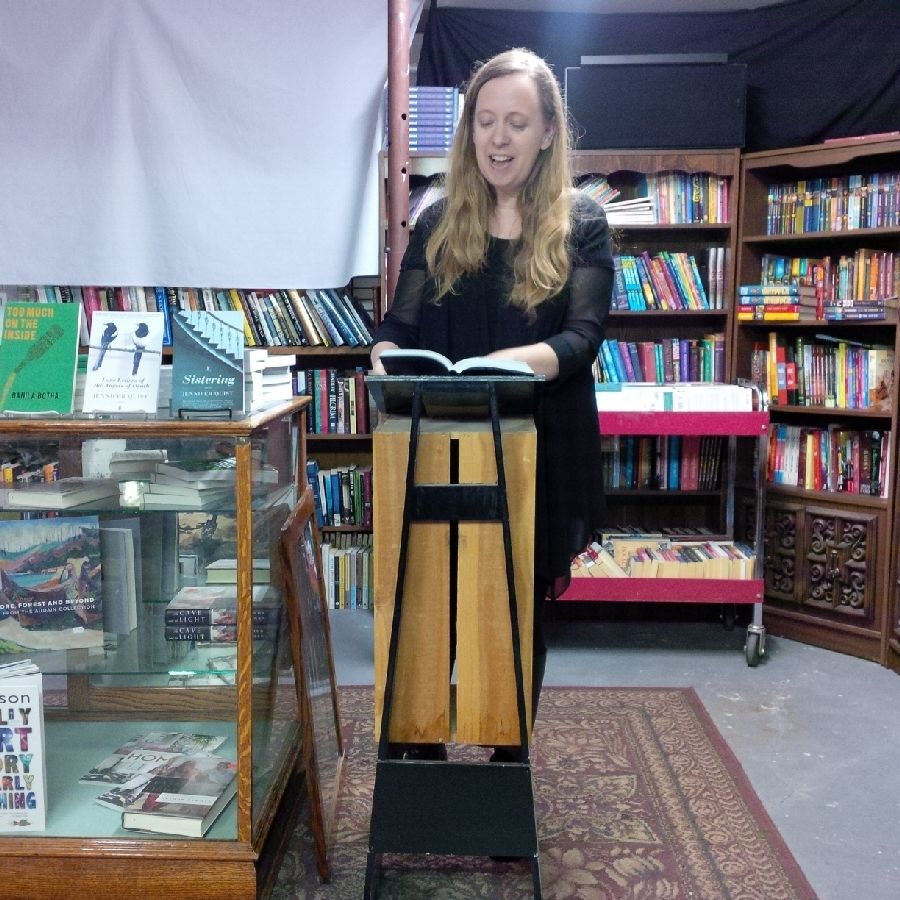
pages2If anyone thinks Calgary is all pancake breakfasts, politicians in Stetsons, and dubious animal handling ethics, they don’t know Calgary. It’s home to a great literary arts scene–poets, writers, literary mags, university programs, the whole package. It’s a pleasure to get to travel there as part of my own book tour. Last night, I was part of filling Station magazine’s Flywheel Reading Series along with fellow writers Erin Emily Ann Vance and Bren Simmers. It was the first time this tour I wasn’t either sick or late, making the event a triumph. I had a great time, was the subject of some horrible photos as I hammed my way through my reading, went back to the hotel, ordered room service with my sponsor (my husby), and crashed. Thanks, YYC!