Travels with GenX — Finally

My husb and I did not grow up blessed with international travel. Husb stayed in a motel with his parents precisely once. It was the Bluebird Motel in Claresholm, Alberta and it lasted as long as it took for their car to be repaired. My family did travel all over Canada and the US, always by car and almost always as part of a grueling long distance move. 

In our 20s — prime backpacking age — husb and I were in school, then in diapers (our little kids were, that is), and deep in debt. For us, big-travel did not arrive until our 40s, beginning as a necessity of my career as a writer and scholar before becoming part of who we are now. 

If you’re not a big-traveler yet, and especially if you’re like us — too young to throw in with the Boomers on the group tour packages, too old for flirty bedbug hostels — here’re some tips. If you’ve already got the GenX nihilism, whatever your age, then, whoa, you’re halfway there.

  • If you’re traveling to try to revitalize a relationship, choose something easy and luxurious like an all-inclusive resort or a cruise. Do not attempt a DIY adventure in a foreign country with someone with whom you do not already enjoy spending a lot of time and with whom you are not really, really comfortable exchanging apologies. I have a sister who has yet to do big-travel but I know she and her husb will be great if they ever do because they happily summit local mountains together every weekend. Find a local “mountain” and take that relationship on a trial run before booking a flight.
  • Give yourself lots of time for everything, especially airport connections. Faster is not always better. Don’t just take it from a girl who has run up stairwells in the Frankfurt airport lugging baggage, take it from the much younger and sweatier man we ran past in time to hear him tell his companions, “Just leave me. I’m not going to make it.”
  • Get over car travel. You go everywhere by car at home where public transit is terrible and expensive but things may be different abroad. A ticket on a train in, say, Norway is a sacred trust and you will arrive at your destination promptly and safely even if the train you booked derails outside Oslo before you even board it. Norway Trains will provide a way. And when the Eurovision song comes on in a maxi-taxi with purple LED lights in the ceiling, blazing through the Swedish border without slowing down, everyone will be singing.
  • Wear your wallet. This is what our 90s cargo pants were made for. Zip or button your passport and cards right into your clothes or get a belt bag and wear it across the front of your body where you can see it all the time, with or without the progressive lenses you should be wearing too. If you leave a bag behind in that Paris restaurant with the distracting wasp problem, it’s just going to be you and your high school French trying to convince the nice, somehow wasp-hardy immigrants who run the place that it’s yours.
  • Be so for real about your not-young body. Sleep. Sit. Leave the pharmacy labels on your medication and bring all of it with you (including—especially—the good pain killers). For me, this has meant traveling with my big, cartoon syringe packed in ice on any trips over nine days. It can also mean lying under an overpass in the West End of London somehow overlooked by hostile architecture with your head in your loved one’s lap, or trying to soak in a bathtub in rural Scotland with your foot pressed to the stopper to keep the hot water from draining long enough for it to have its therapeutic effect.
  • Don’t bring those shoes. Your Docs are too bulky for your carry-on bag. Get some good sneakers, wear them everywhere, and get over the fact that they’re all you see when you look at photos of yourself.
  • Take photos of each other. You’re the only one who expects photos of yourself to look like they would have when you were in your 20s. It might creep everyone out if they still looked like that. And there’s no point photographing empty landscapes anyone could find better shots of with a Google image search. When it comes to my husb’s Instagram, he acts like his sick little old lady companion is a supermodel. I am so not, but I stand up straight, try to open my eyes, dress mindfully, and so far, no one is impolite enough to mention it.

Travel is a privilege no one deserves and not everyone gets. 20s me with the kids and the debt—she never saw all of this coming. Old me is grateful for travel, getting better at it, and wishing you the same.
This is not a Eulogy: Un-Useful Tips at the End of My Degree

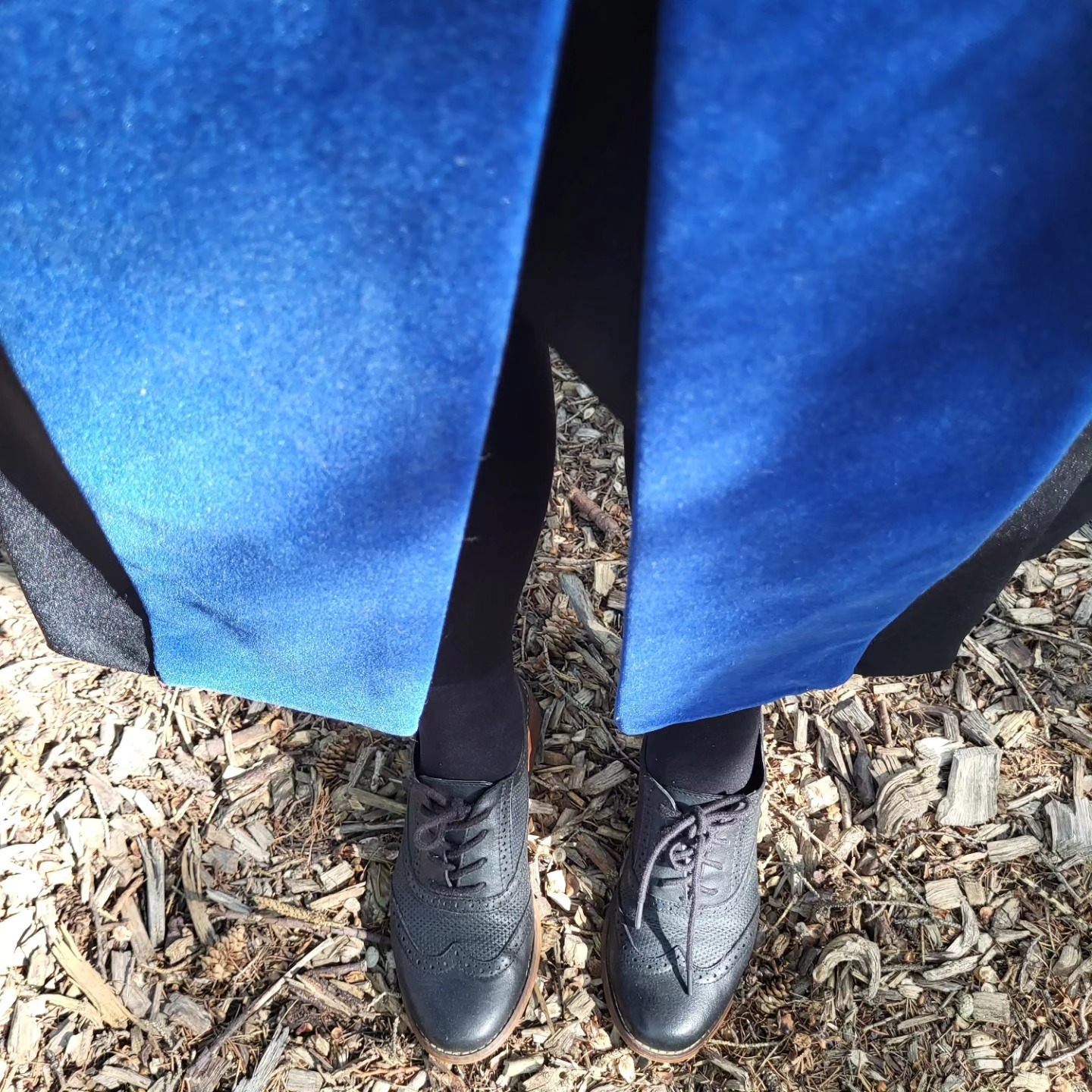
My regalia and my sensible shoes.

I keep trying to write about the seven year project of earning a doctorate in my 40s, but it keeps lapsing into a eulogy – a sober retrospective, a farewell, a melodramatic coda. And though a melodramatic coda wouldn’t be false, it’s not what I want to say. 

What I want to say is that I’m grateful, still tired, changed, etc., and that I was happy all along. My bff gets it, and she sent me a McDonald’s gift card (I love this girl) and a note about the “joy” I took in all of this. Well said, my dear.

So I’m marking the end of my degree with the same kind of written tribute I published on this site when husby and I celebrated our 25th wedding anniversary. It’s not really a list of advice, not exactly tips anyone could use, but it does note some of the things that went into my successful PhD program.

As always, no guarantees expressed or implied.

  • During your program, you’ll be given deadlines, not power over death. Ask for extensions. Go to the doctor. D.A.R.E to say no to Ibuprofen and mindfulness and get prescribed some proper drugs.
  • If your program has a language requirement, don’t fulfill it with two more semesters of a perfectly good language you’ve studied in the past. Start from nothing with a new-to-you language. Does it use the same alphabet as your primary language? Hm. Different alphabet? Hm, naw. No alphabet? Yeah. Yeah, that’s the one.
  • Your best friends are now twentysomethings. If you fail to befriend them, you may very well fail everything else about this. Eat lunch with them, go to hot-pot, room together in China, don’t let the embarrassment of them knowing how often you go to the bathroom hold you back.
  • The straight-middle-aged-woman/young-gay-man pairing is a power-friendship.
  • If you’re a lifelong anglophone, your privilege comes with a responsibility to help colleagues with their questions about English grammar and usage. Give it up.
  • Enjoy a student social life liberated from dating. No matter what Hollywood says, if you don’t understand you aren’t at school to date twentysomethings, you’re not fit to be there, you hecking creeper.
  • Involve your own kids in your schoolwork. Grind through what the YouTube essays don’t tell them. Oh, and remember to take them to the doctor too.
  • Never end your comment with “if that makes sense.”
  • Say “I don’t know” right out loud and with your ego intact. No one here is under the delusion that you know everything. Believe me.
  • Print the article so you can write all over it and then hoard it in a binder like a little rat.
  • Don’t spend the whole conference trip in sessions. Your talk will be sparsely attended and someone else is going to take up most of your time, so enrich your education with the chaos of a foreign municipal transit system.
  • Don’t panic when someone at your candidacy exam tells you their hubby thinks the dissertation you’ve proposed is a waste of time. 
  • Don’t convert to a philosophical theory. Study isn’t discipleship. Theory exists to serve your intellect, not the other way around.
  • There’s no need to wait until you’ve finished the dissertation to start writing another book. 
  • Yes, you have ADHD. Diagnosed or undiagnosed, it’s an unspoken job requirement in academia and, for us, a superpower. Congratulations. Where did you leave your keys?
  • Never say no to a teaching assignment. You may not be an expert in the fine details of the class material the day they offer you the job, but you’ve got the theoretical background, the skills, and the support to be everything anyone in the class will need in the end.
  • Don’t try to teach or research contemporary pop culture like video games, tiktok, fanfiction, ChatGPT, etc. without experiencing them as a user, you hecking poser.
  • Take the nightwatch at the deathbed. You’ve got a lot of reading to do anyway, even if all you can handle is that fanfiction.
  • Tell your students they’re your kids’ ages and you already like them. Don’t apologize to them if your lectures make you cry a bit.
  • When there’s a global crisis and you need to lecture from your home office which is also a laundry room, don’t hide the electric clothes dryer that’s always in the shot. Maybe move the pile of ironing.
  • Don’t fight changing ideas and technologies. They are on our side, even if we’re not sure how just yet.
  • In the same vein, end the denial and get the bifocals.
  • Ask your Chinese Studies professor about the feng shui of the exam room before you choose where you will sit to defend your dissertation. If he tells you to sit where an emperor would, you’re going to do just fine.

Of the 90s, but not in the 90s

I’m teaching English 111, Introduction to Literature and Composition Part I, degree requirement basics. It’s not at my usual university, bleeding funding and scholars. I’m at a small school overlooking Wayne Gretzky Drive, built out of brick by tall Lutheran men, furnished with wooden lecterns too tall for me to see over. It’s a secular university now, but in a little-used courtyard there’s a granite memorial bench engraved with a Bible verse about perfection in weakness where I set my bag while I slip into a mask every day. 

True enough, and even from beneath the lectern, I am qualified as anything to do the job, not at all an imposter. I have everything I need, though some of it is dusty, a bit beige, like the opening unit on English poetry, with its technicalities of rhythm, meter, rhyme, form. 

Quick, how many beats in an anapest, and which of them is the one that is stressed?

My books on these are from the 90s, and they are thick as bricks, marked with the name I got from my father rather than the one I took from my husband. The edges of their covers are reinforced with sello tape, holding up well. The world is different now, and rereading them is opening a familiar window to find the view has changed, and the way the light refracts now makes the place where you stand to open the window look different too. 

I will not call this rhyme feminine. I will not fail to mention that norms of academic English diction are colonial gatekeeping. And I will say, “Don’t necessarily think of Shakespeare as the OP, but as the first big account to repost that trope or saying.”

None of this is to say that the 90s, the old books’ decade of origin, are now lost on me. I started the decade a high schooler and left it a mother. Ten years is half of everything when you’re in your twenties. Big Shiny Years.

Books and music were the only art I could afford in the 90s, and so I’m listening to Blur as I reread for English 111. Past the holiday sarcasm and the Woohoo, it’s more like flawless, earnest harmony not properly appreciated in the – well, in the blur of coming of and out of age in the 90s. 

Still can’t believe Dolores went and drowned.

There will always be Nirvana, I suppose, on the car radio just this week. I’ll usually pass it over. Our songs weren’t radio tunes. (I’ll wear a shield, I’ll go out of my way to prove) to my son, next to me in the car, that I kept the words to “All Apologies.” Try not to cackle when you sing to your kid, “EVeryTHING is my FAULT.” Oh, that last anapest, it might be a joke.

Still in the poetry unit, I found the stack of unworn jeans my last son had outgrown before he could wear them. Tags still on, maybe I could keep them, wear them 90s-ly (or is it 2020s-ly), high and loose everywhere. Scuffing around the house all day, legs dark and stiff, the waistband floating around my ribcage, tripping me on the stairs. Couldn’t make it work then, can’t do it now.

And on the night when my disease flared and I couldn’t eat at dinnertime, my husband brought a tub of chocolate ice cream to bed, and we chipped at it with one big spoon as it softened around the edges of the container, as if we were the only people here to feed off it.

“I haven’t done this in ages,” I said, as he clicked the next episode. “This is how I treated myself in the 90s. I’m telling you, it’s all about the 90s right now.”

He’s not used to thinking about it anymore and asks, “Were we really in it?”

If we hadn’t been there, there’d be no tape on the books, no names, no fault. We were there, thereabouts, in it enough to see selves of ours in the poetry, in the archeology of someone else’s twenties, in English 111.

We’re Here, Because We’re Here, Because…

So my son typed my name into Google and I was the top result. Too legit. Can’t let that slip away so here I am, still posting, still writing, and still alive, which is not nearly as glib of a comment as it once was. Happy 2022, the year a plan to defend my dissertation, finish the manuscript I’ve been calling “my unhinged creative project,” and teach this class at the University of Alberta called “Dystopian Fictions.” I’m teaching online, of course, because we can’t gather in person thanks to — well, all the dystopia going around. Anyways, that is me for now. Keep being there.

Things to Hold at the End of the World – Health, Faith, Family, Work, Art

Me, “chewing through” my medication

I got good news this week. 

My doctor is doing appointments over the phone for now, and he called early, catching me in the bathtub to let me know the scope and the scan I had this summer, almost two years after a life-changing flare of Crohn’s disease, showed I have scar tissue but no actively diseased tissue in my colon. 

He was so proud of us, genuinely happy. 

Not everyone experiences Crohn’s the same way, and the damage I suffered was particularly gruesome and dangerous. Based on that, some setbacks this winter, and a natural drug tolerance that had me, in his words, “chewing through” my fancy IV medication, he didn’t expect the results he found. He expected to be increasing my medications, and the possibility of surgery remained a live one. He was not only proud but openly surprised none of this will be necessary.

I was the opposite of proud. I’m a spiritual person and I embraced the good news as an exchange of grace I don’t deserve or understand, something connected to my father’s faith as he did his dying this spring. It’s a religious person thing, meaning made in the best of faith…

Anyways…

I need to keep taking IV medication to stay this way. The bowel isn’t the only part of the body affected by Crohn’s, and many other symptoms — typical auto-immune garbage — are still with me. The side effects of my medication remain too, a lesser evil but evil all the same, one which leaves me immune compromised during a pandemic. Yes, I am part of the “it’s only the…” population so many are willing to make into human sacrifices. Into the volcano with us. Cheers.

Still, nothing ruins my good news. This year has been astoundingly bad all around. As the year I lost my father to a long illness, it certainly includes some of the worst days of my life. But there have also been moments in the pandemic that bring goodness home to me, not always unlikely remissions, but things worth remembering.

Like…

  • My kids – It became obvious that my programmer son could work anywhere, so he moved 3500km from head office, back to the city where the rest of the family lives. Bonus is that, according to his youngest brother, “he is nice now.”
Home Office
  • My sibs – The sibling group chat (seven of us) has been a lifeline. As we work out Dad’s death, there isn’t much that needs working out between all of us. At the end, my sisters and I (five of us) moved into my parents’ tiny house for two weeks under the most stressful of circumstances, and we couldn’t have loved each other better or more. It was a great testament to my dad’s gift for making families. Elton John’s “Your Song” and Keane’s “Somewhere Only We Know” — basically any bittersweet Brit-alt-pop covered by a woman with a sweet voice — is about them.
  • Love – My husband will still kiss me goodbye for the day, even if I’m in a zoom classroom with twenty teenagers.
  • The earth – My modest yard is dominated by a pair of huge white spruce trees. For the six years we’ve lived here, we dismissed their corner as a black hole of sharp needles and mad insects. But this year, we took the time to see that many of their lower branches had died off. Once we pruned them away, it left the perfect spot to hang a hammock. The bugs hated it and left in a huff. We spent hours out there, in a fake boreal forest, like a place from my childhood. In this spot, I read reams of heavy philosophy that might have been unbearable otherwise. And yeah, it’s close enough to the house to get wifi.
  • My work – I’m a writer and a PhD candidate and this late in my degree, I would continue to do my work whether I was paid for it or not. But I do get paid for it. Months into the pandemic, the government of Canada continued to award funding for research in the humanities, and I benefit directly from that. Clearly, culture and art have been comforting and sustaining people through this crisis. And even as people I know and like fall for anti-intellectual, anti-humanities conspiracy theories, unaware of the irony of the parallels to Maoism in what they repeat, ill- and misinformed about what we do and how and why, I’m still in a place where I can keep working and creating.

Grief is work — grief for what we lose in global disasters, what we lose from our families, from our bodies. 

Grief is collaborative work done with my family, my medical team, in publishing, in research, in social media posts of my feet in my hammock. 

Grief is creative work. Writing my dissertation and my creative projects under newly pruned spruce trees dripping with sap is the same work as making sense of Dad’s death, which is the same work as healing my colon, which is the same work as taking care of my husband and siblings and long lost children, which is the same work as all of this.

Marriage Tips for Crazy People by Crazy People: Our First 25 Years

bishopcarterpic

Mugshot our Bishop took because he couldn’t tell people under 40 apart #relateable

25 years ago this week, I was gift-wrapping chocolates in a Laura Secord shop when a customer, an old lady, noticed my little engagement ring. It was just us girls, and she gave me some NSFW advice to help with my upcoming marriage. It was very good advice, and it’s got me thinking about the unsolicited advice I might give, based on nothing but my experience.

Sooo…..
Prepare yourselves for Jenny’s Terrible Tips for Marriage Success (*Results May Vary). There are 33, one for every centimetre of difference between my height and my husband’s.

  1. Early January wedding date, to prove you just don’t give a care who else is there.
  2. Cheap wedding.
  3. Do not mistake a cheap wedding for saving up money for married life. Save none.
  4. Bring student debt into the marriage. Triple it together.
  5. Never change your hair. Keep the original do in “I do.”
  6. Get married in a ceremony that doesn’t include the words “I do.”
  7. Ignore family’s concerns about who doesn’t look like a worthy breeder.
  8. Have a complicated pregnancy and associated baby by your second anniversary.
  9. Have another baby to raise the first one. Do not graduate from university before completing this step.
  10. Have incompatible blood-types.
  11. With the exception of breastfeeding, sex-determined divisions of household labour are indefensible, so don’t bother.
  12. Forgive your in-laws and lavish love on them. Let the egg salad incident go.
  13. Let the biggest freaker drive everywhere.
  14. Screaming is only for fun.
  15. Buy your first home in a trailer park. Always mention this whenever someone introduces their new baby as Parker.
  16. Couples home renovation projects.
  17. Take the bullet for the 1% margin of error in your contraceptive’s effectiveness rate.
  18. Five is a nice round number.
  19. No pets. Maybe some bird feeders.
  20. The kids must know the loved one is the favourite. It’s for the best.
  21. Cheer each other on in difficult things besides childcare and renos.
  22. If they work in public, show up and cry so everyone knows what a good job they’re doing.
  23. Dedicate the first book to them
  24. Be a good sport about the book dedication.
  25. Learn their field, even though it’s hard and technical.
  26. Go out so often they recognize you at restaurants and stop asking if you want separate cheques.
  27. Don’t be a jerk about what they wear.
  28. Don’t be a jerk about their friends.
  29. Unless you’re rappelling, never bring up their weight.
  30. Make them go to the doctor.
  31. Don’t make them go camping.
  32. When there aren’t enough chairs, be the first to share.
  33. Don’t expect anyone else to peel all those crab apples you brought home from the park.

Gear and Clothing in Las Vegas (and Cedar City)

JQLV2019Last week, I went to a conference in a small city best reached by an international flight to Las Vegas. It wasn’t a big conference, wasn’t particularly relevant to my current research, and in the end, I made my presentation to six other people, mostly conference organizers attending out of the kindness of their hearts. But that’s what conferences are really about anyway, right—the friends we make along the way?  An important point of the trip was its function as a test-flight for my upcoming big conference trip across the Atlantic, to London. Air travel with a chronic illness—can I do it?
The test-flight was a quick one, booked on ultra discount airline Swoop. What’s it like to fly Swoop from anywhere to Las Vegas at the beginning of the May long weekend? Remember that 1990s dance song “The Venga Bus,” the one about the “inter-city disco”? Disappointed there isn’t more beer spilled on your flight? Fly Swoop.

It was my first time in Las Vegas but it had a familiar energy. Strangely, unexpectedly, it felt a bit like China—fat, English China, where what made me stand out in a crowd was nothing but the fact that I was there, in Vegas, alone.

In the dark, I drove north, into mountains which probably have a name, up to Cedar City. In a dormitory with no China-energy at all—mattress on the bed, potable water–I went to bed exhausted and keenly aware of something I hadn’t thought about for at least two weeks: the illness deep in my guts. It was there when I woke up, mounting through the day. Ignorable enough to leave me a clear head for making a comment on the presentation of the one woman who spoke during the morning. In the afternoon, I accidentally went to a talk on water management in Utah but got through it, even the question and answer section where someone asked what changed between the state’s early communal religious settler days when it was a model of responsible water use to now when it’s a complete mess. I did not jump up to yell, “Capitalism! Are you kidding me? It’s capitalism!”

Dinner was fabulous. USA, USA. The keynote address began at a little after six, in a room decorated like Hogwart’s dining hall. By 7:55, the Q&A was still in full swing. I had good will for the man speaking but realized I would be walking out at 8pm whether he was finished or not. And anyways, like most of the speakers I’d heard that day, it was more twentieth century Western theory for 2019 global issues and it was wearing away at me. The trip, the T.S. Eliot quotes, the May weather that would have been bad even in Canada—it was over for me, the conference’s queen of chronic malaise.

I needed drugs and a bathtub. Back at the dorm, damp and freezing, I looked at the raised lip of the shower stall and didn’t wonder for very long about whether I could stop up its drain and rig a tub out of it. No, drugs alone would have to do. And they did. In my own homage to the twentieth century, I laid in bed watching clips of Wayne’s World, lingering on the parts where white people speak Chinese. That’s the joke. That’s the whole joke.

In the morning, the symptoms that had me fantasizing about getting back to Canada and going straight to the emergency room had vanished. I went to just one more talk before rolling out. The conference had been fruitful. I met smart and good people, two of whom invited me to submit the paper I presented to their publications. I left right before another all-girl panel like mine began. Before heading down the mountain, I went up, to the tip top where my church has built a temple. It was a beauty, new but built after the style of the nineteenth century. The parking lot was full, the front plaza lined with people in Sunday clothes—wedding guests. Congratulations, y’all. Share your water now.

Utah, Arizona, Nevada and Vegas on a Saturday afternoon. My big backpack and the sweater I put on in Cedar City were making me look like a lone gunman, parking her rental car one block north of Mandalay Bay. Not the look I wanted, so I went into Ross Dress for Less and bought a summer dress—a red one with an elastic neckline. I wore it over my jeans.

Down at the Bellagio fountain, music came up with the water—bongos and an acoustic bass. How had I not known the soundtrack was “Viva Las Vegas”, the Elvis Presley version, the voice of the ghost of this city, heard half hourly, turning day into nighttime, turning night into daytime?

It was almost time to report back to Venga Airways. I needed to sit and gather strength somewhere out of the sun. I sat down in front of a slot machine, fed it a dollar bill, and pulled the lever, the rent for the seat. When I told a colleague of mine about it, back home, he was shocked. “Capitalism got our star student!” I heard his voice in my head as I read the text, his Shanghaiese accent.

Travel is part of this long, difficult, costly education of mine. That is actually what conferences are all about. The friends are nice but the learning also comes in being alone, unprepared, surprised, suffering a little as we take the schemes we dream up in our offices out into the world, into other people’s worlds, to see if there’s any truth to them. In Vegas and Cedar City, the work I’d done on an obscure problem of East-West ontological and epistemological theory hit the road and found some traction.

Still, when I go to London, it will be as we.

Writer Time: Kicking Off My Term as the Capital City Press Featured Writer

59079075_10155973632740740_5449037549739704320_n

My morning TV news swag


Every time I have a book published, I find it’s harder than the last time for the book (or me) to get noticed. This is contemporary publishing. There are so many compelling new books each season, so many talented and interesting writers, that it can take some special magic to stand out. So of course, I was thrilled something was sparking when an email arrived last fall from the Edmonton Public Library’s Capital City Press program offering me a term as their featured writer. It’s a chance to hold some workshops, and use their platforms and resources to meet with local writer and reader communities. The past year has been high on studies and sickness, low on the writer’s life–whatever that might be. Not this morning, when I was out talking on TV about being, above all other occupations, a writer for at least the next few months.

I got to choose the workshops I’d like to run while in this position and I chose one on Fan Fiction (for writers, readers, and the curious–I’m looking at you, parents) and one on building a writing career within a busy household full of little dependent peoples.

Watch the website for details, read my guest blog posts, and show up to celebrate writing with me. Find it here.

Elevators Full of Spoons

elevatorIt’s been ten days since I was diagnosed with Crohn’s disease. In the medical sense, the condition is still “active” and has been for over four months while the screening process dragged on. Fortunately, it’s responded to my medications well enough for me to resume my usual routine as of the beginning of the new year. Maybe it’s crazy what we can get used to.

My doctor has a plan to put the disease into remission—a plan that involves a mighty gut punch to both the Crohn’s and me. Later this week, I report for the first in a series of intravenous “infusions” of a nowhere-near-real-chemo-level dose of a failed cancer drug that is now used to treat inflammatory bowel diseases. This is the “loading” phase of treatment, a combination of IV and oral drugs and weekly blood tests to make sure my liver doesn’t panic. My immune system is already mad about the pills, but she’s always mad these days. She’s sulking, taking her usual resistance to flus and colds with her as the drugs send her to time-out.

I need to settle in, simplify, and sort out what I’m keeping in my schedule and what needs to be set aside for now. I’ve read Christine Miserandino’s analogy comparing spoons to the units of energy chronically ill people get in a day. It started as a blogpost and became a meme and is now something more like a movement, arguing that there are only so many “spoons” available per day and once they’re used up, it’s bedtime. This means energy—spoons–has to be rationed, leaving sick people with weird choices.

For instance, it’s minus 25 degrees Celsius and your hour-an-half meeting is a twelve minute outdoor walk from your assigned parking spot which is already paid for. Are you going to double-pay for parking today to use the meter right outside the meeting, or burn a whole workday’s worth of energy trudging half an hour through the weather?

Or, you can have a shower, but if you stay in the water long enough to wash your hair, you’ll have to lie down as soon as you get out, and then getting up this early in the pitch dark will be pointless, so is this another quick from-the-neck-down shower and dry shampoo morning?

Or, you can go to the grocery store on the way back from work, but then you’ll have to go home and put your sore, dirty body in the bathtub instead of making dinner with the food you got, but you can’t take your meds without food, so is this another take-out Wendy’s baked potato night?

This is spoon rationing.

The spoon analogy is useful and has resonated with thousands of people. It’s a good shorthand when the time comes to apologize to someone for letting them down. Of course, it’s not perfect and needs to be used with caution and flexibility to keep it from backfiring. In explaining limitations to non-sick people, spoon theory can unduly emphasize limitations to sick people. Instead of inviting people into the struggle, it can inadvertently turn into an excuse for why they can’t come any closer.

Ironically, in its desperation to elicit grace, it can end up not leaving as much room for grace as I’d like. The grace I’m looking for from other people isn’t just understanding why I’m not quite myself right now and backing off. That’s not what I wanted when I texted my sister, “Say something cute, I’m having a sad-bath,” and she obliged by telling me about her day. It’s not what my friend gave me when she saw me coming in out of the cold and hugged me, boosting my power to warm up and my confidence in my choice to leave the house. It’s not what I feel when my group chat says “@_马珍妮 where the %#$& are you?” because someone is really hoping I’ll show up because I’m still me even if I’m old and sick. All of this is nothing, but so much.

Then there’s spiritual grace which is all about paradoxes and getting access to energy which spoon arithmetic says should not be available but sometimes just is.

Whether I’m having a day where I feel like counting spoons or not, there is plenty of rethinking and reorganizing for me to do as I work out the energy I need to keep doing not only what’s important, but what’s awesome. I have made one decision about my future already. I am taking the elevator. It’s not glamorous. According to our 1980s Canadian “ParticipAction” animated Claymation shorts, the elevator turns people into “a big fat ball.” The other day, I rode upstairs with a large unaccompanied garbage bin. No one here in the elevator but us trash. Doesn’t matter. My office is on the fourth floor and until this round of treatment is over, I am going there in the elevator. There—that’s a start.

Fortune Telling for Good Girls: a Tribute to My Recently Deceased Grandmother

20190209_013039My maternal grandmother, Meta McCarthy–born between the 1st and 2nd World Wars, dead as of yesterday–had a favourite passage in the Old Testament. She said if a girl found the verse in the last chapter of the book of Proverbs with the same number as the day of the month when she was born, the Bible would say something nice about her—a gyno-zodiac, a little Bibliomancy I learned from my good Christian Grammie.

The magic doesn’t start until verse ten, so my two sisters and two cousins born too soon in their birth months don’t get a fortune, which is awfully unfair. But the rest of us can play.

“Who can find a virtuous woman?” our King James translation begins.

My fortune is in verse 24: “She maketh fine linen, and selleth it; and delivereth girdles unto the merchant.” Sounds like code words for having to do the laundry AND go to work. True enough.

My mother, verse ten tells me, has a price far above rubies. Accurate.

Grammie’s other daughter, my auntie, has a candle that “goeth not out by night” which I am sorry to hear.

My middle sister “bringeth her food from afar” which makes no sense because her kids can come home from school for lunch, and my baby sister’s verse is about spindles and distaffs. More ornate iron-age messages about laundry.

Grammie’s verse is 28: “Her children arise up, and call her blessed.” Prophecy fulfilled, many times before and again now.

I knew my grandmother well, before she disappeared into Alzheimer’s disease when my children were babies.

She wouldn’t resist swimming at cold Atlantic beaches even if it meant going in fully clothed. Her favourite swimming move was the side stroke.

She taught us how to respectfully track a house cat around the yard, how to gather seeds from the hollyhocks and nasturtiums at the end of the season, how to knit, but not how to avoid getting busted by conservation officers for hauling away 5 gallon buckets of beach sand for the grandkids’ sandbox.

She was a pioneer meme-maker, overlaying our baby pictures with goofy captions. Her sense of humor was mostly fart jokes and that story about the drunk cousin who thought he’d made it outside and peed on the Christmas tree when she was a kid.

All summer, she drove us into “barrens” and woods to pick berries as though we wouldn’t survive the winter without them, and then brought them home to put up in reused pickle jars sealed with paraffin wax.

She used old-fashion Scottish words for things sometimes—especially us lads and lasses–and spoke in a drawn out sing-song cadence, complete with an inhaled “yeah-YEAH-yeah.” Her laugh was a cackle that I hear in my own.

Grammie chose a spiritual path for me decades before I was born. I’ve kept to it all this time. In its service, she took me with her on visits to the old, sick and lonely. When we went to see the lady with the coffee table made out of a Ouija board, the only comment Grammie made about it was a pleasant, “Well, will ya look at that.”

She took me to her 90-year-old parents’ house to spend entire days cleaning it, telling me to just graciously accept it as a compliment when Great-Grammie called me Dawn, after one of her other daughters.

When I got married at age 21 while living from one student loan disbursement to the next, she cheered me on anyway, giving me the wedding gift of enough money to buy my broke young husband the gold ring he still wears.

I don’t know what it would take to make a loved one’s death a welcome event. If anything could make it so, the almost-decade of profound Alzheimer’s dementia that was the conclusion of Grammie’s life before she died at age 97 might be it. It’s true, this is probably the least traumatic death of a family member I’ve ever experienced. But it is not nothing. And I arise up and call down her blessing.