Family Christmas Newsletters: Confessions and Unsolicited Tips

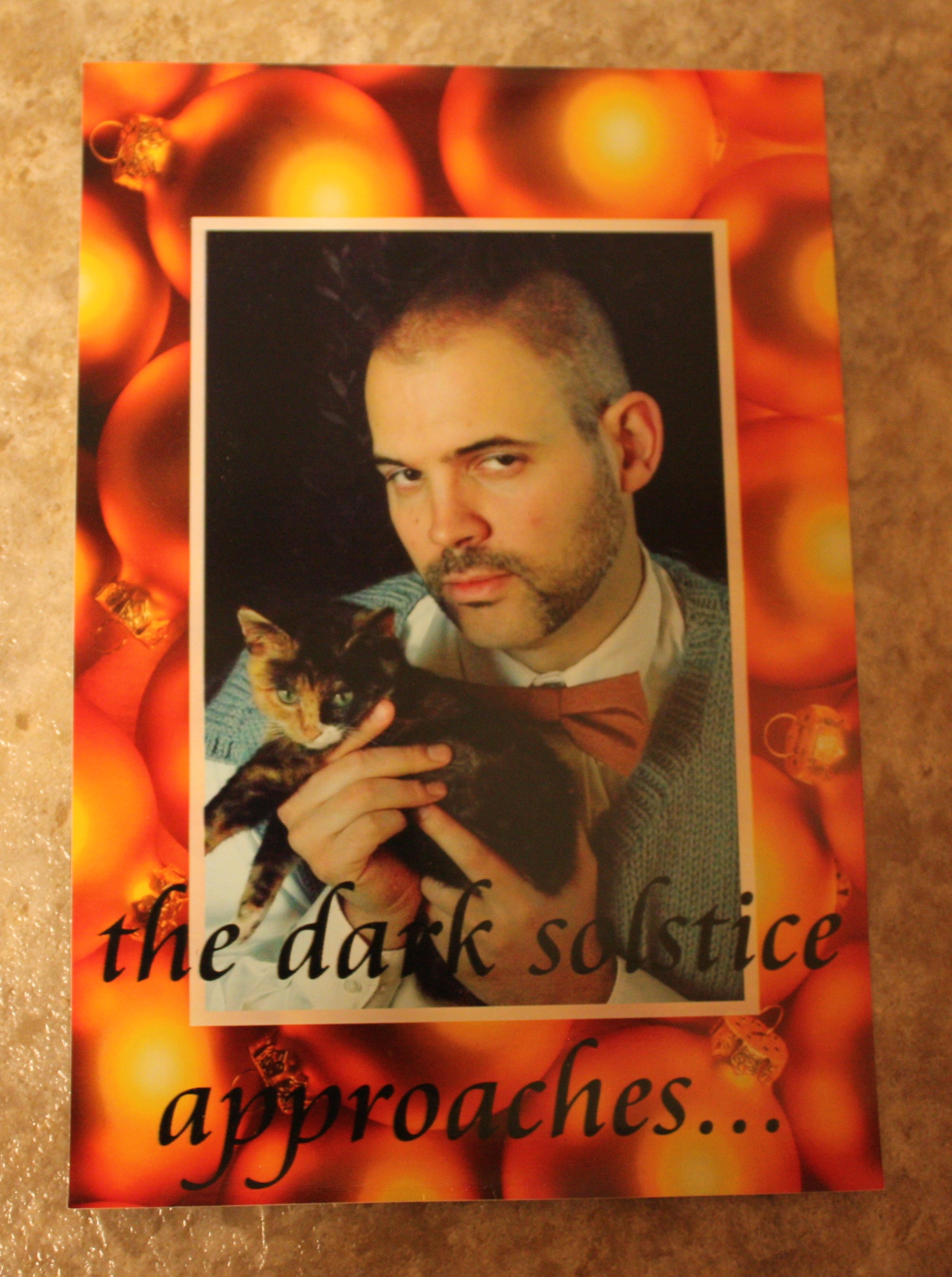
My cousin, Rachel, composed and photographed her perfectly lovely husband and cat to make this and win at Christmas cards.

My cousin, Rachel, composed and photographed this to win at Christmas cards.

The year I moved house, finished construction on our basement, gestated and started raising my fifth son, I didn’t get much writing done.  The only thing I published that year was a Christmas newsletter all about my immediate family.

Some people hate reading letters like these.  I know that.  I don’t send them to everyone – like the person who once soundly told me off for “always bragging.”  He gets an empty card with a hand-scrawled inscription and just as much love as everyone else.  The letters aren’t meant to please me but the people on my mailing list — good will toward men, and all that.  I hope anyone who isn’t made merry by my letter throws it in a snowbank on the way home from the mailbox.

For letter-writers, there are lots of ways to approach the family Christmas newsletter.  An artsy friend of mine wrote hers as an acrostic poem.  My Manga-loving sister-in-law once included an original, hand-drawn cartoon in hers.  I have a family of cousins who usually aim for the absurd – cats and paganism and stuff.  And I have a friend from a town called Spring Coulee who doesn’t use any gimmicks but always manages to dash off a letter that’s hilarious and real and totally charming.

Don’t misunderstand.  I like conventional Christmas letters too — the blessing-counting, the press releases, the shine-a-grams.  If I stopped getting them, I’d be very sad.  I love them.  But I love the wacky letters.

To write, mail, or post either kind of letter is to run the hazard of spreading Christmas cringing along with Christmas cheer.  It takes guts to attempt a holiday year-in-review letter.  Sometimes, we all get it wrong.  With my husband’s job, I find it hard to write a letter without the words “rape” or “murder” and there might be people on my list who dread reading about it.

Still, here’s a list from imperfect, sometimes-offensive me sharing my personal preferences for Christmas newsletters — some tips on how to keep me smiling all the way to the “Happy New Year” at the end.

1)      Good News, Bad News – We’ve all got good news and bad news.  A letter that’s nothing but good news is not going to be seen as dishonest or deceptive.  We should all know enough about the human condition to be able to assume that the year had some crud in it that didn’t make it into the letter.  Bad news shouldn’t come from an ink-jet.  It’s for the hand-written note on the inside of the card for people we only communicate with through Christmas cards – and there aren’t many people like that anymore.

Often, bad news is embarrassing for the people involved.  That makes it embarrassing for readers too — like witnessing a public shaming.  It’s one thing to say the cat ran away or someone broke her arm in a heroic feat of sports.  It’s another thing to report that someone’s weight is out of control or that he has a court-date.  If telling bad news isn’t necessary, leave it out.  If letter-writers can spin bad news with the right kind of humor or hope or, if it’s already well-known, nod to it gently and obliquely, they might get away with sharing it.  Get an editor to confirm if this has been done successfully.  And when in doubt, leave it out.  For the love of all that is holidays, leave it out.

2)      Keep it short.  Christmas letters are an exercise in pith.  Don’t waste space waxing lyrical about snowflakes or telling readers how every bit of news should make us feel.  We can assume someone was happy about finishing the marathon without being told.  If we’re the kind of people who sat down to read the letter in the first place, we’re probably the kind of people who can empathize between the lines.

3)      Avoid the hallmarks of bragging.  Apparently, I haven’t been very good at this.  But may I suggest avoiding the braggiest of all brag words: proud.  For some people – and we can never be sure for whom – the word proud can’t be separated from implications of feeling superior.  Even if we are feeling this way, we shouldn’t admit it in the Christmas letter.  As we write about the best parts of our lives, we’ll probably find that the word “pleased” serves just as well as “proud” anyway.  It expresses all the happiness we’ve felt without running the risk of offending readers prone to feeling oppressed by other people’s good fortune.

4)      Make sure the news we share is rightfully ours.  This is about more than respecting privacy.  Even within families, there’s a hierarchy of ownership over news.  If my sister finds out the sex of her unborn baby, it certainly affects me as the baby’s aunt but I can’t mention it in my newsletter until my sister has had a chance to tell everyone first.  She’s closer to the news so her claim on it supersedes mine and I defer to her on how it’s spread.  The newsletter should be about our own small world where we are the experts and owners of everything.

5)      Avoid predictions.  It might be hard for readers to remember what’s actually come to pass and what we only hoped would happen.  It’s going to be awkward next year when we have to answer to past unfulfilled predictions and “un-tell” the good news we thought we’d be sharing.

6)      Illustrate.  Don’t use lists of vague adjectives to express something that can be told with an example or quick anecdote.  All journalism — including amateur holiday journalism — is essentially storytelling.  Good reporting makes the letter memorable and gives the people in it the character they deserve.  Concrete experiences and direct quotes make for a good newspaper and a good family Christmas newsletter.

I could add something like “be yourself” but, really, that can’t be helped.  Maybe a better parting idea would be that we might enjoy our letters more if they read like something we would like to receive ourselves.  If it’s wacky, so be it.  If it’s stodgy, that’s fine too.  People on our mailing lists already love us.  They’ll forgive us a few cringes.  And we’ll forgive them too.

Mothers of All Brothers at the Mall

My sister had just posted a new picture of her baby on Facebook.  In it, my big-eyed, beautiful niece was wearing layers and layers of frilly pastel ruffles.  Beneath the picture, I wrote, “I didn’t know ruffles were the big thing right now.”  Even for idle social media chatter, my ruffle comment was pretty idle.  I didn’t expect anything to come of it.

But then, out of the vastness of time and space, through the miracle of post-modern social networking, another comment came answering back from an old friend of mine.  I didn’t know she and my sister were in touch.  I was surprised.  Frankly, they hardly know each other.  Frankly, my friend and I hardly know each other anymore.  We were closest during our early teenaged years, before I outgrew the worst of my hideous phase and started encroaching on her boy-chasing territory.  Things had been very quiet between us for a very long time.  But now that ruffles were on the table, she had something to say to me about them.

“That’s because you are the only girl in your home,” she told me, “And I don’t think that ruffles were ever your thing…”

She was right about that.

“…Little girls LOVE ruffles,” she continued, emphasis in the original.  “And sparkles, and tiaras, and glitter, and magic wands.  Maybe you should see if you can get a girl to balance out all of that boyness in your house.”

Maybe I’m crazy but it read like a smack-down.  It sounded like my family of nothing-but-sons was being called out as karmic.  She may as well have written, “You like boys, do ya?  Well, take THAT, boy-stealer.”

I replied by doing what anyone put in my position would have done: I quoted out-of-context Bowie lyrics at her.

“There’s only room for one and here she comes, here she comes.”

Unlike me, my old friend – the ruffle expert – has a daughter.  She goes shopping for tiny frilly dresses while I’m pushing a cart full of black and navy sweatpants.

I’ve heard people remark how tragic it is that mothers of boys don’t have as much fun shopping as the mothers of girls.  The idea is familiar enough to make it feel like everyone must agree.  But who actually makes this complaint?  I took a straw poll, pulling comments out of Internet parenting forums dedicated to mothers of all-boy families.  I was looking for any self-reports of mothers being disappointed about not being in the market for pretty dresses for anyone but ourselves.

Here’s what I found: hardly anything.

Every now and then, a long, sad venting post would appear where a mom of boys lists everything about parenting that hurts her.  Once she’d started brainstorming her disappointments, she’d usually toss in a line about shopping.  But in pages and pages of healthy, happy chit-chat about raising boys, it was nearly impossible to find any boys-only moms complaining about the lack of sparkles in their laundry.

So who keeps talking about how sad we must be?  It seems the people most likely to think shopping in the pink section is important are people who are actively enculturating a little girl with prissy, Western notions of acceptable gender roles.  These people care very strongly about it.  But guess who doesn’t care much about it?  Everyone else.

Groaner at the Scholastic Book Fair

Groaner at the Scholastic Book Fair

Shopping may be a strange and backward place for flagrant plays of gender politics but it’s a real one.  Most of the time, gendered shopping is a marketing tool meant to get parents with kids of both sexes to buy double the merchandise they need because pink bicycles burst into flames if boys try to ride them.  It’s got nothing to do with what’s good for the human psyche and everything to do with selling products.

When it comes to underwear and tampons, I can see the wisdom in dividing the marketplace between the sexes.  But when I walked into the Scholastic Book Fair at my kids’ school this winter and saw a table labelled “Books for Boys,” I got angry.  Thanks, Scholastic, for making sure arbitrary gender division in education and the arts stay staunchly and clearly defined.

And thanks, I guess, to everyone harbouring any compassion for women who only mother children of the opposite sex.  Go ahead and feel sorry for us.  In truth, there are reasons for boy-moms to feel a little lonely – a little empty.  They’re real and I believe they’re profound.  The reasons women might mourn for never creating another human in their own image are existential, rooted in our personal identities, our senses of our own immortality, and our fears about dying alone.  And that makes the suggestion that our feelings are all about vapid unfulfilled shopping fantasies outrageously offensive.

Sign Seeker

There I was, walking across the University of Alberta campus in 1992 – stupid, lonely, horrible — and at my feet on the concrete outside the Central Academic Building was a playing card, face down.  I’m a believer is signs and wonders (and I was thinking seriously about dropping out of my statistics class) so there was no way I could walk any further without drawing the card – a wild card, free-range, occurring naturally in the earth.

A Card in the Wild

A Card in the Wild

The back of it was printed with some tiny, uniform pattern, white and blue.  And I wasn’t so bad at statistics that I could fail to know the odds were ten to thirteen – excellent odds — that the side of the card still pressed against the ground would bear a number, pips.  There was a three out of thirteen chance it would be a face card with eyes and hands, a crown and a weapon, footless.  There was only a one in thirteen chance it would be a queen.  As I stooped to flip it over, I decided that if the card was a queen – just lying here, at this precise time — it would mean something.

It was a queen – the queen of clubs.  It’s the lowest suit, the flower queen, dark-robed, white-faced, grim.  No one writes songs about her.  And what is that clover thing of hers supposed to be good for anyways?

I picked the card up, right in front of everyone else walking by, as if it was mine.  No one asked.

I took the card to the library, found some kind of book – I have no idea anymore what it was called or even what term I would have typed into the clunky database to find it.  All I remember of what the book said about the meaning of the queen of clubs is one word: worry.  That was my sign.  Worry — it wasn’t good but it was true.

I kept the queen of clubs, took it home, taped it to the wall beside my bed, right next to a colour print of a detail from a painting of the Virgin Mary that had fallen out of a different library book and landed on the desk, as if it was a sign too.  This Mary was languid, brown-haired like she’s supposed to be.  My hair is yellow.  They always said it would turn brown but it never did.  That’s why it was never me but my sister who they got to play Mary in the pageants at Christmas.  They told me to be the angel – which was embarrassing because, in the book, the Christmas angel is clearly a boy, a white-haired boy.  Little, neuter, dirty-blonde me, the fake Christmas angel standing on a kitchen chair.

The signs stayed posted on my wall until I moved.  The first time I unpacked, I hung them up again.  When I moved for love, they stayed in a box.  They’re still here somewhere – I think.  I could probably find them again if I wanted to but – signs change.

And today, as I walked over the wet ice and traction sand on the road in front of the mailbox, I stepped over a single playing card, face down in the freezing, dirty water.  Its back was printed in a pattern called “bicycle,” white and red.  I’m more of a believer in signs and wonders than ever and I did end up with an improbable A in that statistics class so there was no way I could walk any further without drawing one more wild card.  Signs may change but odds don’t.  The odds were still just one in thirteen that the card would be a queen.  If it was a queen, I would have no idea whether it meant anything.

I stooped in the middle of the road and picked it up.

I’m not stupid, okay.  I know that if this was fiction, I’d have to write this story so that the card was not a queen.  It would have to be something else or we’d all hate this story.  It would be silly.  We’d be right to sneer at it.  But this is a real story – the kind that doesn’t need my permission to be a little bit perfect.

Here I was, on a Tuesday in November, two hours before my kids got home from school, with a new sign,  a real sign — the queen of hearts.

What Not to Say About My Sick Family Member

In an eerie coincidence, the same week my book was published – a family saga with the word “death” right in its title — a close family member was diagnosed with a serious illness.  It’s a liver disease that’s been seen in our family before with fatal results.  Though not hopeless, it is at best an extremely difficult crisis.  It is the boogeyman.

We’re not the kind of family to hit the social media circuit with alarming, heart-wrenching announcements.  We suffer best in intimate surroundings.  But as time goes on and the disease muscles its way into everyday life, it becomes necessary to tell people outside our inner circle why things are changing.  Some of the people who should respond with the simple sympathy and support we need choose another route.  They respond with unwanted, quack-tastic theories and advice about what went wrong.

Questionable health advice is part of social life in the Google age.  When it’s aimed at me – a healthy person just entering mid-life – I can grin and listen to it.  If an idea is important to my friends, I can make it important enough to me to bear a thorough, good-humoured airing of it.  That’s empathy.  But when Google-lore is leveled at my loved one’s acute health crisis, it becomes a different matter entirely.  Suddenly, the onus is no longer on me not to be callous about my friends’ attachments to their pet beliefs.  It’s now on them not to be callous of my grief and anxiety.  That’s empathy.

I understand that no one I know has any malicious intent toward sick people or their loved ones.  At the root of unsolicited advice about magic grease and mega-minerals and super-berries is an earnest desire to be helpful – to give me the information I need to escape the suction of the awful yellow-green vortex swirling in the depths of my gene pool.

And I do have friends and relatives – people with decades of education and experience in both conventional and alternative medical fields – whom I shamelessly pester for unpaid, informal advice on health matters.  The problem isn’t that I’m too proud to seek out or listen to advice.

The problem is the subtext people like me, who are dealing with sensitive situations, can read into well-meant advice.

Let me explain what it sounds like when I’m told by anyone other than an attending health care worker how to save my loved one and myself.  It could be any kind of advice, like do not, under any circumstances, drink sweet, fizzy drinks.  (Yes, someone once told me pop is the worst thing anyone can drink.  Actually, I’d wager mercury is the worst thing anyone can drink – or molten lava, or tailing pond-water, or bleach, or a broken-glass smoothie).  The advice could be warnings never to eat gluten or dairy or red meat or unicorn hoofs.  It could be voicing suspicions about all those sinister vaccines.  It could be nothing more than pushy chatter about positive thinking.

Right now, this kind of advice all sounds harsh and denunciatory.  No matter what anyone intends when they say it, none of this feels like good will to me.  Instead, it’s like being told my loved one deserves to be sick because he’s not as smart as the people on Google and he fricked up his body, like an idiot.

And that’s not true.

Even if it was true, what good would it do to lavish scorn on someone’s choices now that he’s already sick?

So save it.  When someone cracks the door open and makes the darkness of their tragedy visible, don’t shoulder through the gap and start tripping around wreaking havoc in the gloom.  Accept what they’ve shared and tell them, “Oh my gosh, I am so sorry to hear that.”  Sit and listen.  If you can, find out where that sick loved one is and go shovel the snow off his sidewalks. Or tell that struggling friend how it was when you were living in the same kind of shadow.  Say a prayer.  Give a hug.  Shut your face.

Kleines Mӓdchen: Little Girls on a Book Tour

Reading on the Road

Reading on the Road

I never meant to cram a month’s worth of book promotion into seven days.  It just happened — an unforeseen consequence of good luck, good will, and good publicists.  I was so busy last week my kids actually noticed and mentioned how little time I’d been spending in my pumpkin shell.

I told them, “Look, I took a seventeen year mat-leave.  You’ve got nothing to complain about.”

Sure, it was a maternity leave full of freelance work and “will-you-just-let-me-finish-this” but I was here, in the house with them, for almost all of it.

The week started early Monday (because, that’s when it always starts) when I went into my closet — the room in the house most like a radio booth — and did a telephone interview with a talk-radio station in Edmonton.  It was a “top-line” interview meant to promote an appearance I’d be making in the city the next day.  It went well until the very last question.

“So,” Mr. Radio asked, “who’s taking care of the kids while you’re [in Edmonton]?”

Instead of musing, “You know, when my husband gets interviewed by the media, on the courthouse steps, no one ever asks him who’s looking after his kids,” I laughed it off.

“That’s their problem,” I told the interviewer.  “The oldest is seventeen so it’s Lord of the Flies over here when I’m gone.”

So far, no visit from Child and Family Services.

By bedtime that evening, I was gone.  I was at my sister’s house in Edmonton, getting ready for another “top-line” interview on the most terrifying of all media: television.  I haven’t watched television for years and I was scheduled to appear on a morning news show I’d never seen before.  What I remembered from TV was mostly how it’s been used to make “real” people look foolish and grasping.

In the morning, I got dressed while it was still dark — high black boots, skinny black pants, white top, black jacket.  Looking in my sister’s mirror, I finally saw it: I had subconsciously dressed myself to look like the black and white magpies on the cover of my book.

After a breakfast of Diet Coke with the coolest girl in Yellowbird Elementary School, I was on the freeway.  I got to the studio early enough to meet the other author being interviewed that morning.  In the green room was a man my age wearing a raspberry-coloured suit with a peach handkerchief tucked into the breast-pocket.  This was self-proclaimed over-dresser and Edmonton literary institution, Todd Babiak.  I thought I might run into him here.

“Don’t get nervous and start making fun of him,” one of my little sisters had warned me.  “That’s what I’d do.”

This was good advice.  It turns out Babiak isn’t a TV watcher either and we sat in the green room puzzling at the monitor on the wall as the program wound its way toward our segments.  He nodded at the anchor-lady on the screen.  “She’s actually read my book,” he said because, in a top-line interview, this is remarkable.

Left alone in the green room, I watched Babiak’s interview.  Of course, his raspberry suit had to be acknowledged on-air, just like my five kids at home had to be acknowledged on the radio on Monday morning.  The boys — they’re my raspberry suit.

Walking the hallway to the studio, I asked the producer with the pixie-cut hairdo, “There aren’t going to be any questions about who’s taking care of my kids, are there?”

She smirked.  “Any what?”

I told her about the radio station and we all scoffed together.  The anchorman who interviewed me was sweet in a clean-cut-captain-of-the-football-team kind of way.

I spent the rest of the day in the city, visiting family, calming the frick down before I went to a reading in a bookstore downtown.  The guests at this reading included some old friends I hadn’t seen in this century.  One of them reintroduced herself in case I’d forgotten her — which I certainly had not.  A wonderful thing about a book tour is the way it’s also a time machine.

After two days of massaging social media, the time came for another reading.  This one was closer to home, in the city my husband commutes to for work.  The Red Deer venue was warm and cozy and the time machine coughed out a long lost aunt and cousin.  There was a question from a woman — a fellow artist — who earnestly and innocently wanted to know how I “do it” with so many kids in my life.

I shrugged, “By being a crap mother, I guess.”  This might be my new pat-answer.  Put it right in the press kit.

fmroad

Get your kicks on Route 63

The last event of the week was the most ambitious one of all.  The person stepping out of the time machine this time would be me.  The  machine took the form of my black pickup truck — the kind they issue everyone crossing into Alberta’s borders.  I picked up my sister (the third sister in this story) and we went north, to Fort McMurray.

I’m no carpet-bagger, no oilsand opportunist.  For five years during the early 2000s, the city was my hometown.  I bought my first house, repaid my student loan, met bears, planted trees, and had two magnificent babies in the city.  An entire chapter of my novel is set in the Wood Buffalo region.  To get there, we drove for five hours — me boring the heck out of my sister with all my “Wow, this is so different.”  I alternated between, “I can’t believe all this is here” and “I can’t believe all that is gone.”  No matter what the Old Man says, the region is not Hiroshima.  It’s not a wasteland.  But it’s not like it used to be either.

In seven years, the city’s service industry hasn’t changed.  We arrived at 2:45 pm but we couldn’t get into our hotel room to change our clothes.  It was still a mess.  I’d be appearing in public looking like I’d spent the day in a pickup truck.  We hadn’t had a meal all day and we went to a fast food restaurant with milk and grease smeared all over the sky-blue tabletops.  This was familiar too.  The restaurant couldn’t hire enough staff to have anyone to clear the tables.  Customers go there knowing they’ll have to do it themselves.

At the event — a launch party for the latest edition of NorthWord: A Literary Journal of Canada’s North  I was invited to read first.  I chose the chapter set in the neighbourhood where I now stood reading.  And when I got to the part about the trees along the highway — the ones that now exist only in my imagination — I choked into the microphone.  Maybe it’d sound noble and Neil Young would pat me on the head if I tried to say I was having a fit of environmental conscience.  It wasn’t that.  It wasn’t the trees.  It was me.  There was some kind of awful longing rising in my throat with the words I read.  The whole time machine idea — it’s wrong.  This place that I love had moved on without me.  I was abandoned.  And I hadn’t even known it.

Part of the NorthWord event was in impromptu poetry contest.  The theme was contrast.  I jotted some lines and signed my sister’s name to them.  The poem was about the dirty tabletop at the restaurant.  It was silly and pretentious right down to the lines I wrote in German.  The judges got the joke and it won a prize in the contest.  But my sister was too embarrassed to let them announce it.  Fair enough.

Sister-Sleepover

Sister-Sleepover

When we were finally let into the hotel, we put on pajamas, got into one of the beds, put our heads together, and watched YouTube on my sister’s tablet — a sisters’ sleepover, just like old times, only not at all like old times.  Neither of us had wi-fi or a credit card or an ex-husband or a book to tour when we were little girls.

Still, those German words — the refrain from our winning poem — they were these:

Kleines Mӓdchen.

The Head Sneer-Leader Takes to the Field

We knew by the way he sacked the basemen as he ran around the tee-ball diamond that football was the sport for our fourth son.  That was when he was five years old.  Now, at age eight, he weighs 100lbs, is tall enough to look his mother in the eye, and is finally old enough to play for our town’s Atom Chargers football team.

athletes onlyOne month into the season, he looks great on the field – shoving and sauntering.  But it hasn’t always been that way.  The first two practices were disasters.  He ignored the coaches, walked while everyone ran, and eventually wound up standing with his helmet pressed against the goal post in a self-imposed timeout.

With half an hour left in the second practice, I stood up from the stands and headed onto the field.  “You’re not going to want to make a habit out of that,” my friend, a seasoned football dad warned me.  He’s right.  But watching my kid bouncing his own head off the goal post over and over again was more painful than storming onto the field as “that parent.”

I got to the goal post, took my boy by the arm, and said, “You have exactly one more chance to do what the coaches say or you are grounded from the computer and all the video games.”

“Okay, Mom.”

So began his football career.  He’s still the slowest guy on the team but he’s playing a position where his job is to get in the way and knock people over.  He’s a natural.  Wherever he is at this very moment, he’s probably getting in the way and knocking things over right now.  He will never touch the ball during a game.  For a kid like mine, playing on the line, football is more a martial art than a ball-game.  And I am shocked at how much I – a former high school football sneer-leader – am enjoying watching my son playing sports.

Yes, it’s taken me four sons to finally have one involved in team sports.  Before him, I didn’t have any first-hand knowledge of how kids behave in organized sports.  Along with that ignorance, I didn’t have any experience with how parents behave while watching kids play sports.  I’d heard horror stories about parents cursing at coaches, threatening referees, yelling at kids, running out onto the ice or the field, embarrassing and upsetting everyone.  It seemed like craziness.  I didn’t disbelieve those stories.   But I didn’t understand the complexities of them either.

Not every parent meddling in his or her kid’s game is out there abusing coaches and trying to bully kids into far-fetched pro-sports careers.  Some of them are just trying to get their kids to do flaming anything.  When my son zoned out in the end zone, I could have got all tender, sighed something about how he wasn’t interested in football after all, unlaced his brand new cleats, and taken him home to our soft couches and lovely, glowing screens.

Big Mic in his practice gear

Big Mic in his practice gear

The fact is if my kids had it their way, they wouldn’t do anything that wasn’t easy for them.  They’d be charming writers, artists, and readers but they wouldn’t know how to swim or ride bicycles or speak French or do any number of other things that make them happy now that they’ve mastered them.  Young kids – like my linesman — don’t know anything about work or rewards or regrets or how everything in life but real love comes with an expiration date looming over it.  When my kid acted like he wanted to quit football, he wasn’t thinking about the day disillusioned adult-him might come brimming with blame, asking why I didn’t push him hard enough to make a difference when he was still a kid.  He’s not thinking of old-lady-me trying to justify to my daughter-in-law all the times I failed to kick his butt, leaving her to do it.  (I, on the other hand, am constantly thinking about my daughters-in-law.  I want those harpies happy.)

Someone owes it to kids to give them chances to learn new things – hard things.  For some parents, giving a kid a chance means writing a check, dropping him off at the sports field, and watching the magic happen.  For slow-to-warm-up kids like mine, giving them a chance often means riding them until they figure out what’s important for themselves.  And for other parents, like the guy I saw calmly carrying his screaming son off the field after the kid ripped off his cleats and threw them at his dad’s head, it means knowing when certain horizons are already as broad as they’re going to get and moving on to different ones.

So to all those parents of the eager, easygoing kids, don’t take those kids’ good attitudes for granted.  Thank them for it.  And take it easy on all of us “that parents” out on the field mixing it up with our more difficult kids.  We’ll try to go easier on ourselves too.  If it helps, let’s think of our different parenting-styles as CFL versus NFL football.  To people who don’t know much about it, the games look the same — but they’re not.

Oh, and go Chargers!

It’s Not You, It’s Me – The Post-Fiction Movement and My Novel

A gravestone of a real great-great aunt at the real Butcher Hill Cemetery

A gravestone of a real great-great aunt at the real Butcher Hill Cemetery

There were cupcakes, pink tissue paper flowers bigger than my head, cupcakes, a sunny backyard full of people I love, and cupcakes. It was a family party – a birthday bash for one of my nieces.

Eventually, the conversation turned to the book I wrote that had been published exactly one week earlier.  My sister-in-law, who hadn’t read a word of the novel yet, was not quite kidding when she asked me, “So, which character am I?”

I could answer with confidence.  “None of them.  None of the characters in the book is anyone here.”  I glanced around the yard to make sure it was true.  It was.  None of the real people at this particular gathering cast any shadow on my fiction (except, I recall on rereading this, a few of my little sons).

“Doesn’t matter.  When I’m reading it I’ll think one of them’s me anyway,” my sister-in-law warned, because she’s funny and she’s self-aware enough to know how hard it is not to see ourselves in everything.

The conversation jostled my latent social science senses awake.  What would I find if I did a good old “content analysis” of my novel, chapter by chapter, looking for traces of real life?

Here’s what I found.  The chapters of my book roughly fell into three categories of reality/unreality:

  1. Chapters almost completely ripped from real life:   7 out of 23

This proportion is smaller than I feared.  These are the chapters where a few identifying features are changed, the sequence of events is streamlined, but most of the action and reaction unfold almost exactly like events from my personal and family histories.

2.  Chapters I Made Up Almost Completely — Almost:  6 out of 23

Hey, there’s real fiction in here!  What a relief!  I was gratified when my mum’s BFF wanted to know who in our real lives a certain character from the book was and I could answer with a resounding, “He’s no one!  I made him up!”

3.  Chapters Made from Conglomerations of Fictional and Real Elements: 10 out of 23

Not surprisingly, this mixed category is the largest one.  What’s odd about these chapters is that it’s the reality in them that strains the hardest against plausibility.  If a reader ever looks up from the book and says, “Nah, I can’t buy that” he’s probably rejecting something I lifted from real life and then toned down with fiction to make it less jarring.  An old lady who sleeps on a saw bench?  No way.  A cemetery called Butcher Hill?  That’s too much.  An exhumation? Get right out, that never really happens.  It does.  It did.  As they say, I can’t make this stuff up.  Maybe I don’t have the guts.

Since before I was born, it’s been a Beatles cliché that it’s hard for artists to come up with anything new.  The world is old and full of people and stories.  Part of the art-imitates-life problem is genuinely accidental, especially for people from large families like mine. The more people a writer knows with the intimacy of family, the more difficult it is for her to avoid treading on real life situations in her work.

For instance, I have an unpublished novel currently circulating with my agent about a group of five sisters.  Not coincidentally, I am one of five sisters.  When it came to writing sisterhood, a group of five was the size that made the most sense to me.  I make no apologies for that.  However, I started to squirm when I saw that, in order to advance the plot, I needed one of the sisters to have a professional medical background.  Fine.  But in my real sister-group, one of us works as a nursing instructor.  Medicine is full of women and this alone could be dismissed as chance.  But then the story needed one of the sisters to have a husband who’s adopted.  One of my brothers-in-law fits this description.  Another sister in the novel needed access to the justice system.  That’s me.  And the plot was going nowhere without a sister with lots of money – enter another fact from one of my sisters’ lives.  I finished the novel, looked at all the parallels, and wondered what really happened.  Did the plot arise first and demand all these real life details or did real life tumble around in my imagination until it formed into the plot?  And was the same kind of thing happening in my published novel?

There’s a literary movement hatching out of this chicken-and-egg fiction conundrum.  It questions whether recounting real life is actually a problem.  It’s been called “post-fiction” and refers to writing that obscures boundaries between fiction and fact.  As critic Michael H. Miller of New York Observer explains,

This writing represents a chiasmus between the real and the made-up, blurring the two into nonrecognition, confronting the reader with all those issues one is trained by the Western academy not to look for: namely, the author herself, hiding behind the words.

Recently, there’s been a spell of writers – like Sheila Heti and Tao Lin – producing novels with real people from their lives cast as characters.  Those real people include themselves.  Sometimes, not even the names are changed.  These narratives have been called tedious by some critics.  They state the obvious, deal in the mundane, they can be repetitive.  Some readers dislike them.  Some think they’re brilliant.

Whatever they are, they make me feel a little more confident in my own post-fiction inclinations.  I’m so comfortable with it I’ve made this digital “scrapbook” where I collect images, quotations, and music that inspired or emulate my book.  In true post-fiction style, I borrowed the idea from fellow writer, Rebecca Campbell.  You can see it here:

http://lovelettersoftheangelsofdeath.tumblr.com/

Readers might be getting used to seeing the author standing in front of the lens, in the foreground.  Maybe I’m cheating them if they don’t see me.  And I’m hard not to recognize.  Like me, the main female character in my novel is a mother of a group of sons, raising them under the influence of her solid marriage and her rather jaunty death fixation.  She goes where I’ve gone and seen much of what I’ve seen.  We have matching root canals in one of our teeth.  We both said the same thing to our husbands when we saw they’d cut their throats shaving the morning before we married them.  But even after all this, she is not really me.  The very act of creating her made her different from me.  She’s a story I tell.

And in the same way, regardless of any likenesses, I promise, none of the characters in my book is you.

Schwester, Seour, Eonni, Jiejie, and Other Ways I Can Say “Sister”

My German textbook.

I love the English language.  I was an early English talker, an average English reader, and have made writing in English my profession.  Sometimes, I imagine English loves me back.  Even if it doesn’t, I can usually coax it to stand up on its hind legs and help me say whatever I want.

No matter how much I love it, English is only one language.  I don’t know how many other languages there are in this world – maybe no one knows for certain.  It’s debatable and ill-defined.  At any rate, there are hundreds.  Maybe I’m greedy and faithless but it makes me sad to have full use of only one of them.

It’s not that I haven’t tried to learn more.

Just about every English-speaking Canadian reaches adulthood with some ability in French.  Our country has two official languages.  Like most of my comrades, I sat through daily French classes in public school.  On the east coast of Canada, most of my teachers were Francophones – Acadians with an accent different from the one in Quebec and definitely different from the Continental chit-chat on the cassette tapes that came with our textbooks.  When my parents moved us back to western Canada, I was taught French by an Anglophone who spoke like a computer simulation of a human being talking French.  Whatever their quirks, I’m glad for those lessons.  They were not a waste of time.  The proof is that I can hold my own in my sons’ elementary school French immersion classes – for now.

In university, I needed credit in a language other than English in order to qualify for my degree.  I was tired of speaking badly only in a Romance language so I enrolled in German.  The vocabulary was a blast.  German pronunciation was fun and I found myself reading it aloud even without comprehension simply because the sound of it made me so happy.  The grammar, however, was cruel.  I took my introductory course and was surprised to receive a letter from the German department offering me a spot in their honours programme.  It was sweet but the fact was (and is) that the German phrase I used most often was, “Wiederholen Sie das, bitte?”  It means, “Can you repeat that please?”  I used it to stall conversations while I slowly and painfully tried to decode the language.

I discovered Asian languages outside of school when my kids became fascinated with east Asian pop culture.  Currently, most of the television we watch comes from Japan, South Korea, or Taiwan.  I know about twenty words in Japanese, slightly fewer than that in Mandarin Chinese, and about 90 words in Korean.  But my Asian vocabularies are not very useful in normal, daily conversation.  The phrases I know tend to be the kind of thing someone might shout in dramatic dialogue – things like, “How can this be?” or, “There’s no time!” or, “Do you want to die?” or, for really special occasions, “Don’t go!  I’m sorry!  I love you!  Come back!”  Yes, my conversations with the nice Korean guys who own my favourite gas station have to be kept short or things might get a bit melodramatic.

Tallied up, that’s 4+ languages attempted and only one mastered.  It’s not an impressive record.  But I can’t quit now.  This summer, I’ve started seeking out a new second language.  It’s different again from anything I’ve ever studied.  For once, pronunciation isn’t a concern.  This language is not in my mouth.  It’s in my hands.  I need to learn American Sign Language.

A family member – the wife of one of my brothers – is losing her hearing.  It’s her story and I won’t try to tell it for her.  She’s a writer and can share it without any help from me.  My sister-in-law is a smart, pragmatic, optimistic person – a problem solver – and I’m sure she’ll figure out how to cope in a world where not enough people know how to talk directly to her.  She’s losing her hearing, not her speech so she’ll remain able to tell us whatever she wants.  No doubt, the person doing the heaviest lifting with my sister-in-law’s new communication strategies will always be her.  But maybe I can help in my tiny way.  And maybe language study will be different for me this time.  It will come with an urgency, a purpose, and a focus it’s never had before.  I’m not learning for grades or entertainment or curiosity or even in the interest of fostering Canadian national unity.  Instead, I’m learning in order to stay connected to someone I love.  It’s a language study aid I’ve never tried before.  It’s more compelling than any of the  impressive cultural, political, commercial, or neurological arguments that can be made for studying a new language.

Whatever it is, “Sister” is one of the first signs I’ve learned.

The Finder: Neuro-Sexism and Super Heroes

hero

Salon .ll., an online literary magazine, just posted a two-part piece I wrote on trying to keep neuro-sexist fantasies out of my family life.  Neuro-sexism — the belief that men and women are helpless to biological structures that determine our neurological strengths and weaknesses — is a peril for every family but it’s a particularly galling issue in mine.  In my household there are six males and one female.  (And I mean human males.  I’m not cheating and trying to count a bunch of male pets in that ratio.)  The lone female, of course, is me.

One conversation-starter that comes around frequently in our house is, “If you had a superpower, what would it be?”  It’s an easy question for me to answer since I already have a superpower.  And I maintain, no matter what anyone else says, that my superpower has nothing to do with my sex.

Check it out at the links below.

Part 1:  http://www.lindaleith.com/posts/view/256

Part 2:  http://www.lindaleith.com/posts/view/257