“Love Letters…” in the National Post Newspaper – A Review by Philip Marchand

Great news today: Philip Marchand, a book columnist for a national Canadian newspaper, National Post, read my novel, reviewed it, and shared some lovely insights about it.  Here’s the link to his review:

http://arts.nationalpost.com/2013/08/23/open-book-love-letters-of-the-angels-of-death-by-jennifer-quist/

It appeared in print this weekend, under a “Books and Writers” banner, all by itself in a big square of text, sharing the page with nothing but a large yet low-key ad.  Marchand quoted some of my favourite lines from the story and I felt like he made validating nods at some of the narrative, structural, and substantive risks I took.

Highlights for me include:

“For all this dwelling on mortality, Love Letters of the Angels of Death can be quite perky, mostly because of the personality of Caroline.”

“Throughout the novel, her husband addresses Caroline in the second person…The technique works in the main, however, conveying to the reader the very strong impression that these two love each other.”

And my publicist’s favourite:

 “There is great tenderness…in this powerfully emotional novel.”


So, Um, What Are You Doing Next Thursday?

Yes, this is me, asking you out.

Invitation to my book launch party

Next Thursday, I’m having a party to launch my novel.  Whoever you are — whether you know me in person or not, whether I can see your house from mine or not — consider yourself invited (unless you are a child who is old enough to walk but not old enough to keep your mitts out of the punch bowl and sit and listen to Auntie Jenny read stories about dead people).

If you can’t make it to the Lacombe launch party, I’ll be reading in Red Deer at Sunworks on Friday, September 27 at 7pm.  And if you’re a big city type, I’ll be reading in Calgary at Pages Kensington as part of Filling Station’s Flywheel Series on Thursday, Sept 12 at 7:30.

Look, I’m delicate and socially awkward.  Come see me.

It’s Not You, It’s Me – The Post-Fiction Movement and My Novel

A gravestone of a real great-great aunt at the real Butcher Hill Cemetery

A gravestone of a real great-great aunt at the real Butcher Hill Cemetery

There were cupcakes, pink tissue paper flowers bigger than my head, cupcakes, a sunny backyard full of people I love, and cupcakes. It was a family party – a birthday bash for one of my nieces.

Eventually, the conversation turned to the book I wrote that had been published exactly one week earlier.  My sister-in-law, who hadn’t read a word of the novel yet, was not quite kidding when she asked me, “So, which character am I?”

I could answer with confidence.  “None of them.  None of the characters in the book is anyone here.”  I glanced around the yard to make sure it was true.  It was.  None of the real people at this particular gathering cast any shadow on my fiction (except, I recall on rereading this, a few of my little sons).

“Doesn’t matter.  When I’m reading it I’ll think one of them’s me anyway,” my sister-in-law warned, because she’s funny and she’s self-aware enough to know how hard it is not to see ourselves in everything.

The conversation jostled my latent social science senses awake.  What would I find if I did a good old “content analysis” of my novel, chapter by chapter, looking for traces of real life?

Here’s what I found.  The chapters of my book roughly fell into three categories of reality/unreality:

  1. Chapters almost completely ripped from real life:   7 out of 23

This proportion is smaller than I feared.  These are the chapters where a few identifying features are changed, the sequence of events is streamlined, but most of the action and reaction unfold almost exactly like events from my personal and family histories.

2.  Chapters I Made Up Almost Completely — Almost:  6 out of 23

Hey, there’s real fiction in here!  What a relief!  I was gratified when my mum’s BFF wanted to know who in our real lives a certain character from the book was and I could answer with a resounding, “He’s no one!  I made him up!”

3.  Chapters Made from Conglomerations of Fictional and Real Elements: 10 out of 23

Not surprisingly, this mixed category is the largest one.  What’s odd about these chapters is that it’s the reality in them that strains the hardest against plausibility.  If a reader ever looks up from the book and says, “Nah, I can’t buy that” he’s probably rejecting something I lifted from real life and then toned down with fiction to make it less jarring.  An old lady who sleeps on a saw bench?  No way.  A cemetery called Butcher Hill?  That’s too much.  An exhumation? Get right out, that never really happens.  It does.  It did.  As they say, I can’t make this stuff up.  Maybe I don’t have the guts.

Since before I was born, it’s been a Beatles cliché that it’s hard for artists to come up with anything new.  The world is old and full of people and stories.  Part of the art-imitates-life problem is genuinely accidental, especially for people from large families like mine. The more people a writer knows with the intimacy of family, the more difficult it is for her to avoid treading on real life situations in her work.

For instance, I have an unpublished novel currently circulating with my agent about a group of five sisters.  Not coincidentally, I am one of five sisters.  When it came to writing sisterhood, a group of five was the size that made the most sense to me.  I make no apologies for that.  However, I started to squirm when I saw that, in order to advance the plot, I needed one of the sisters to have a professional medical background.  Fine.  But in my real sister-group, one of us works as a nursing instructor.  Medicine is full of women and this alone could be dismissed as chance.  But then the story needed one of the sisters to have a husband who’s adopted.  One of my brothers-in-law fits this description.  Another sister in the novel needed access to the justice system.  That’s me.  And the plot was going nowhere without a sister with lots of money – enter another fact from one of my sisters’ lives.  I finished the novel, looked at all the parallels, and wondered what really happened.  Did the plot arise first and demand all these real life details or did real life tumble around in my imagination until it formed into the plot?  And was the same kind of thing happening in my published novel?

There’s a literary movement hatching out of this chicken-and-egg fiction conundrum.  It questions whether recounting real life is actually a problem.  It’s been called “post-fiction” and refers to writing that obscures boundaries between fiction and fact.  As critic Michael H. Miller of New York Observer explains,

This writing represents a chiasmus between the real and the made-up, blurring the two into nonrecognition, confronting the reader with all those issues one is trained by the Western academy not to look for: namely, the author herself, hiding behind the words.

Recently, there’s been a spell of writers – like Sheila Heti and Tao Lin – producing novels with real people from their lives cast as characters.  Those real people include themselves.  Sometimes, not even the names are changed.  These narratives have been called tedious by some critics.  They state the obvious, deal in the mundane, they can be repetitive.  Some readers dislike them.  Some think they’re brilliant.

Whatever they are, they make me feel a little more confident in my own post-fiction inclinations.  I’m so comfortable with it I’ve made this digital “scrapbook” where I collect images, quotations, and music that inspired or emulate my book.  In true post-fiction style, I borrowed the idea from fellow writer, Rebecca Campbell.  You can see it here:

http://lovelettersoftheangelsofdeath.tumblr.com/

Readers might be getting used to seeing the author standing in front of the lens, in the foreground.  Maybe I’m cheating them if they don’t see me.  And I’m hard not to recognize.  Like me, the main female character in my novel is a mother of a group of sons, raising them under the influence of her solid marriage and her rather jaunty death fixation.  She goes where I’ve gone and seen much of what I’ve seen.  We have matching root canals in one of our teeth.  We both said the same thing to our husbands when we saw they’d cut their throats shaving the morning before we married them.  But even after all this, she is not really me.  The very act of creating her made her different from me.  She’s a story I tell.

And in the same way, regardless of any likenesses, I promise, none of the characters in my book is you.
So, What’s It About, Anyways?

What’s this book about and where does it fit?

Ever since I got my book deal last autumn, I’ve been fumbling with the inevitable, perfectly natural question of, “So what’s your book about?”  Maybe I’m over-thinking it but I find this question difficult.

The first thing that makes my book hard to explain is the fact that it doesn’t fall neatly into a genre — and I’m not just saying that to try to sound cool and transcendent and stuff.  If the book was about sorceresses with magic necklaces and metal undies I could say it was fantasy.  If it was peopled with smoochy vampires it would be paranormal romance.  If it was about stabby psychopaths I could call it a crime novel.  If it prattled on about dating and shopping it would be chick-lit.  But it’s none of those things.  It’s kind of lovey-dovey, a bit creepy in parts.  It’s a little otherworldly yet it’s realistic and earthy.

When I was still submitting the manuscript, still ticking boxes in search engines of databases listing publishers’ interests, the box that fit best was called “literary fiction.”  And it’s the classification now stamped on the back cover of the book.  However, it’s also a term that gets sneered at for its elitist implications.  Who’s to say what’s of literary merit, and on and on and on… Still, if for no other reason than its acknowledgement that a flashy, racing story-line can come second to arty, thematic prose, literary fiction is the category that suits the novel best (she said, cringing, hoping not to sound elitist).

Another category fits simply because of my geography.  It’s “Can-Lit” — Canadian literature.  I am Canadian so, in some ways, I can’t help but write Canadian literature.  I’ve fallen back on this description a few times.  But Can-Lit has gained a character of its own over the years and when I offer it as an answer, I need to be prepared to embrace that character.  I need to be able to wave my hand and believe myself when I say, “It’s CanLit — you know, bad weather and complicated relationships.”

Nothing I say is very precise or descriptive or satisfying for nice people asking about my book.  So here’s a short Q&A with me about my novel.  It appears in my publisher’s online literary mag, Salon .ll., and hopefully it will shed some light on what I’m writing and why someone might want to read it.  Go ahead and click the link below.

http://www.lindaleith.com/posts/view/280

Woke Up This Morning a Published Novelist

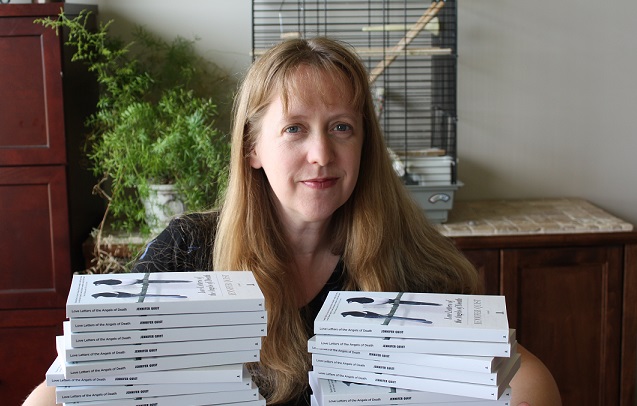
See, it's real.  Here I am with stacks of beautiful, traditionally published books I wrote myself

See, it’s real. Here I am with stacks of beautiful, traditionally published books I wrote myself

This morning when I woke up, my publisher was messaging to congratulate me on the release of my debut novel and my five-year-old son was throwing up in the hallway.  Way to keep it real, Sweetie-Boy.

My good mood is holding up well anyway.  If you’d rather not come get a signed copy of Love Letters of the Angels of Death at my house, the book is available from the publisher, in online stores, and is making its way into fine bookstores (coming soon to my local, Sunworks in Red Deer, Alberta).

Woohoo!

Amazon.ca Jumps the Gun

Even though the official release date isn’t until Saturday — about 36 hours from now — a friend of mine has already received her copy of my book.  Couldn’t have happened to a cooler person!  Thanks for sending me this picture, Janine.

j9mail

First Review of My Book!

Montreal Review of Books looks at my novel in the Summer 2013 Issue

Montreal Review of Books looks at my novel in the Summer 2013 Issue

The summer issue of Montreal Review of Books is out today.  And I am thrilled to report it includes Elise Moser’s review of my soon-to-be-released novel.  It’s a feature review complete with quotations from emails Elise and I exchanged.  Read it here:

http://mtlreviewofbooks.ca/reviews/love-letters-angels-death/

Here’s the first paragraph:

“I think Babies “R” Us is one of the saddest places there is – everyone looking to buy something that will make a very traumatic and life changing experience into something more manageable.” Like her main characters, Jennifer Quist does not hesitate to express firmly held, intelligent opinions. That’s her talking about birth. You should hear what she has to say about death…


Lost in the Post: My Silly Ambivalence for Epistolary Novels

The first epistolary book I ever disliked.

At one point during the painful process of compressing my novel into a tiny synopsis to print on the back of the book, we ended up with a paragraph that described the book as a series of letters.  Letters — I guess the connection between the book’s back cover copy and the title, Love Letters of the Angels of Death, on its front should have been obvious, especially to me.  So it must have seemed pretty strange to everyone else involved when I objected to seeing “letters” mentioned in the synopsis.

I blame L.M. Montgomery for my aversion to the epistolary novel — a work of fiction imagined as a bundle of personal correspondence.  Yes, I said Lucy Maude Montgomery, the Canadian author of the Anne of Green Gables series – the woman I hold personally responsible every time I cringe at a fellow Canadian using “delicious” to describe something that cannot fit into a mouth.  She’s also prone to portraying fat people as bad and birch bark as important enough to interrupt everything with a lengthy description of it.  She might be onto something with the birch bark but she’s definitely wrong about the fat people.

Naturally, after our visit to Prince Edward Island when I was nine, my mum bought me the first book in the Anne series.  Maybe because we moved so much, we were often without many books to read and I was stuck with Anne.  Then came the rest of the series.  I enjoyed the books well enough that I started adding to the collection myself.  They were great resources for soaking up vocabulary and learning to discern the sublime in domestic life.

The worst of the Anne books is Anne of Windy Poplars.  It does nothing to advance the larger story arc.  It’s like a long detour.  And it’s the volume of the series written as a collection of letters.  I must have balked at the idea of the novel I’ve written getting filed in the same letter-book category.  The little girl reader still working somewhere inside my consciousness didn’t want our work to bear any similarities to the book we remember as one of the most boring reads of our adolescence.  Readers accumulate some strange, complicated baggage.

It’s true that my book’s title does contain the word “letters.”  But my book lacks the form and lexicon of letter writing – or even diary writing or any of the other gimmicks that flag a book as epistolary.  There is no “Dear,” no “To Whom it May Concern,” no “Yours Truly” with a signature at the end — not even a token date dashed beside the chapter headings.

The reason I put “letters” in the title is to orient readers to the book’s second person narrator.  Most of the writing we produce and read – all of our emails and texts – is written in the second person.  Poetry and song lyrics are typically written this way too.  A second person narrator speaks as “I” but he doesn’t just ramble to himself.  He’s talking to “you, you, you.”  With all our experience reading short pieces in the second person, it didn’t seem like much of a stretch to ask readers to follow this familiar point of view throughout a book-length piece.  An introduction to a second person narrator, along with an informal, intimate tone was all I wanted out of the epistolary form.

I was about to say Anne of Windy Poplars made such an enduring, negative impression on me because it was the first epistolary novel I ever read but then I remembered Judy Blume’s Are You There God? It’s Me, Margaret.  (This one counts as epistolary even though its second person messages are sent through prayers.)  I read this book during the same time period (ahem) as the offending Anne book but I’m fairly certain it didn’t bore me.

With more thought, I realized there were other fictitious diaries and letters I had forgotten on my bookcase.  There’s Bram Stoker’s Dracula, Anne Brontё’s The Tenant of Wildfell Hall, Douglas Coupland’s Hey Nostradamus!, my husband’s copy of C.S. Lewis’ The Screwtape Letters, and Christopher Priest’s The Prestige – a novel I’ve been meaning to return half-read to my brother-in-law for ages.

I enjoyed some of these books – but not all of them.  When I was enjoying them most, their letter-writing form slipped past my notice.  While I didn’t remember that Dracula was epistolary, I do remember getting up at night to quiet my baby while I was reading it and being idiotically afraid of running into undead Lucy in the hallway.  I felt many things for all of these books but I never felt confused or alienated by their narrative styles.  It works.

I’ve over-generalized my dislike for the epistolary form.  Rejecting it was silly – the result of a tenacious childhood prejudice.  I wrote an epistolary novel.  And that’s okay.  It’s not the kind of thing that should amount to a scrap with an editor — though I did feel a little lighter when I flipped my advance reading copy onto its back to read the synopsis and saw the word “letter” had disappeared.

Reconnaisance at Someone Else’s Book Launch

Here’s one more insultingly obvious pro-tip from a newbie novelist: the first book launch event you ever attend should not be your own.  For once, I didn’t wait to learn this bit of wisdom the hard way.  My novel’s release date is Aug 3, 2013 – just 86 days from now.  There isn’t much time left for me to get familiar with promotional literary events before the author in the fabulous arts-chick shoes standing behind the microphone winds up being me.

Fortunately, the closest publisher to me geographically – Edmonton’s NeWest Press – held a “spring spectacular” this week.  They collected three of their authors and one poet and brought them into the city for readings and signings of their newly released books.  It was a perfect opportunity for me to sneak into the literary scene and do some reconnaissance.

I started by plotting.  What I needed was a pair of wing-people.  I convinced these two.

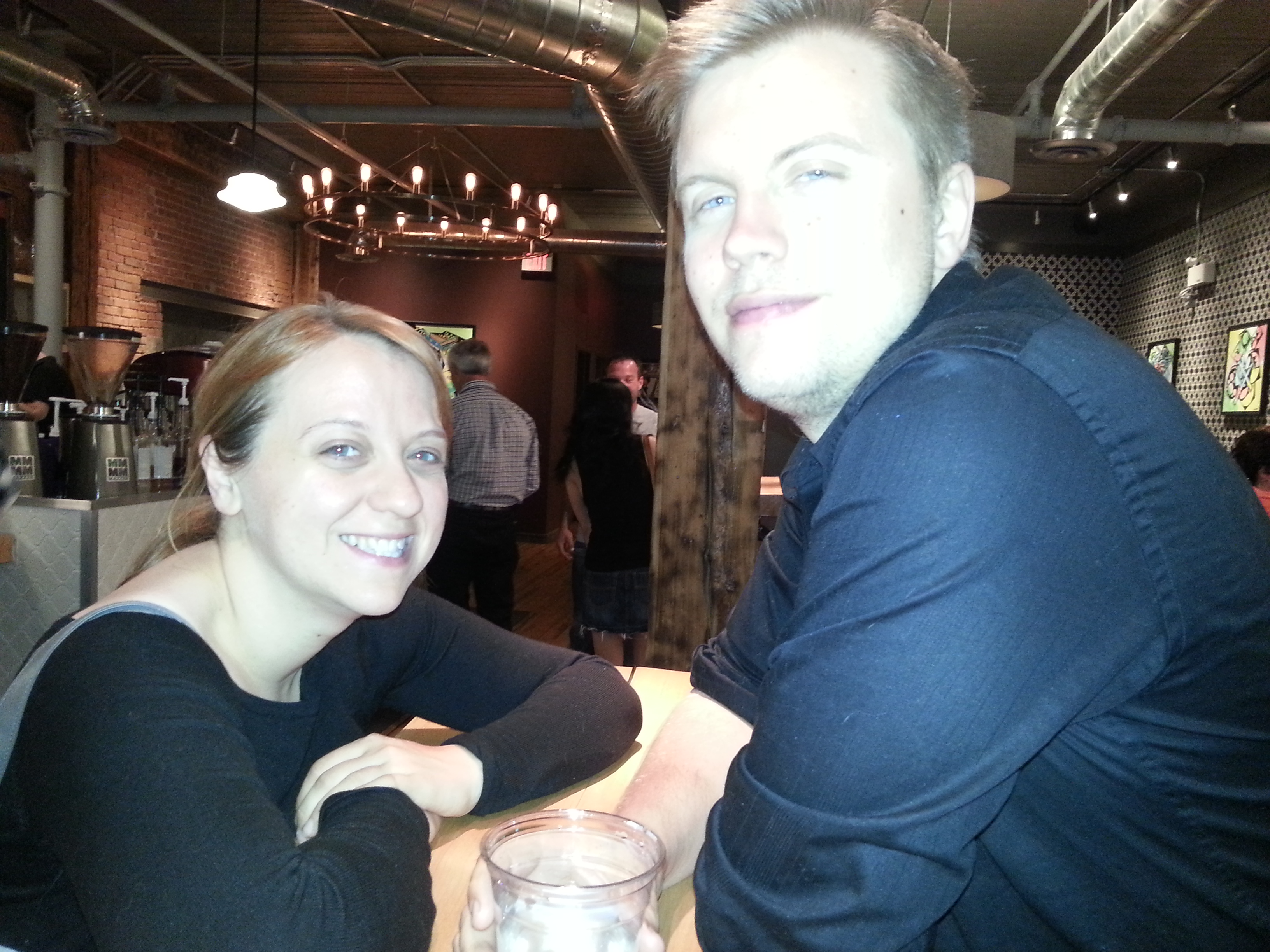
Emily MacKenzie and Allan Taylor -- you know, from the Hunt and Gather blog

Emily MacKenzie and Allan Taylor — you know, from the Hunt and Gather blog

This is my extremely helpful and supportive brother-in-law and my baby sister.

[You mean the nursing professor sister? No.  The millionaire business tycoon sister? No.  The ultra-marathon runner sister? No.  The Edmonton slow-food lady sister?  Yes, that’s the one.  I am gifted with lots of gifted sisters.]

NeWest was holding the launch in a downtown coffee house housed in a restored brick building.  By the time we arrived, it was humid-warm and crammed with people and hot beverages.  Its name – Roast – couldn’t have been more apt.

The only place left to sit was in a dim, empty corner.  This was exactly how I had pictured myself here – dark and peripheral.

As we waited for the readings to start, I kept accidentally making eye contact with a lady sitting along the wall perpendicular to me.  I’m awkward and silly so I kept making sure I politely turned away every time we looked at each other.  But if I’d checked my Twitter feed at that moment I would have found this:

@JennQuistAuthor hi, I’m sitting at the next table over #creepytweets

The message was from one of my Twitter/blogger buddies, Laura Frey.  She was the woman I kept looking at across the crowded room.  I’d never met her in person and I was too stupid to recognize her until later when I overheard her name.  This is fairly typical.  Sometimes we joke (because brain injuries are hilarious, I guess) that I have prosopagnosia – brain damage that makes it hard to recognize faces.  I probably don’t.  It’s the kind of disorder that usually only comes on in survivors of horrendous no-helmet motorcycle accidents.

The time came for us to stop whispering in our corner and start listening to the readings.  The first was poetry from Jenna Butler’s Seldom Seen Road.  Her work is set on the central Alberta prairie but it isn’t the usual  western Canadiana.  In the selections she read, there was a longing and loneliness that didn’t just arise from the physical struggle to subdue a harsh landscape while maintaining human relationships.  It rose instead from the decline of the communities that had originally been built on the land.  The first wave of prairie settlers is ebbing away as their posterity rejects their way of life.  And the second wave of settlers, like Butler and her family, is arriving without a script for how to connect themselves to the crumbling social and physical landscapes left behind.

I hadn’t heard of Butler before the launch but the second reader was someone I’d already been admiring on the Internet.  She’s Rebecca Campbell, author of The Paradise Engine.  I know it’s sexist and vapid to comment on a woman artist’s appearance but I have to mention how impressed I was by Campbell’s height.  There’s nothing I’ve seen on her website to reveal the fact she’s at least six feet tall once she puts on shoes (yes, I asked her).  Her book was the one I used my launch party budget to bring home.  The section she read – a gorgeous picture of a Cold War kid’s night frights over nuclear war – could have been a narration of my own childhood.  Campbell writes about crows and Apocalypses – things I love.

Marguerite Pigeon – yet another author I’ve stalked on the Internet – read from her central American thriller Open Pit.  It’s about a hostage taking and a fictitious open pit gold mine.  This was the book Emily brought home after Pigeon tantalized us with a crafty cliff-hanger ending.  Em and I are going to trade books once we’re finished reading – which, knowing me, will not happen soon.

The fourth reader was novelist Corrina Chong.  I’ve quoted her insightful ideas about the influence of authors’ realities in their fiction in an earlier post.  Any girlie-ness that might have been implied by her pinkish book cover is offset by pencil sketches of squid in all their tentacled loveliness.  The selections she read from her book, Belinda’s Rings, felt a lot like real family life to me – especially real life with a demanding little boy who needs his caregivers to be everything and nothing to him all at the same time.  She nailed it – nailed it right to my Goodreads to-read list.

Roast was roasting and my home was over 100km away so we didn’t stay very late into the night after the readings were finished.  I got to meet a few people but not as many as I wanted before my wing-people and I stepped out into the fresh-enough inner-city air.

On the sidewalk, with Emily and Allan, I indulged in lamenting my missteps.  When I groaned at myself for demanding to know how tall Rebecca Campbell is Emily said, “It’s okay.  I figure as long as you’re still talking, it’s all good.”

And for my first outing, maybe she’s right.  The mix-and-mingle concept is not a big part of my current skill set.  Maybe it never will be.  Under the high wooden beams of the old coffee house, maybe we were all just a bunch of bookish writer-types lurching out of our comfort zones, trying to recognize each other’s faces from tiny Twitter and blogger head-shots, forgiving each other for not being as smart and shiny in person as we are in print.

Crybaby Reads Her Book

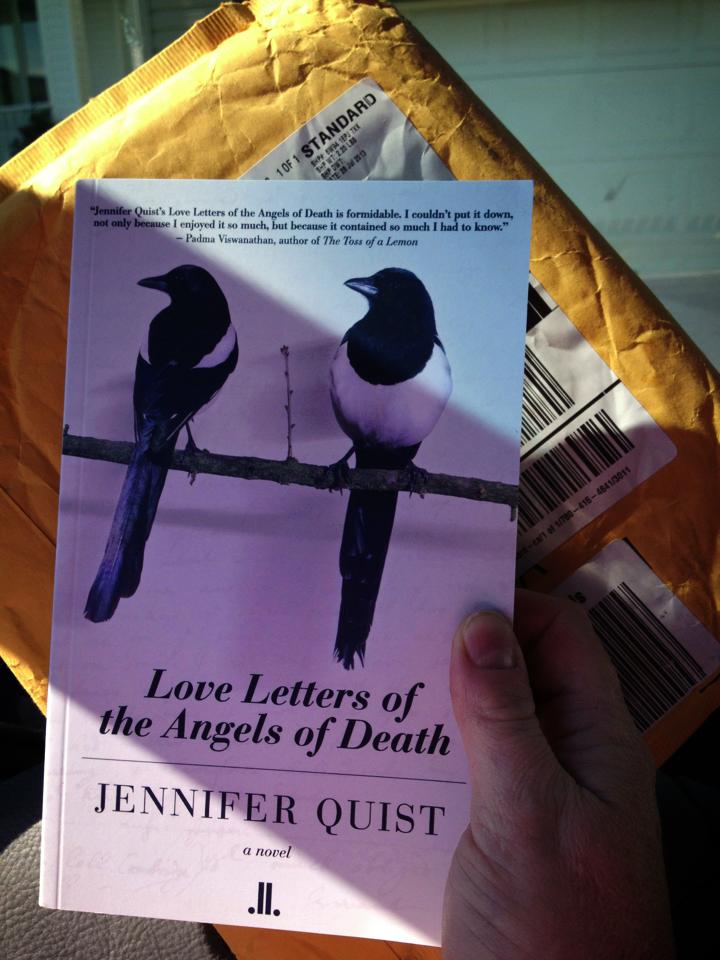
Me and my advance reading copy, taken from my good side.

Me and my advance reading copy, taken from my good side.

The sight of a thick, yellow envelope postmarked from Montreal usually means a happy day for me.  It’s mail from my publisher, Linda Leith.  The most recent envelope was closed around an advance reading copy of my unreleased novel,  Love Letters of the Angels of Death.  I was as happy to see it as I can get without crying.

The same week, my brand new writers’ group had its first meeting.  Each of the members was invited to bring “one or two pages” of work to read aloud.  The timing was perfect.  Here was a small, low stakes environment where I could make an early attempt at reading my novel in public.

It sounded easy.  As long as it’s all talk — no singing or yodeling involved — I’m comfortable with my own vocal performance skills.  I already had the chops I needed to do a reading from my novel.  All that was left for me to do was pick a short section out of the book, read through it once, jam the pretty new book into my purse, and show up at the meeting as if I do this kind of thing every day.

The first step — choosing a selection — was harder than I thought it would be.  I’m ginger with other people’s time so I wanted to be sure I read something I could end neatly when I reached the equivalent of the roughly two 8.5×11” sized pages I’d been invited to share.  It meant simply reading the first chapter of the book wasn’t an option.  I also wanted to avoid spoilers, which meant the last third of the book was off limits and I had to be careful about what I chose from the middle.

And then there was one more consideration.  I wanted to read something gripping.  But it also had to be something that would not make me cry.  If you know me, you know that’s asking a lot of myself.

I may have held it together the day I found the ARC of my book in the mail, but I can still call myself an easy crier.  It’s awful.  I hate it.  Everyone hates it (especially my teenaged sons).  I am such an easy crier that my own novel – a story I wrote myself – still makes me sniffle two years after I’ve finished writing it.  The last sentence in it is only two words long and it makes me choke into tears almost every time I look at it.

Don’t misunderstand.  I am not emotionally delicate.  I react with appropriate sorrow when something terrible happens but I’ve never struggled with enduring feelings of depression or anything crippling or frightening.  Alarming as it may be, I simply relieve tension best by crying.  And it’s not just negative tension.  It’s the positive too.  When a stranger stopped on the Alberta Autobahn and helped me change my flat tire last month, I was so touched by his kindness I could hardly speak to him.  I knew if I loosened up, I’d start crying.  Stupid crying – or even just the dread of ending up crying — it taints most of my best moments.

I guess I should be grateful my emotional depressurization system isn’t any more complicated than simply opening the valves of my tear ducts.  It’s a fine mechanism in private but in public it’s an embarrassing mess.

Back to the book: chapter nine was where I found what I was looking for.  I chose a main character’s quick flashback to a bad teenaged romance.  That was my selection – the very first part of my novel I would ever read aloud in public.  I’ve always thought the passage was strong.  It has everything except something to cry about.

Still, when the time came to read it to a room full of friendly, un-threatening writers, I felt shaky and unnecessarily emotional anyway.  And when I was finished, I was a little mad at myself for being too high strung to read it exactly the way I had wanted to.  I’m experienced in speaking about many things.  But my novel isn’t one of them – not yet.  I’m still cagey and protective when it comes to my book and the secret well inside me that it sprang from in the beginning.

Here is yet another aspect of this career as a novelist that I hadn’t anticipated.  Once again, writing the book wasn’t enough.  I guess I need to become slick, smooth, and professional at reading my novel out loud.  Even though its opening chapter is a little long and a lot emotional, I need be able to chew up it until I can recite it with a fluent, steady voice.  I need to hone my reading until those two tight passages where it’s easy for me to get overwhelmed don’t squeeze me anymore.  I will transform myself into a flesh and blood book-on-tape.  There – I’ve decided.

“No,” one of the nice Nancies (there are two of them) from the writing group gently protested, “the fact that your book means so much to you made it mean more to me.”

And with that, I’m weeping all the way back to where I started.  Dang it, Nancy.