Regional Bestseller!

Edmonton Journal’s Bestseller List, Nov. 15, 2013

Our book was number 5 on the Edmonton Journal newspaper’s list of best-selling fiction yesterday. It was fifth after the Giller Prize winner, two collections by the Nobel Prize winner, and a Giller Prize nominee. I am very please and extremely grateful to everyone who has ever picked up a copy of Love Letters of the Angels of Death. Enjoy!

Reading In Toronto, Traveling Some Unexpected Full Circles

The first time I was in the Pearson Airport in Toronto this year, 4000 km from home, I was on a stop-over on a cross-country flight with all my immediate family members.  There were seven of us but, suddenly, only six boarding passes.  It made for some exciting air-travel fun.

The second time I was in Pearson Airport this year, I was by myself.  It was a bit too quiet but at least my passenger to boarding pass ratio was a solid one to one.  This time, I was stopping in Toronto, staying for a book event at the venue my publisher calls “the bookstore of our dreams.”  Maybe it’s a good thing I didn’t bring along anyone to pinch me.

The view – When I sent the pic to my husband he thought it was of the inside of an empty vending machine.

I booked a room downtown, not realizing until I saw it jutting out of the skyline, that I’d be staying two blocks from the CN Tower.  In the hotel lobby, I wondered if I’d be able to see the tower from my tenth floor window.  Not so much…

The book event – which was for all five of the 2013 authors of Linda Leith Publishing — was on Bay Street at Ben McNally Books.  In every city, long-established, well-known stores are sometimes called landmarks but Ben McNally Books really is picturesque – pillars, carved woodwork, chandeliers, and books, even my book.

In the shop were people I’d been working with for the past year whom I had yet to meet in real life.  What puts the “Linda Leith” in Linda Leith Publishing is a real person: a lovely, bold, accomplished writer, teacher, editor, and publisher.  She’s a fellow mother of boys, the eldest daughter of a large family, a survivor/beneficiary of her parents’ many relocations during her years at home.  It’s no wonder she was the publisher to look at my work and “get it.”

The ceiling in Ben McNally Books on Bay Street

The ceiling in Ben McNally Books on Bay Street

Here’s something I know about myself.  I love doing readings.  I love audiences and microphones and voice-acting my way through my story for people to hear.  The storytelling part of a book event is always my favourite part.

Meeting the other LLP authors was another pleasure.  I already knew they were formidable people.  They’ve written multiple books, worked in publishing and academia, lived and studied abroad, eschewed car ownership.  They’re multi-lingual and speak with cool accents.  They don’t get lost traveling on foot in downtown Toronto.  And they are very kind to the dippy little sister figure in their midst.

The consensus at the casual dinner after the event was that I should spend the time the next day, before my return flight, visiting the Royal Ontario Museum.  It was a long walk to get there – one that kept getting interrupted by women about my size asking for directions I couldn’t give.  In a big city, little girls gotta stick together.

Even after the rave reviews, the museum far exceeded my expectations.  It was vast and fascinating.

And up on the third floor, in a dim room with stone mortared to the walls, was a mummy taken from Egypt.  There he was, as the narrator of my novel would say, “caught in a bad funeral that threatened to go on until the end of the world.”  Dry and brown and desecrated with his face, neck, and toes exposed from the bandages — dead people, there’s no one more helpless.  Take that zombie garbage and grind it into compassion.

Canopic Jars at the Royal Ontario Museum

Canopic Jars at the Royal Ontario Museum

The book I wrote – it’s small and it’s only paper, but it’s a museum for the dead too, complete with all the ambivalence pent up in the display cases.

“I’m sorry,” I told the dead man from my side of the glass tomb.

Sorry but standing there anyway, seeing, knowing I would go away and tell.  This mummy and I – we were in my book together, part of the original art that brought me here, and made me this.

The circle closed.  It was time to go home.

Bon-Bons and Soap Operas and Other Stories

Stop asking me what I do all day.

I’ve been wanting to say that since 1996 when my sister arrived at my apartment during one of the fifteen-minute intervals when my ravenous newborn baby was asleep and found me standing in my living-room flipping through a board book about farm animals.  My reply to “what do you do all day” used to sound noble – the kind of thing that gets championed on Facebook by mothers in need of recognition and respect and, heck, some social justice.  When I was raising my little boys I would have been justified in replying with something like, “I spend all day making human beings from my own guts and mettle, you ignorant boors.”

Oedie, the blue lineolated parakeet. She’s nuts.

1996 was a long time ago.  It’s been ages since that original farm animal board book fell into the toilet and passed out of our lives.  But questions about what I do with my daylight hours remain.  In fact, I’m getting questioned about them more than ever.  My youngest son started full-day school last month.  From 8:25am to 3:40pm, no one has any business being in my house except me and my deranged parakeet.  When my last son left the building, so did my best “excuse” for being at home full-time.

Sometimes I admit my life is now all soap operas and bon-bons, all day long.

But when I’m not feeling sarcastic, I’ll go on and on about how when I’m not doing all the cleaning, errands, shopping, and emergency interventions my family of seven still needs during the day whether any of them are inside the house or not, I’m at home working on my writing career.

These days, enough people work from home that we should all understand it’s not a sham for lazy folks.  Working from home may not be slick and pretty but it’s real.  And it’s an especially common practice for people working as writers.  Still, claiming I’m working as a writer just triggers more questions.

“Working?  But you already wrote your book, didn’t you?  What’s left to do?  What do you actually do all day?”

As far as occupations go, writing is pretty flaky.  I get that.  There’s no tool belt, no lunch kit.  And sometimes working as a writer means looking out the window, driving around crying, or using all the hot water zoning out in the shower.  Yeah, it’s pretty flaky some days.  But in between all those black-box creative cognitive processes there is real work to do.  We write at our big projects but we also write smaller pieces, read and review other people’s books, scour listings for new places to send our work, and manage systems for tracking what’s been submitted to where and how long we should wait before we give up on getting a reply.

For new writers, publicity is vital to success.  It doesn’t come naturally for most of us and it takes a lot of time and energy.  In addition to doing spoken and written interviews (if we’re lucky), we maintain social media presences on three or four different platforms and most of us write blogs.  Sure, some people do this stuff for fun.  I happen to thinking mowing lawns is fun.  But that doesn’t mean people who get paid to mow lawns aren’t really working.

In many ways, writers bring the perception that our jobs are jokes upon ourselves by talking about our work in terms of a lot of goofy, mystical claptrap.  It might help us feel gifted and precious in our own minds but if we’re going to indulge in silly, fanciful claims that make our skills sound like dubious super-powers, other people aren’t going to relate to our work the same way they relate to their own jobs.  People don’t really believe in super-powers – and frankly, neither do writers.  So let’s stop it.

If we catch ourselves beginning sentences with “Only a writer would…” or “You know you’re a writer if…” we ought to know we’re being pretentious and throwing away our professional credibility.  We’re begging people to ask us what we do all day.  I know it may be fun to think we’re doing the opposite – getting people to take writing seriously by astounding them with the “specialness” of it.  But it doesn’t work.  Stop it.  Let’s get off the “Memes for Writers” Pinterest boards and Tumblr blogs and grind our way through some word processor software instead.  That’s what writers do all day.

Kleines Mӓdchen: Little Girls on a Book Tour

Reading on the Road

Reading on the Road

I never meant to cram a month’s worth of book promotion into seven days.  It just happened — an unforeseen consequence of good luck, good will, and good publicists.  I was so busy last week my kids actually noticed and mentioned how little time I’d been spending in my pumpkin shell.

I told them, “Look, I took a seventeen year mat-leave.  You’ve got nothing to complain about.”

Sure, it was a maternity leave full of freelance work and “will-you-just-let-me-finish-this” but I was here, in the house with them, for almost all of it.

The week started early Monday (because, that’s when it always starts) when I went into my closet — the room in the house most like a radio booth — and did a telephone interview with a talk-radio station in Edmonton.  It was a “top-line” interview meant to promote an appearance I’d be making in the city the next day.  It went well until the very last question.

“So,” Mr. Radio asked, “who’s taking care of the kids while you’re [in Edmonton]?”

Instead of musing, “You know, when my husband gets interviewed by the media, on the courthouse steps, no one ever asks him who’s looking after his kids,” I laughed it off.

“That’s their problem,” I told the interviewer.  “The oldest is seventeen so it’s Lord of the Flies over here when I’m gone.”

So far, no visit from Child and Family Services.

By bedtime that evening, I was gone.  I was at my sister’s house in Edmonton, getting ready for another “top-line” interview on the most terrifying of all media: television.  I haven’t watched television for years and I was scheduled to appear on a morning news show I’d never seen before.  What I remembered from TV was mostly how it’s been used to make “real” people look foolish and grasping.

In the morning, I got dressed while it was still dark — high black boots, skinny black pants, white top, black jacket.  Looking in my sister’s mirror, I finally saw it: I had subconsciously dressed myself to look like the black and white magpies on the cover of my book.

After a breakfast of Diet Coke with the coolest girl in Yellowbird Elementary School, I was on the freeway.  I got to the studio early enough to meet the other author being interviewed that morning.  In the green room was a man my age wearing a raspberry-coloured suit with a peach handkerchief tucked into the breast-pocket.  This was self-proclaimed over-dresser and Edmonton literary institution, Todd Babiak.  I thought I might run into him here.

“Don’t get nervous and start making fun of him,” one of my little sisters had warned me.  “That’s what I’d do.”

This was good advice.  It turns out Babiak isn’t a TV watcher either and we sat in the green room puzzling at the monitor on the wall as the program wound its way toward our segments.  He nodded at the anchor-lady on the screen.  “She’s actually read my book,” he said because, in a top-line interview, this is remarkable.

Left alone in the green room, I watched Babiak’s interview.  Of course, his raspberry suit had to be acknowledged on-air, just like my five kids at home had to be acknowledged on the radio on Monday morning.  The boys — they’re my raspberry suit.

Walking the hallway to the studio, I asked the producer with the pixie-cut hairdo, “There aren’t going to be any questions about who’s taking care of my kids, are there?”

She smirked.  “Any what?”

I told her about the radio station and we all scoffed together.  The anchorman who interviewed me was sweet in a clean-cut-captain-of-the-football-team kind of way.

I spent the rest of the day in the city, visiting family, calming the frick down before I went to a reading in a bookstore downtown.  The guests at this reading included some old friends I hadn’t seen in this century.  One of them reintroduced herself in case I’d forgotten her — which I certainly had not.  A wonderful thing about a book tour is the way it’s also a time machine.

After two days of massaging social media, the time came for another reading.  This one was closer to home, in the city my husband commutes to for work.  The Red Deer venue was warm and cozy and the time machine coughed out a long lost aunt and cousin.  There was a question from a woman — a fellow artist — who earnestly and innocently wanted to know how I “do it” with so many kids in my life.

I shrugged, “By being a crap mother, I guess.”  This might be my new pat-answer.  Put it right in the press kit.

fmroad

Get your kicks on Route 63

The last event of the week was the most ambitious one of all.  The person stepping out of the time machine this time would be me.  The  machine took the form of my black pickup truck — the kind they issue everyone crossing into Alberta’s borders.  I picked up my sister (the third sister in this story) and we went north, to Fort McMurray.

I’m no carpet-bagger, no oilsand opportunist.  For five years during the early 2000s, the city was my hometown.  I bought my first house, repaid my student loan, met bears, planted trees, and had two magnificent babies in the city.  An entire chapter of my novel is set in the Wood Buffalo region.  To get there, we drove for five hours — me boring the heck out of my sister with all my “Wow, this is so different.”  I alternated between, “I can’t believe all this is here” and “I can’t believe all that is gone.”  No matter what the Old Man says, the region is not Hiroshima.  It’s not a wasteland.  But it’s not like it used to be either.

In seven years, the city’s service industry hasn’t changed.  We arrived at 2:45 pm but we couldn’t get into our hotel room to change our clothes.  It was still a mess.  I’d be appearing in public looking like I’d spent the day in a pickup truck.  We hadn’t had a meal all day and we went to a fast food restaurant with milk and grease smeared all over the sky-blue tabletops.  This was familiar too.  The restaurant couldn’t hire enough staff to have anyone to clear the tables.  Customers go there knowing they’ll have to do it themselves.

At the event — a launch party for the latest edition of NorthWord: A Literary Journal of Canada’s North  I was invited to read first.  I chose the chapter set in the neighbourhood where I now stood reading.  And when I got to the part about the trees along the highway — the ones that now exist only in my imagination — I choked into the microphone.  Maybe it’d sound noble and Neil Young would pat me on the head if I tried to say I was having a fit of environmental conscience.  It wasn’t that.  It wasn’t the trees.  It was me.  There was some kind of awful longing rising in my throat with the words I read.  The whole time machine idea — it’s wrong.  This place that I love had moved on without me.  I was abandoned.  And I hadn’t even known it.

Part of the NorthWord event was in impromptu poetry contest.  The theme was contrast.  I jotted some lines and signed my sister’s name to them.  The poem was about the dirty tabletop at the restaurant.  It was silly and pretentious right down to the lines I wrote in German.  The judges got the joke and it won a prize in the contest.  But my sister was too embarrassed to let them announce it.  Fair enough.

Sister-Sleepover

Sister-Sleepover

When we were finally let into the hotel, we put on pajamas, got into one of the beds, put our heads together, and watched YouTube on my sister’s tablet — a sisters’ sleepover, just like old times, only not at all like old times.  Neither of us had wi-fi or a credit card or an ex-husband or a book to tour when we were little girls.

Still, those German words — the refrain from our winning poem — they were these:

Kleines Mӓdchen.
Return of an Edmonton Cleaning-Lady as an Audreys Author

The best thing about being from nowhwere is being from everywhere.

I lived in thirteen different houses by the time I moved away from my happy, nomadic family at age eighteen (only to have them move right along after me a few months later).  That counts as growing up everywhere doesn’t it?

When I made my first solo move, the place I went was Edmonton, Alberta.  Don’t know Edmonton?  It’s a metropolitan area of about a million people at 54 degrees latitude.  If anyone’s thinking, “That must be a pretty great city for people to put up with living that far north,” they’re right.   I went there to get an education at the University of Alberta.  I met my husband on Whyte Avenue, earned my degree, published my first guest column in the Edmonton Journal, and my two eldest children were born in Edmonton.  I was there for eight years — longer than I’ve lived in any city.  My Edmonton days were happy but not glamorous.  Most of the time, I lived in Strathcona walk-up apartments like this:

The Apollo Apartments, just off Whyte Avenue

The Apollo Apartments, just off Whyte Avenue

Even this place was only affordable because I worked as the resident manager and cleaning-lady. I don’t live inside the city limits anymore but if the weather is good, I can get to them in under an hour.  Edmonton is still one of my many hometowns — part of the everywhere I’m from.  In fact, several of the chapters of the book I wrote are set in city — University of Alberta campus, the High Level Bridge, Cloverbar Waster Transfer Station — all Edmonton.

This coming Tuesday night, I’m bringing my book home to Edmonton.

A few weeks ago, my novel was nicely reviewed by Edmonton Journal book columnist (and fellow newly debuted local author) Michael Hingston.  He called it, “A surprising, thoughtful and captivating debut that uses death to illuminate all that’s at stake in life itself.”

The good local review sets the stage for my author reading hosted by Edmonton’s indie bookstore mainstay, Audreys Books. (No, there isn’t supposed to be an apostrophe in the name.  It refers to more than one Audrey and is grammatically above reproach.)  Audreys is a place little girls slogging away at their Arts degrees, and young-mother-cleaning-ladies writing indignant guest columns keep in their minds as the setting for scenes from the futures they want for themselves.  The store is a landing-pad for Edmonton writers in traditional, book-length publishing.  I am beyond happy to be appearing there.

And since my publicist, Sarah, is a total animal, I’m getting right up in Edmonton’s face about my homecoming.  I’m doing a radio interview with talk radio station 630 CHED on Monday, Sept 23, at around 7:20am.  The morning of the reading itself, Tuesday Sept 24, I’ll be interviewed outside the safe, blind box of radio on television with the CTV Edmonton Morning show.  I’ll be on for just a few minutes at around 8:40am.  So crazy!  And if I botch it, remember that we must never speak of this again.

One Party With Everything On It: Launching My Novel

A few of the lovely guests at our book launch

A few of the lovely guests at our book launch

It had family, friends, librarians, my childhood bestie, a surprise appearance, great food, fresh flowers, surly teenagers, pretty babies, a local literary mainstay, and a book.  Our book launch party had everything.

Signing Books

Defacing Books with My Scrawl

Last night, in my current hometown of Lacombe, we did indeed launch my first novel, Love Letters of the Angels of Death.  Fran Kimmel introduced me, I read the first two sections of the book’s first chapter, and the rest was just love.  I imagine it was kind of like being at my own funeral – which, if you know me or my book, is wonderful.

My thanks to everyone.

It’s Not You, It’s Me – The Post-Fiction Movement and My Novel

A gravestone of a real great-great aunt at the real Butcher Hill Cemetery

A gravestone of a real great-great aunt at the real Butcher Hill Cemetery

There were cupcakes, pink tissue paper flowers bigger than my head, cupcakes, a sunny backyard full of people I love, and cupcakes. It was a family party – a birthday bash for one of my nieces.

Eventually, the conversation turned to the book I wrote that had been published exactly one week earlier.  My sister-in-law, who hadn’t read a word of the novel yet, was not quite kidding when she asked me, “So, which character am I?”

I could answer with confidence.  “None of them.  None of the characters in the book is anyone here.”  I glanced around the yard to make sure it was true.  It was.  None of the real people at this particular gathering cast any shadow on my fiction (except, I recall on rereading this, a few of my little sons).

“Doesn’t matter.  When I’m reading it I’ll think one of them’s me anyway,” my sister-in-law warned, because she’s funny and she’s self-aware enough to know how hard it is not to see ourselves in everything.

The conversation jostled my latent social science senses awake.  What would I find if I did a good old “content analysis” of my novel, chapter by chapter, looking for traces of real life?

Here’s what I found.  The chapters of my book roughly fell into three categories of reality/unreality:

  1. Chapters almost completely ripped from real life:   7 out of 23

This proportion is smaller than I feared.  These are the chapters where a few identifying features are changed, the sequence of events is streamlined, but most of the action and reaction unfold almost exactly like events from my personal and family histories.

2.  Chapters I Made Up Almost Completely — Almost:  6 out of 23

Hey, there’s real fiction in here!  What a relief!  I was gratified when my mum’s BFF wanted to know who in our real lives a certain character from the book was and I could answer with a resounding, “He’s no one!  I made him up!”

3.  Chapters Made from Conglomerations of Fictional and Real Elements: 10 out of 23

Not surprisingly, this mixed category is the largest one.  What’s odd about these chapters is that it’s the reality in them that strains the hardest against plausibility.  If a reader ever looks up from the book and says, “Nah, I can’t buy that” he’s probably rejecting something I lifted from real life and then toned down with fiction to make it less jarring.  An old lady who sleeps on a saw bench?  No way.  A cemetery called Butcher Hill?  That’s too much.  An exhumation? Get right out, that never really happens.  It does.  It did.  As they say, I can’t make this stuff up.  Maybe I don’t have the guts.

Since before I was born, it’s been a Beatles cliché that it’s hard for artists to come up with anything new.  The world is old and full of people and stories.  Part of the art-imitates-life problem is genuinely accidental, especially for people from large families like mine. The more people a writer knows with the intimacy of family, the more difficult it is for her to avoid treading on real life situations in her work.

For instance, I have an unpublished novel currently circulating with my agent about a group of five sisters.  Not coincidentally, I am one of five sisters.  When it came to writing sisterhood, a group of five was the size that made the most sense to me.  I make no apologies for that.  However, I started to squirm when I saw that, in order to advance the plot, I needed one of the sisters to have a professional medical background.  Fine.  But in my real sister-group, one of us works as a nursing instructor.  Medicine is full of women and this alone could be dismissed as chance.  But then the story needed one of the sisters to have a husband who’s adopted.  One of my brothers-in-law fits this description.  Another sister in the novel needed access to the justice system.  That’s me.  And the plot was going nowhere without a sister with lots of money – enter another fact from one of my sisters’ lives.  I finished the novel, looked at all the parallels, and wondered what really happened.  Did the plot arise first and demand all these real life details or did real life tumble around in my imagination until it formed into the plot?  And was the same kind of thing happening in my published novel?

There’s a literary movement hatching out of this chicken-and-egg fiction conundrum.  It questions whether recounting real life is actually a problem.  It’s been called “post-fiction” and refers to writing that obscures boundaries between fiction and fact.  As critic Michael H. Miller of New York Observer explains,

This writing represents a chiasmus between the real and the made-up, blurring the two into nonrecognition, confronting the reader with all those issues one is trained by the Western academy not to look for: namely, the author herself, hiding behind the words.

Recently, there’s been a spell of writers – like Sheila Heti and Tao Lin – producing novels with real people from their lives cast as characters.  Those real people include themselves.  Sometimes, not even the names are changed.  These narratives have been called tedious by some critics.  They state the obvious, deal in the mundane, they can be repetitive.  Some readers dislike them.  Some think they’re brilliant.

Whatever they are, they make me feel a little more confident in my own post-fiction inclinations.  I’m so comfortable with it I’ve made this digital “scrapbook” where I collect images, quotations, and music that inspired or emulate my book.  In true post-fiction style, I borrowed the idea from fellow writer, Rebecca Campbell.  You can see it here:

http://lovelettersoftheangelsofdeath.tumblr.com/

Readers might be getting used to seeing the author standing in front of the lens, in the foreground.  Maybe I’m cheating them if they don’t see me.  And I’m hard not to recognize.  Like me, the main female character in my novel is a mother of a group of sons, raising them under the influence of her solid marriage and her rather jaunty death fixation.  She goes where I’ve gone and seen much of what I’ve seen.  We have matching root canals in one of our teeth.  We both said the same thing to our husbands when we saw they’d cut their throats shaving the morning before we married them.  But even after all this, she is not really me.  The very act of creating her made her different from me.  She’s a story I tell.

And in the same way, regardless of any likenesses, I promise, none of the characters in my book is you.

Woke Up This Morning a Published Novelist

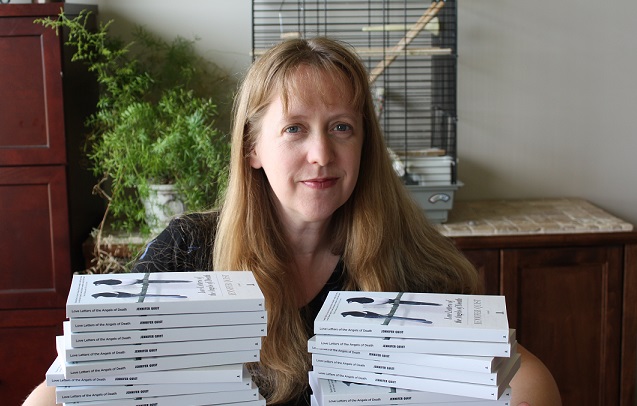
See, it's real.  Here I am with stacks of beautiful, traditionally published books I wrote myself

See, it’s real. Here I am with stacks of beautiful, traditionally published books I wrote myself

This morning when I woke up, my publisher was messaging to congratulate me on the release of my debut novel and my five-year-old son was throwing up in the hallway.  Way to keep it real, Sweetie-Boy.

My good mood is holding up well anyway.  If you’d rather not come get a signed copy of Love Letters of the Angels of Death at my house, the book is available from the publisher, in online stores, and is making its way into fine bookstores (coming soon to my local, Sunworks in Red Deer, Alberta).

Woohoo!

Amazon.ca Jumps the Gun

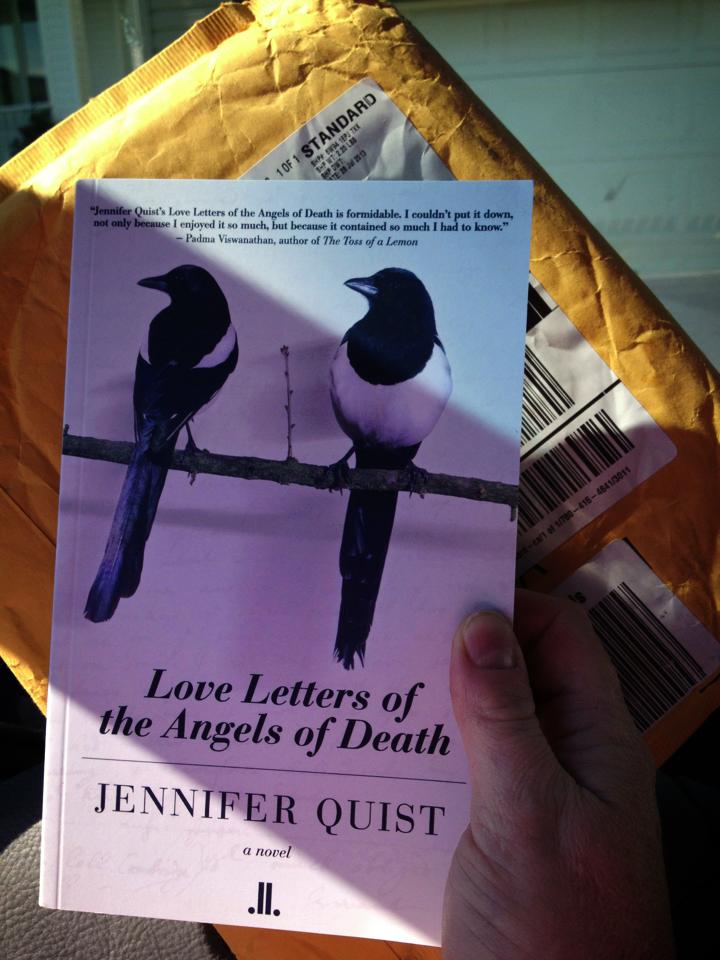
Even though the official release date isn’t until Saturday — about 36 hours from now — a friend of mine has already received her copy of my book.  Couldn’t have happened to a cooler person!  Thanks for sending me this picture, Janine.

j9mail