Reeling with Reviews

I assumed the new Facebook message was going to be another invitation to an in-house-selling-stuff-party from one of my girlfriends (events for which I have a lot more sympathy ever since I started hawking books out of the back of my car).

It was actually a message from — you guessed it — my high school boyfriend’s dad, a man I have not seen in over twenty years.  Even so, he had sought out and read my novel.  And he liked it — said he wished the book was longer.  He’s not a professional literary critic but he is someone I admired so much as a teenager I always made myself into an idiot in front of him.  His review of my book — short, private, informal, encouraging – meant as much to me as a printed page in a prestigious publication.

That’s real-me talking.  Pro-writer-me can’t be so sentimental.  Amassing reviews in established, well-known publications is serious business.  It’s no place for getting mushy and indulging in adolescent vindication.  For some of us, book reviews — those columns bundled in newspapers and obscure literary journals, those afternoon public radio programs I listen to while folding laundry — are not idle entertainment.

I treasure all the professional reviews I’ve got.  It’s a huge honor to see half a page of a national newspaper devoted to discussing a story I made up.  In return, I’ve started writing long-form book reviews myself.  The first will appear this winter in a new Canadian literary journal called The Rusty Toque.  Writing a review is time consuming and intellectually demanding.  But I owe it to my community to do it anyway.

Book reviews are also controversial.  Some of the nastiest squabbling in the writing world today revolves around the state and fate of book reviews and literary criticism.  Authors of commercial fiction complain about reviewers being snobs fixated on “serious” literary work and ignoring popular books.  Reviewers who write for established, bookish publications have been known to sneer at other reviewers who start book-blogs and write about whatever they want.  Even more casual than book bloggers are blurb-length reviewers on websites like Amazon and Goodreads.  Some authors denounce these hobbyist reviewers who sometimes off-handedly and ignorantly judge their work — and their private lives.  At the same time, the hobbyists complain about website policies they feel are muzzling them.  In the world of book reviews, everyone’s threatened, no one’s completely happy.

Reviews for self-published books are an even murkier morass.  Most publications still won’t review self-published books.  Among whatever high quality work might be out there in self-publishing, there are literally millions of sub-standard products glutting the system.  Being shut out of the traditional review pool leaves self-publishers to create their own systems for evaluating each other’s work – systems vulnerable to abuse where real reviews can be hard to distinguish from ones that have been bought or swapped for reciprocal but meaninglessly gushy reviews.

All of this might be very important but I’m still newbie enough to just be thrilled anyone is reading and talking about my work.  I’m grateful for any airtime or column space or bandwidth I can get.

And that includes coverage by book bloggers.  I’m not moved by arguments from those who worry bloggers are cheapening and proletarianizing literary criticism.  I think there’s definitely room for plain-spoken, personal reflections on books and reading.  In my experience, there’s some very good writing in book blogs, like Daniel at The Indiscriminate Critic who described the narrative style in my book as “a mental Mobius strip.”  This is exactly what I hoped to achieve even though I didn’t see it that way until he said it.  Authors who’ll agree to interviews are being asked thoughtful questions on book blogs too.  Laura at Reading in Bed came up with a list of questions that excavated the roots of the themes I write about just as well as any professional has done to date.

Book bloggers can read earnestly and critically.  They take their work seriously.  And they can write from a personal angle that more formal reviews can’t approach.  They’re doing for literary criticism what book clubs are doing for publishing – keeping it relevant and accessible to people not professionally invested in the industry.  That’s a great service to all of us.

Kleines Mӓdchen: Little Girls on a Book Tour

Reading on the Road

Reading on the Road

I never meant to cram a month’s worth of book promotion into seven days.  It just happened — an unforeseen consequence of good luck, good will, and good publicists.  I was so busy last week my kids actually noticed and mentioned how little time I’d been spending in my pumpkin shell.

I told them, “Look, I took a seventeen year mat-leave.  You’ve got nothing to complain about.”

Sure, it was a maternity leave full of freelance work and “will-you-just-let-me-finish-this” but I was here, in the house with them, for almost all of it.

The week started early Monday (because, that’s when it always starts) when I went into my closet — the room in the house most like a radio booth — and did a telephone interview with a talk-radio station in Edmonton.  It was a “top-line” interview meant to promote an appearance I’d be making in the city the next day.  It went well until the very last question.

“So,” Mr. Radio asked, “who’s taking care of the kids while you’re [in Edmonton]?”

Instead of musing, “You know, when my husband gets interviewed by the media, on the courthouse steps, no one ever asks him who’s looking after his kids,” I laughed it off.

“That’s their problem,” I told the interviewer.  “The oldest is seventeen so it’s Lord of the Flies over here when I’m gone.”

So far, no visit from Child and Family Services.

By bedtime that evening, I was gone.  I was at my sister’s house in Edmonton, getting ready for another “top-line” interview on the most terrifying of all media: television.  I haven’t watched television for years and I was scheduled to appear on a morning news show I’d never seen before.  What I remembered from TV was mostly how it’s been used to make “real” people look foolish and grasping.

In the morning, I got dressed while it was still dark — high black boots, skinny black pants, white top, black jacket.  Looking in my sister’s mirror, I finally saw it: I had subconsciously dressed myself to look like the black and white magpies on the cover of my book.

After a breakfast of Diet Coke with the coolest girl in Yellowbird Elementary School, I was on the freeway.  I got to the studio early enough to meet the other author being interviewed that morning.  In the green room was a man my age wearing a raspberry-coloured suit with a peach handkerchief tucked into the breast-pocket.  This was self-proclaimed over-dresser and Edmonton literary institution, Todd Babiak.  I thought I might run into him here.

“Don’t get nervous and start making fun of him,” one of my little sisters had warned me.  “That’s what I’d do.”

This was good advice.  It turns out Babiak isn’t a TV watcher either and we sat in the green room puzzling at the monitor on the wall as the program wound its way toward our segments.  He nodded at the anchor-lady on the screen.  “She’s actually read my book,” he said because, in a top-line interview, this is remarkable.

Left alone in the green room, I watched Babiak’s interview.  Of course, his raspberry suit had to be acknowledged on-air, just like my five kids at home had to be acknowledged on the radio on Monday morning.  The boys — they’re my raspberry suit.

Walking the hallway to the studio, I asked the producer with the pixie-cut hairdo, “There aren’t going to be any questions about who’s taking care of my kids, are there?”

She smirked.  “Any what?”

I told her about the radio station and we all scoffed together.  The anchorman who interviewed me was sweet in a clean-cut-captain-of-the-football-team kind of way.

I spent the rest of the day in the city, visiting family, calming the frick down before I went to a reading in a bookstore downtown.  The guests at this reading included some old friends I hadn’t seen in this century.  One of them reintroduced herself in case I’d forgotten her — which I certainly had not.  A wonderful thing about a book tour is the way it’s also a time machine.

After two days of massaging social media, the time came for another reading.  This one was closer to home, in the city my husband commutes to for work.  The Red Deer venue was warm and cozy and the time machine coughed out a long lost aunt and cousin.  There was a question from a woman — a fellow artist — who earnestly and innocently wanted to know how I “do it” with so many kids in my life.

I shrugged, “By being a crap mother, I guess.”  This might be my new pat-answer.  Put it right in the press kit.

fmroad

Get your kicks on Route 63

The last event of the week was the most ambitious one of all.  The person stepping out of the time machine this time would be me.  The  machine took the form of my black pickup truck — the kind they issue everyone crossing into Alberta’s borders.  I picked up my sister (the third sister in this story) and we went north, to Fort McMurray.

I’m no carpet-bagger, no oilsand opportunist.  For five years during the early 2000s, the city was my hometown.  I bought my first house, repaid my student loan, met bears, planted trees, and had two magnificent babies in the city.  An entire chapter of my novel is set in the Wood Buffalo region.  To get there, we drove for five hours — me boring the heck out of my sister with all my “Wow, this is so different.”  I alternated between, “I can’t believe all this is here” and “I can’t believe all that is gone.”  No matter what the Old Man says, the region is not Hiroshima.  It’s not a wasteland.  But it’s not like it used to be either.

In seven years, the city’s service industry hasn’t changed.  We arrived at 2:45 pm but we couldn’t get into our hotel room to change our clothes.  It was still a mess.  I’d be appearing in public looking like I’d spent the day in a pickup truck.  We hadn’t had a meal all day and we went to a fast food restaurant with milk and grease smeared all over the sky-blue tabletops.  This was familiar too.  The restaurant couldn’t hire enough staff to have anyone to clear the tables.  Customers go there knowing they’ll have to do it themselves.

At the event — a launch party for the latest edition of NorthWord: A Literary Journal of Canada’s North  I was invited to read first.  I chose the chapter set in the neighbourhood where I now stood reading.  And when I got to the part about the trees along the highway — the ones that now exist only in my imagination — I choked into the microphone.  Maybe it’d sound noble and Neil Young would pat me on the head if I tried to say I was having a fit of environmental conscience.  It wasn’t that.  It wasn’t the trees.  It was me.  There was some kind of awful longing rising in my throat with the words I read.  The whole time machine idea — it’s wrong.  This place that I love had moved on without me.  I was abandoned.  And I hadn’t even known it.

Part of the NorthWord event was in impromptu poetry contest.  The theme was contrast.  I jotted some lines and signed my sister’s name to them.  The poem was about the dirty tabletop at the restaurant.  It was silly and pretentious right down to the lines I wrote in German.  The judges got the joke and it won a prize in the contest.  But my sister was too embarrassed to let them announce it.  Fair enough.

Sister-Sleepover

Sister-Sleepover

When we were finally let into the hotel, we put on pajamas, got into one of the beds, put our heads together, and watched YouTube on my sister’s tablet — a sisters’ sleepover, just like old times, only not at all like old times.  Neither of us had wi-fi or a credit card or an ex-husband or a book to tour when we were little girls.

Still, those German words — the refrain from our winning poem — they were these:

Kleines Mӓdchen.

Marriage Tips of the Angels of Death?

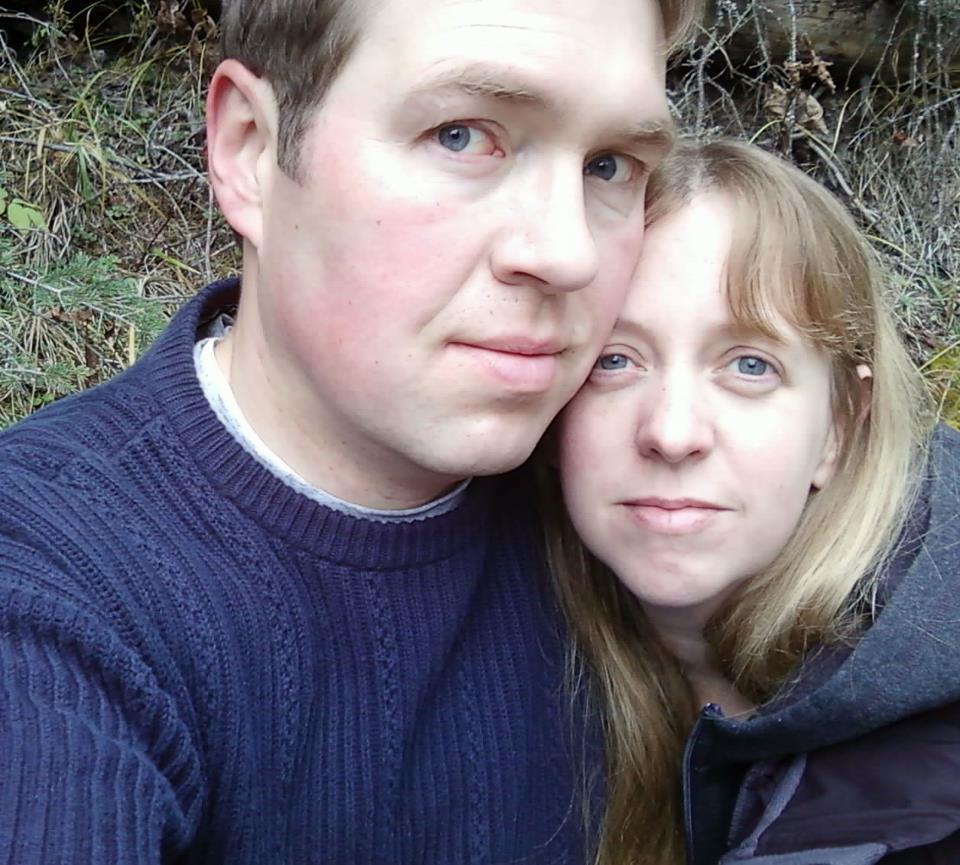
My Mr. and Me

My Mr. and Me

I wrote a novel about marriage.  It’s a novel, not a manual.  It’s meant to start conversations about love and relationships, not necessarily to resolve them.  Recently, I had one such conversation.  It was a discussion about whether the marriage I wrote is truly a happy one.  Would my main characters actually love each other if they had to live in the real world?

My position, of course, is that they would.  Most of my reviewers agree — but not all of them.

I’m not a marriage counselor.  When I’m writing, my job is not to lecture but to describe what I see in life and in my imagination.  That’s where the marriage I wrote came from – not from relationship theories but from inspiration found in things I’ve seen, heard, felt, and (as one reviewer pointed out) smelled.  And, since this is the Internet, I’ll write some of what I see in happy marriages in a list.  Maybe everyone’s list would be different.  But this list is mine – and ya won’t find anything on it about toothpaste caps or crapping with the bathroom door open.

Quick Disclaimer: I’m speaking of marriages where both partners are fairly healthy emotionally and socially.  I don’t mean situations of abuse or flagrant craziness where self-preservation demands a different list entirely.

What a Good Marriage Looks Like To Me:

1)      It’s Not Dating.  And thank goodness.  During his dating days, I had a miserable conversation with one of my brothers.  He didn’t want to live alone but at the same time he was worried marriage meant being trapped in a never-ending date – having to keep up a stream of witty conversation, fussing over the etiquette of opening car doors or not, orchestrating lavish events – all those company manners stretching on and on until someone in the couple mercifully dies and the other can relax.  Married people can go on dates but we are not dating.  Even if we aren’t holding hands at the movies every night, romantic moments can arise out of daily life – moments much more natural and genuinely loving than stunts copied out of hackneyed, soap-opera-inspired cultural scripts.

2)      It Maintains Physical Contact.  Look, it’s hard to stay mad at someone when she’s sitting in your lap.  The power of physical affection shouldn’t be underestimated.  Between people who love each other, it can take the edge off just about anything.  It can change fighting into flirting.  And it’s easy to use.  Slather it on.

3)      It’s Generous With the Benefit of the Doubt.  Everyone makes mistakes.  In a good marriage, mistakes are handled by thinking, “There is no way he meant that to sound so awful.  We must be missing something.”  When attributing motives to a spouse, it’s best to use a deductive approach – one that begins with the premise that the loved-one truly loves us.  From there, we assume the most basic motive is love.  We may be clumsy and unsuccessful in showing love but we try to see it underlying behaviours anyway.  We use humor and affection and warm, open communication to let partners know when there’s a glitch. We also use tenderness.  Frankness is not always a virtue.  Sometimes, it’s just laziness, malice, and thoughtlessness dressed up in a goofy costume made of 1970s self-help mystique.  Ironically, frankness can sometimes foster more misunderstanding especially when an issue calls for slow, delicate defusing to keep it from detonating and devastating the relationship.

4)      It Doesn’t Keep Score.  A good marriage has no tally sheet.  It doesn’t worry about “love banks” or throw down rules about how love must be proven or earned.  Marriage isn’t a corporation.  Instead of keeping balance sheets weighing good deeds against bad behaviours it just forgives and forgives and forgives.  It’s like a soccer game for 5-year-olds.  Try your best, have fun, concentrate on teamwork, forget the score, and it’s okay if everyone wins.

5)      It’s Not Preoccupied With Boundaries.  Individuality is the human condition, okay?  We’re all different and separate from one another.  Nothing anyone tries to do to us can change that.  For a romantic sap like me, the greatest challenge of our lives – including our married lives – isn’t to find ourselves but to find someone else and make them as much a part of ourselves as possible.  Marriage is one of those transcendent paradoxes about losing ourselves in order to find ourselves.

6)      It’s Open to Miracles.  This item on the list is important enough for me to break the Internet convention of limiting lists to five points.  Like I’ve said before, I don’t really know what makes marriage work.  It just does.  I have a good one.  Without much effort, I’ve been happily married to the same man for eighteen years.  But it’s not because we’re any better or smarter than anyone else.  There’s got to be a lot of luck – or something like it – involved.  A good marriage is not unlike a miracle.  And a miracle, by definition, demands faith that something unlikely can actually happen.  So believe in marriage.  Hope in marriage.  On many levels, marriage in the twenty-first century doesn’t make much sense.  But here we are.

One Party With Everything On It: Launching My Novel

A few of the lovely guests at our book launch

A few of the lovely guests at our book launch

It had family, friends, librarians, my childhood bestie, a surprise appearance, great food, fresh flowers, surly teenagers, pretty babies, a local literary mainstay, and a book.  Our book launch party had everything.

Signing Books

Defacing Books with My Scrawl

Last night, in my current hometown of Lacombe, we did indeed launch my first novel, Love Letters of the Angels of Death.  Fran Kimmel introduced me, I read the first two sections of the book’s first chapter, and the rest was just love.  I imagine it was kind of like being at my own funeral – which, if you know me or my book, is wonderful.

My thanks to everyone.

“Love Letters…” in the National Post Newspaper – A Review by Philip Marchand

Great news today: Philip Marchand, a book columnist for a national Canadian newspaper, National Post, read my novel, reviewed it, and shared some lovely insights about it.  Here’s the link to his review:

http://arts.nationalpost.com/2013/08/23/open-book-love-letters-of-the-angels-of-death-by-jennifer-quist/

It appeared in print this weekend, under a “Books and Writers” banner, all by itself in a big square of text, sharing the page with nothing but a large yet low-key ad.  Marchand quoted some of my favourite lines from the story and I felt like he made validating nods at some of the narrative, structural, and substantive risks I took.

Highlights for me include:

“For all this dwelling on mortality, Love Letters of the Angels of Death can be quite perky, mostly because of the personality of Caroline.”

“Throughout the novel, her husband addresses Caroline in the second person…The technique works in the main, however, conveying to the reader the very strong impression that these two love each other.”

And my publicist’s favourite:

 “There is great tenderness…in this powerfully emotional novel.”


So, Um, What Are You Doing Next Thursday?

Yes, this is me, asking you out.

Invitation to my book launch party

Next Thursday, I’m having a party to launch my novel.  Whoever you are — whether you know me in person or not, whether I can see your house from mine or not — consider yourself invited (unless you are a child who is old enough to walk but not old enough to keep your mitts out of the punch bowl and sit and listen to Auntie Jenny read stories about dead people).

If you can’t make it to the Lacombe launch party, I’ll be reading in Red Deer at Sunworks on Friday, September 27 at 7pm.  And if you’re a big city type, I’ll be reading in Calgary at Pages Kensington as part of Filling Station’s Flywheel Series on Thursday, Sept 12 at 7:30.

Look, I’m delicate and socially awkward.  Come see me.

So, What’s It About, Anyways?

What’s this book about and where does it fit?

Ever since I got my book deal last autumn, I’ve been fumbling with the inevitable, perfectly natural question of, “So what’s your book about?”  Maybe I’m over-thinking it but I find this question difficult.

The first thing that makes my book hard to explain is the fact that it doesn’t fall neatly into a genre — and I’m not just saying that to try to sound cool and transcendent and stuff.  If the book was about sorceresses with magic necklaces and metal undies I could say it was fantasy.  If it was peopled with smoochy vampires it would be paranormal romance.  If it was about stabby psychopaths I could call it a crime novel.  If it prattled on about dating and shopping it would be chick-lit.  But it’s none of those things.  It’s kind of lovey-dovey, a bit creepy in parts.  It’s a little otherworldly yet it’s realistic and earthy.

When I was still submitting the manuscript, still ticking boxes in search engines of databases listing publishers’ interests, the box that fit best was called “literary fiction.”  And it’s the classification now stamped on the back cover of the book.  However, it’s also a term that gets sneered at for its elitist implications.  Who’s to say what’s of literary merit, and on and on and on… Still, if for no other reason than its acknowledgement that a flashy, racing story-line can come second to arty, thematic prose, literary fiction is the category that suits the novel best (she said, cringing, hoping not to sound elitist).

Another category fits simply because of my geography.  It’s “Can-Lit” — Canadian literature.  I am Canadian so, in some ways, I can’t help but write Canadian literature.  I’ve fallen back on this description a few times.  But Can-Lit has gained a character of its own over the years and when I offer it as an answer, I need to be prepared to embrace that character.  I need to be able to wave my hand and believe myself when I say, “It’s CanLit — you know, bad weather and complicated relationships.”

Nothing I say is very precise or descriptive or satisfying for nice people asking about my book.  So here’s a short Q&A with me about my novel.  It appears in my publisher’s online literary mag, Salon .ll., and hopefully it will shed some light on what I’m writing and why someone might want to read it.  Go ahead and click the link below.

http://www.lindaleith.com/posts/view/280

Woke Up This Morning a Published Novelist

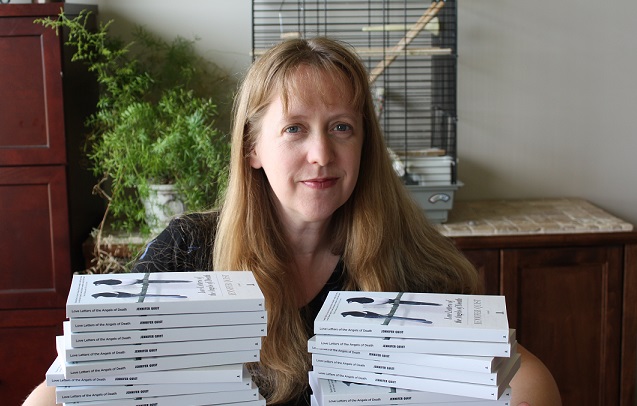
See, it's real.  Here I am with stacks of beautiful, traditionally published books I wrote myself

See, it’s real. Here I am with stacks of beautiful, traditionally published books I wrote myself

This morning when I woke up, my publisher was messaging to congratulate me on the release of my debut novel and my five-year-old son was throwing up in the hallway.  Way to keep it real, Sweetie-Boy.

My good mood is holding up well anyway.  If you’d rather not come get a signed copy of Love Letters of the Angels of Death at my house, the book is available from the publisher, in online stores, and is making its way into fine bookstores (coming soon to my local, Sunworks in Red Deer, Alberta).

Woohoo!

Amazon.ca Jumps the Gun

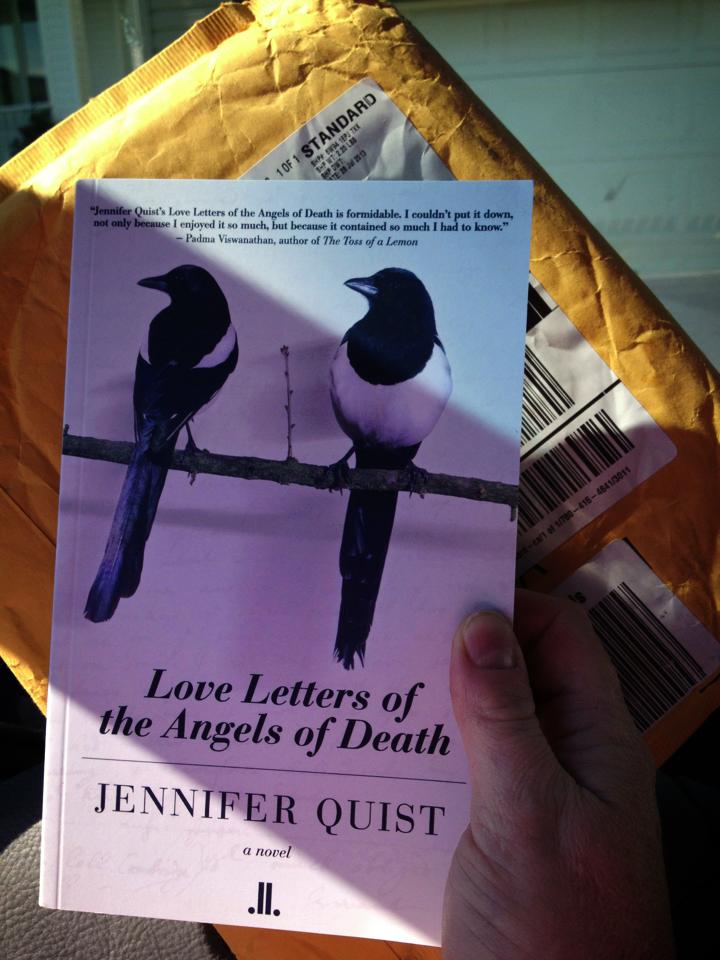
Even though the official release date isn’t until Saturday — about 36 hours from now — a friend of mine has already received her copy of my book.  Couldn’t have happened to a cooler person!  Thanks for sending me this picture, Janine.

j9mail

First Review of My Book!

Montreal Review of Books looks at my novel in the Summer 2013 Issue

Montreal Review of Books looks at my novel in the Summer 2013 Issue

The summer issue of Montreal Review of Books is out today.  And I am thrilled to report it includes Elise Moser’s review of my soon-to-be-released novel.  It’s a feature review complete with quotations from emails Elise and I exchanged.  Read it here:

http://mtlreviewofbooks.ca/reviews/love-letters-angels-death/

Here’s the first paragraph:

“I think Babies “R” Us is one of the saddest places there is – everyone looking to buy something that will make a very traumatic and life changing experience into something more manageable.” Like her main characters, Jennifer Quist does not hesitate to express firmly held, intelligent opinions. That’s her talking about birth. You should hear what she has to say about death…