The 2016 Alberta Readers’ Choice Awards Long-List

ARCpic

Libraries are good for books and authors. Not only do they buy, circulate, and promote our work, they’re involved in the ever-more delicate process of cultivating readers so the pursuit of professional writing can continue to mean something. In my area, libraries also trouble themselves to run the annual Alberta Readers’ Choice Awards. Our Sistering has been included on this year’s ARC long-list. I am delighted.

Thanks again, libraries.

The Association for Mormon Letters Best Novel of 2015

20160305_123344

The AML’s Andrew Hall and me in our kukui nut leis

My career as a novelist is still fairly new but I’ve already been on both the loved up and the snubbed up sides of literary prizes. Awards are a bittersweet fact of life in contemporary publishing. For an essay that says everything I’d like to about literary prizes, I highly recommend this, by poet Kimmy Beach.

Sitting alone, secretly and miserably refreshing Twitter as award long-lists and short-lists are announced without any of our own work on them has got to be a universal experience for writers. It’s certainly been mine. However, I’m grateful to have also stood and bowed my head as winners’ medals have been hung around my neck. For my first novel, it was a weighty pewter disc on a blue ribbon. For my second novel, it was a lei made of kukui nuts. Yes, Sistering was awarded Best Novel of 2015 by the Association for Mormon Letters at their conference in Laie, Hawaii.

In a book-world full of so much good material, it’s hard to stand out. Being part of a group outside the deep, swift mainstream can help. I’m a white Anglophone woman but there’s no P in my WASP. Instead, I am the granddaughter of women who raised their families in post-World War II, post traumatic stressed New Brunswick, both of them seeking new spiritual compasses. Independently of each other, they found Mormonism. It was passed down to me, and while most of my family has let go of my grandmothers’ spiritual legacies, I’ve held onto them. The reasons are personal and religious—which means they don’t have much to do with reason at all. My faith is based in transcendent experiences that began in my childhood and continue today. I don’t usually talk about them in detail, not in public, and especially not on the Internet. But they are real, not the kinds of things I would deny or abandon.

Religious codes that include direction on how to live face criticism. It’s unpleasant but I suppose it does move adherents to keep examining our praxis and to focus on prevailing ideals like love and compassion. Differences of beliefs and lifestyles don’t have to mean discord. For instance, according to my religious beliefs, people shouldn’t be drinking coffee. That’s how I live, but I can still sit at a table and watch anyone drink coffee without feeling the slightest bit of bigotry or enmity between us. This example can be extended to any behaviour contrary to my religious ideals. Regardless of how I believe people should live, my strictest principles are leveled at my own heart. They’re based on the first laws of Christianity which are all about love—love to the point of the losing of the self, which, with typical religious irony, is actually the finding of the self. No matter how differently someone may live from me, I can love them. I do love them. It’s something I’ve learned to do because of my religion rather than in spite of it.20160306_165902

The Association for Mormon Letters “is a nonprofit founded in 1976 to promote quality writing ‘by, for, and about Mormons.’“ It’s not the only organization set up to serve and promote Mormon writing but it is the best fit for quirky Can-lit like mine which tends to get a rough ride in heartwarming “inspirational” fiction circles. The judges were kind enough to call me “one of the most talented” Mormon novelists writing today. The AML are my people. I’d be happy to join them even if they didn’t hand out their awards on the north shore of Oahu.

My husband and I were only out of the country for three and a half days. We left our kids here in Canada, in the care of their oldest brothers. One them is legally an adult, and the other has a driver’s license. Between the two of them, they’re enough man to run our household for a few days—but just a few days.

20160305_154555Outside the Honolulu airport, Hawaii is just as delightful as everyone says it is. Thanks to our Mormon ties we didn’t have to go full-tourist. Friends of ours–fellow Mormon-foreigners, a couple where the wife is South Korean and the husband is Japanese—have been living in Hawaii for years and showed us local favourites like a huge old banyan tree hidden off the side of the road, and a strip-mall restaurant serving massive “Hawaiian-sized” slabs of sushi. On Sunday, we wound up at a church service singing from a hymnal written all in Samoan and witnessing a congregation sending off a woman named Celestial to be a missionary abroad.

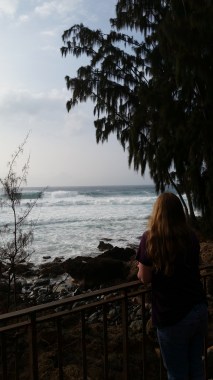
Our religious ties were a source of diversity and authenticity. It was our Mormonism—something often thought of as a parochial American backwater—that made this weekend of thoughtful, artful validation of my work possible. It was our Mormonism that spared us a spending frenzy in crowded, urban Waikiki and provided us with a walk through idyllic daily life in small-town Hawaii. It was our Mormonism that gave me something to say as I stood —so low and so small—in the Pacific Ocean, pitching in the currents, my back to continents I’ve never seen, calling out psalms to my husband and the sea and everything above it.

I shouted what, in one form or another, I always shout. “What is man, that thou are mindful of him?”


The Edmonton Launch of “Sistering”

audreyspic

This is not what’s usually meant by books going viral

After spending the summer terrified, plunking through oral presentations spoken all in Chinese, this fall’s chance to appear in public, speaking to people about my novel in my native language seemed like a breeze.

Easy!

But there’s precious little in life that turns out to be easy. The week of my book launch, I came down with a cold. Grownups muscle through colds all the time. It’s not heroic or dangerous. However, my family, the MacKenzie family, has a talent for coughs and colds. We cough until we gag. We cough so loudly little children cover their ears. We cough until the blood vessels around our eyes break, giving us a scary petechiae–a rash of red-brown flecks on our skin. In the late 19th century, one of our great-great-grandmothers lost nine of her eleven young children to influenza. I’m not convinced there’s any such thing as a man-cold but I do believe in the Mac-cold: the MacKenzie cold.

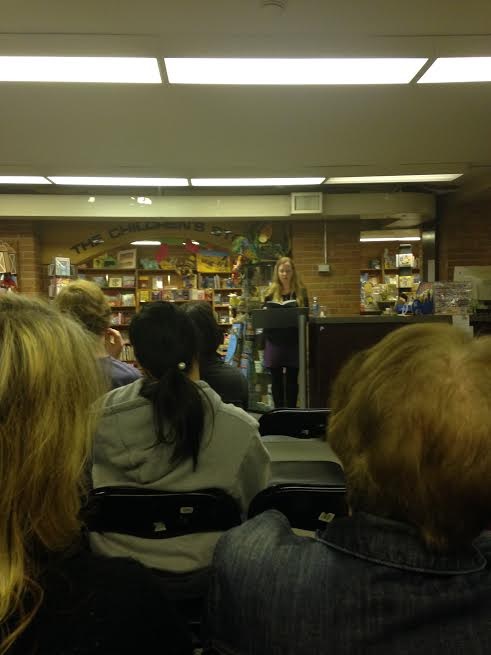
So I turned up at my book launch at Audreys Books in Edmonton with a Mac-cold. I arrived still embarrassed about having to leave a lecture earlier that afternoon to go hack in the privacy of a stairwell. All the hopes I had for the event had been reduced to one simple goal. I wanted to make it through the reading without a spectacular, face-bleeding coughing spasm. All that mattered was breath.

I took my medicine, prayed, took comfort in the goodwill of the family, friends, and colleagues who came, and accomplished my reading in a low, smoky but cough-free voice.

Then I came home and crashed, just like the computers at the store.

From the fog of medication and illness, I missed a few event details that would have been nice. I couldn’t taste any of the cake my sister made for the guests. I also failed to set up any proper photos and am left with phone-shots to document the night.

That’s okay. Someone with a Mac-cold is best seen through a fuzzy screen at a far distance anyway. And the more adversity, the more thankful I am to be in the position to be headlining the launch of my own book, for the second time, in a venerable space, surrounded by people who wish me well.

Thank you, from the bottom of my lungs.

A National “Must-Read Books of the Season” List Featuring Our Own “Sistering”

Oh, how I love the Canadian Broadcasting Corporation, especially when it does stuff like this. The CBC has a healthy, powerful books department in a world thin on books departments. They just made a “Fall 2015 Reading List” suggesting fifteen “must-read books of the season.” They’ve included new fiction from international writers like Salman Rushdie and Franzen, Canadian names like Lawrence Hill and Marina Endicott — oh yeah, and my latest novel.

Wha?! I mean, “Yay, for Sistering!” See the list here.

Great way to end a day of spit-washing spaghetti sauce off people’s faces.

Angie Abdou Reviews “Sistering” on the CBC

datbreakWe were pleased to hear Angie Abdou reviewing Sistering on CBC Radio’s Daybreak Alberta programme. Here she is talking to host, Chris dela Torre, about my new novel. My favourite line? “Jennifer Quist makes you believe it.” Thinking of having a t-shirt made…

Here’s the link to listen to the 6 minute bit: Sistering on the CBC

What I Didn’t Tell My Fellow Creative Writing Students

Sesame Street’s Don Music with a bust of William Shakespeare

I remembered them from my days as a twentysomething undergrad: certain “mature” post-secondary students heck-bent on sharing their wisdom and experience. They stalled lectures, dominating professors’ attention with “the adults are talking” airs or by questioning everything professors professed—because what do those ivory-tower hacks know anyways?

This winter, I took a class called Advanced Creative Writing at my old university. It was a writing workshop—my first. Though I’m firmly on the path of free-range writing rather than a hot-house writing, it’s okay if my range overlaps a hot-house for a few hours every week.

As I walked up the Humanities Centre stairs, I knew I didn’t want to be “that” mature student. I said so when it was my turn to introduce myself to the class. My professor, a talented author who had kindly waived the portfolio prerequisite because he’d already read my novel, stopped me and told the class I was there “to help” as well as to learn.

This was generous of him. I’m not sure how well I walked the line between helping and infuriating my classmates. I’m pretty sure I used the phrase, “I already graduated, what do I care?” too many times.

Naturally, I gravitated toward class members most like my sons and my youngest sister. Though familiar, this was not my usual writing crowd—far from the scene of a Linda Leith Publishing vin d’honneur—but the honor of being among talented people before they’ve made it (whatever that means) wasn’t lost on me. In the end, I managed to leave the course with a good though moot grade, one hug, and some sweet goodbyes.

Now that it’s over, no more restraint. Here’s the list I’ve suppressed all semester—the things Mama Mature Student would have told the class if she hadn’t been checked by all this dang self-awareness. It’s not that I wasn’t asked questions—one about episiotomies leaps to mind—but the full force of my advice rampage has been held back until now.

If you are or ever plan to be a creative writing student, consider this:

Be nice – This echoes the university’s writer in residence who visited our class. He went so far as to recommend we read How to Win Friends and Influence People. It’s not bad advice. Some of the most cringe-worthy things I can’t forget myself saying were said in my early twenties. Remember Franzen made his name before the social media age, back when authors’ rough styles could be easily managed by publicists. Personal scrutiny has never been closer than it is now and in a competitive arts world full of very good work, a skill like not openly rolling our eyes might be a career tipping point. Unfortunately, arts careers are a little like small businesses and our personalities can combine with our art to form an unsightly hybrid product that’s difficult to sell.

Take heart. Canadian literary communities, particularly the Alberta one with which I’m most familiar, tend to be collegial. We cheer one another, writing blurbs and retweeting announcements along the way. It’s easy to be nice here.

Be generous – Our professor held a book launch during the semester and only three of us came. Not cool. Go to local book events. We don’t have to buy all the new books (with writer wages, we probably won’t be able to) but realize that many authors arrive at their events convinced they’ll be facing a room of empty chairs, peppered with a few blood relatives feeling sorry and embarrassed for them. If at all possible, do not let this happen. Anyways, it’ll be fun. It’s moving and fascinating to hear people offering vocal interpretations of their own work—not work they’ve been picking at for classes but work they’ve toiled over for years, work they’ve staked their futures on. Go ahead and laugh at their jokes, gasp at their horror stories. Weep openly, if you feel like it. Events are more fun, more productive, and more satisfying when we invest ourselves in them.

Don’t take the workshop process too seriously – I am an old woman raised in the pre-Elmo golden age of Sesame Street and one of my favourite characters was Don Music. He’s an angsty songwriter we find one word shy of completing perfect nursery songs like “Twinkle, Twinkle Little Star.” When his near-perfect songs get “help” from a visitor, they get mangled into parodies with details that make so much literal sense the artistry of the songs become absurd. Our workshops were like that at times. I saw (and benefitted personally from) great suggestions coming from workshop discussions. However, I also saw classmates balk at truly powerful and original aspects of their stories because of well-meant questions these risks raised during workshops.Critique is a vital tool in writing but so is the discretion to resist pressure when it’s pushing a story in the wrong direction–when we know it’s time to depart from expectations. Remember the lessons of Don Music.

Don’t take your parents too seriously – Everyone’s parents betray them in some way. That’s the rule, not the exception. We all sit down to write reeling from that trauma. But look at where we are. We’re not roughneck-ing in the oil patch, we’re in university. We’re in university not to get a traditionally marketable skill like teaching or engineering. We’re in the Faculty of Arts. And we’re not just in the Faculty of Arts, we’re studying the fine art of creative writing. There are reasons we are here and our parents are probably among them. Maybe they hate this field. Maybe they deserve to become caricatures lampooned or eviscerated in fiction. But they also deserve a nod for the privilege we enjoy as people having a go at an expensive, elite liberal arts education. The idea that this privilege is universal regardless of the circumstances and people we were born among–even in Canadian society, it’s false.

Explore the free range – Make sure life is built upon pillars other than reading and writing. Duck out of the academic hot-house for a while–and not just through travel stunts. The daily grind is an excellent teacher. Some of the most interesting fiction in the class came from people who work part-time in stores and bars, in the real world where they form and sustain relationships with people nothing like themselves.

There was great sensitivity in the class. Sensitivity to our own feelings needs to be augmented by sensitivity to other people’s feelings or it will never be enough to make our writing real and potent. Empathy is everything. As the man says, “You can’t write if you can’t relate…” Love people—everyone. That is how they are known. That is how they will come to know and love you and your art.

Thank you so much, and all the best…

In Canada, Oprah Winfrey is Called Shelagh Rogers

No school for the kids today so I woke up late to a notification for this Tweet:

The US has it’s Oprah Winfrey book world–nods given by a bright, trustworthy, well-read media personality to books of note. In Canada, where everything but geography and weather unfold on a less flamboyant scale, we have a national radio book programme on the CBC called “The Next Chapter” anchored by a bright, trustworthy, well-read media personality named Shelagh Rogers. That’s her smiling face in front of my book cover in the Tweet. The book and I were the subjects of a feature called “How I Wrote It” on her programme this week. It was short and fun but a great moment nonetheless.

Listen here, it begins at 23:45.

Laugh Track at the Beauty School

This is not a picture of my four sisters and me; neither is my next novel.

I am one of five sisters. I was born first and in exchange for having the best memories of our parents when they were young and cool, I missed out on adventures my sisters had together after I swore off women for a life with my husband and sons. Different combinations of my sisters have traveled to Disneyland, New York City, Winnipeg, Amsterdam, the Northwest Territories, and the old gravel pit in Prince George all without me.

This year, for the first time, I made it to one of their “girls’ trips.” I met the three of my sisters who aren’t currently breastfeeding (see, someone’s always left out – it’s not personal) in Calgary to spend a weekend together.

I am terrible at ordering and it was over a bowl of thick green sauce at dinner that I taught the girls a new word: sistering. It’s like mothering only just between us. And then I warned them about my second novel. It’s about a group of five sisters.

No, it’s not about us.

If it’s not a tribute to our family why stretch the cast over five main characters? Well, because it’s not a stretch. There were five Spice Girls, five Go-Gos, five Miss Bennetts in Pride and Prejudice, and, of course, five Dionne quintuplets. My mind isn’t the only place where a group of five girls is the only size that makes sense.

It was impossible to write the book-sisters without invoking bits of my real sisters. I used some of our quirks and experiences as inspiration, like any writer would have done. To add to the tangle, our family is large. On my side alone there are seven siblings, seven spouses, one ex-spouse, and twenty-two nieces and nephews. It’s hard to create characters and situations that don’t overlap in some way with people I know very well simply because I know so many people so very well. When we’re primed to look, even general coincidences can seem like deliberate rip-offs. For instance, one of the sisters is the book is a nurse, just like Amy. One is divorced, like Sara. One is married to a man who’s adopted, like Mary’s husband. These elements aren’t uncommon inside or outside literature. Moreover, my book’s story wouldn’t work without them. And the story definitely wouldn’t work without the intimate understanding of sisterhood we sisters have given each other.

None of this is the same thing as writing a story about my sisters.

Still, I submitted to the girls teasing me about the book for the rest of the weekend. They let me have it, with that sharp sweetness of theirs and lots of laughter.

The next day Amy had planned girlie activities for us. We spent the morning shopping. That was easy. The afternoon was more difficult. The other girls wanted to go to a spa together. The only place that could book all four of us at the same time was not exactly a spa but a beauty school. I don’t want to use its real name so let’s just call it – oh, I don’t know – Carvel Mollege.

I’d had a facial only once before. It seemed like witchcraft – a superstitious ritual in smearing stuff on my face and wiping it off, a cycle of application and removal. The key to a successful facial is to end it immediately after finishing a thorough removal.

I was about to learn this.

If I’d been a more experienced exploiter of the pink ghetto that is esthetics, I would have realized how strangely my facial was unfolding and made some kind of protest. As it was I laid under a towel that smelled like someone else while a college girl let facial goops drip into my hairline, while she failed to rinse the cocktail of creams and toners and tonics off my skin.

At some arbitrarily determined point she said we were done. My skin felt tight and tacky as I stood up and looked for a mirror. There was only one in the room, mounted too high for me to see much of my face in it. All I could see was a dark, oily perimeter where my hair had soaked up the skin treatments.

Not a good sign.

The supervising instructor was waved out of a classroom to inspect my student’s work. “How do you feel?” she asked me.

“Pretty sticky.”

“From the moisturizer,” she finished for me.

I went downstairs, fingering the gummy surface of my face. In the lobby, my three little sisters were sitting in a love seat meant for two. They looked great. But when they saw me, they looked concerned – and amused. That’s when I knew for sure something wasn’t right. While the receptionist ran my card through the machine, I flexed my sticky face until it cracked. I stood in the lobby and peeled a sheet of – something – off my face.

Across the room, my sisters were cackling. “Why’d it have to be Jenny?”

Between my fingers I held a transparent mask of most of my face. It reminded me of a bored habit I had in grade four, pouring white glue into my hand and letting it dry before trying to peel it off in one piece. This glue mask was a good one. Every hair of my left eyebrow was perfectly visible.

I rolled the film into a ball between my fingers. “I’m not paying for this.”

My sisters kept laughing.

“I understand they’re just students,” I told the receptionist. “But look at my sisters: they’re not down here peeling their faces off.”

No one argued about refunding my money. Maybe they should have. My sisters and I had spun the barrel in a game of college student esthetician roulette and on our fourth shot, my shot, the game fired its inevitable concluding round.

We got in my minivan and drove away, off to a dinner where I would order another plate of food I wouldn’t like. Mary told me how radiant I looked. Amy lent me some makeup. And we never stopped laughing. That’s my sisters: the laugh track of my life, calming me down, cheering me up, convincing me this drama is much more fun than any amount of reason says it should be.

When my new book appears next year (please read it) don’t skip the dedication page. But just in case, let me reveal now how it will read:

For Amy, Sara, Mary, and Emily

All of whom inspired, none of whom is depicted in this book
Final Post Before Moving House: On Depression and Sadness

My house from the creek-bed below it.

My house from the creek-bed below it.

With less than a week before my family moves house — leaving the town we’ve lived in for eight years, longer than I’ve lived anywhere, ever in my entire life – I’m feeling kind of depressed. I love this place.  I love my friends here. I love my kids’ friends. I love the atom football team. I love the trees we raised from saplings. It makes sense to be sad about a departure from a happy hometown. As one of the characters in my novel says, “I’d be more worried about my state of mind if something like this failed to upset me.”

So this is not a confession of an artist speaking frankly about her troubled mental health. That artist is real but I am not her. While I’m definitely feeling depressed today, it’s not the same thing as having the disease of depression.

When it comes to mental health, I’ve got nothing to complain about. It’s not because I’m smarter or better than people who do have valid complaints. I think it might be little more than an endowment from my mother –an ability to shout or cry away bad feelings before they settle in for torturous long-term engagements.

Even so, I do get sad. Over my lifespan, I’ve probably lost months-worth of sleep to grief and worry. My personal best record for uninterrupted crying exceeds three hours. One summer, my daily routine included standing alone in my garage painting boards for the epic fence we were building, quietly weeping over them.

None of this was depression. It wasn’t an illness. It was a reaction to well-defined, acute stress and tragedy. It’s like the difference between bruising for a few days after bashing a knee on something and bruising maybe until death because there’s something fundamental missing from the blood that keeps it from clotting.

With the recent death of a famous entertainer, a lot has been said about depression as a dangerous disease. All of that needs to be said. Depression is still far too stigmatizing. I have a close friend who suffered depression after each of her kids was born. She still worries someone will find the medical records of her diagnosis and medication and use the information as prejudice. “All your history of depression really shows,” another friend explained to her, “is that you were smart enough to go get treated for it.” She’s got nothing to be ashamed of and much to be commended for.

While not everyone suffers from depression as a chronic debilitating illness, everyone (except maybe, I don’t know, people with anti-social personality disorders) feels sad sometimes. Sadness is part of the human condition. It’s inevitable and normal. There is nothing strange or sickly about the sadness most of us encounter.

Here, in the middle of my move, I was talking with another friend who suffers from depression. She saw my mood was low and jumped to recommend treatments she uses when she feels herself falling – when her disease flares up. But I don’t have her disease. I don’t need to fight sadness as quickly or as fiercely as she does. I thanked her anyway. And above my pangs of healthy-person-guilt I was surprised to hear myself telling her I don’t mind letting myself experience a bit of my own sadness. It hurts but it doesn’t damage me. There’s value in it. I can trust I’ll survive it. My preferred treatments are patience and time, love and companionship, faith, music, food someone else has cooked, fresh air, and new things I discover every time circumstances demand my character adapt and change.

For people with severe depression, sadness can be, very literally, the end of the world. They need to fight it with heavy medical and social artillery and no one should fault them for it.

For the rest of us, sadness, deep at its core, is a horrible, putrid, unwanted gift. It’s okay to unwrap it and handle it. And no one should fault us for that – trying to convince us we’re deluded or unhealthy or callous when we take our sadness into our own hands to see what we can learn from it.

Sadness is part of our life stories. Its gift to us is our stories.

Because Camping is Actually Writing

Me, arriving at camp with a bit of baggage

Me, arriving at camp with a bit of baggage

Two decades without camping didn’t seem like too many to me. I love being outdoors but I crave a proper roof overhead when it’s time to call it a night.

Then, this winter, I was asked to take over as leader of a youth group for 30 girls ages 12 to 17. It’s a great gig. It tempers the Smurfette vibe I’ve cultivated living alone in a pack of men for the last nineteen years. I’m honoured and happy to be there.

Still, I spent the spring dreading our youth group’s traditional annual camping trip. Fortunately, some of my fellow leaders are skilled, enthusiastic campers. They took over. My camp role was to sign off on expense claims, make a few rousing presentations, offer hugs to the homesick, and not sabotage the whole thing with my incompetence.

It was a simple role but I fretted anyway. What might have been more daunting than whatever challenges awaited at camp were the challenges I’d leave behind at home. Not getting things done can be just as hard as getting things done. My family is in the middle of moving house. It’s not a great time for me to flee into the wilderness. In order to take the girls camping, I left my house unpacked and unsold, left my kids, left a chance to see my commuter husband who was traveling home to stay with them. And, I left my second novel in the process of an intense unfinished edit.

For me – and probably for other writers who finish manuscripts – there’s no such thing as taking time off simply because life is busy. Activity inspires creativity and the paradoxical truth is I sometimes work best when it should be logistically impossible for me to get anything done. This summer, while single-parenting my five sons and trying to sell our house, I’ve written more, and more consistently than I have all year.

The prospect of my second novel is a bit terrifying. My first book has been well-received and part of its legacy is fear of a “sophomore slump.” I wrote the first version of my second novel before I’d found a publisher for my first book – before I knew who I was as a novelist. It was an experiment. The first version of it was plotty and funny and fairly glib. There were hardly any “that’s my soul up there” moments in it. It ate away at me a little – the secret that I didn’t love my second novel the way I love my first one. I liked it. But…

With this second book I have access to something I didn’t have when I wrote my first one. I have someone in the industry willing to read it and skilled enough to tell me what’s wrong with it. I knew the book was lacking but I couldn’t tell how or what to do about it. With good editorial feedback fueling my revision process, I hope I’m starting to understand.

The radical edits demanded I change something fundamental to the book – the title itself. Every time I opened the document I changed the title and every time I changed it, I hated it more and more.

campgroup

Me, when my hair was still clean, welcoming the campers

So I went to camp with my novel gutted, untitled. I went trusting my familiar paradoxes, sure a four day pajama party in the woods would improve everything unsettled in my life right now – maybe even my second novel.

Camp was fantastic. We should have called it “Camp Slacker.” There wasn’t much of a schedule, I kept driving the girls to the beach in the back of my pick-up truck, we stayed up all night every night, we never really stopped eating.

On the final morning of camp, I woke up underneath a brand new spider web, listening to music – not in my ears but in my mind. It was a song I hadn’t heard in a long time – one I first learned when I was a 16-year-old girl. It was Leonard Cohen’s “Suzanne.”

Now Suzanne takes your hand
And she leads you to the river…
And she shows you where to look
Among the garbage and the flowers
There are heroes in the seaweed
There are children in the morning
They are leaning out for love
And they will lean that way forever
While Suzanne holds the mirror…

It’s unlikely LC was thinking of youth camp leaders working to convince young girls of their worth and power and potential – to “show them where to look among the garbage and the flowers” – when he wrote these lyrics. But art is sublime and it doesn’t matter what he was thinking. For a moment, the song was about me and my “children in the morning” – the ones born to other mothers but sent into the woods with me for a few days in hopes we’d all come to understand ourselves a little better.

Suzanne loads you in her pick-up truck, and she leads you to the river

Suzanne loads you in her pick-up truck, and she leads you to the river…

My second novel – the awkward one with no name – it’s always been about sisterhood. And in the early morning sisterhood of my first camping trip in over twenty years, the paradox worked its perfection and I think I learned what I will call the book.

Photos by Naomi Stanford