One Party With Everything On It: Launching My Novel

A few of the lovely guests at our book launch

A few of the lovely guests at our book launch

It had family, friends, librarians, my childhood bestie, a surprise appearance, great food, fresh flowers, surly teenagers, pretty babies, a local literary mainstay, and a book.  Our book launch party had everything.

Signing Books

Defacing Books with My Scrawl

Last night, in my current hometown of Lacombe, we did indeed launch my first novel, Love Letters of the Angels of Death.  Fran Kimmel introduced me, I read the first two sections of the book’s first chapter, and the rest was just love.  I imagine it was kind of like being at my own funeral – which, if you know me or my book, is wonderful.

My thanks to everyone.

So, Um, What Are You Doing Next Thursday?

Yes, this is me, asking you out.

Invitation to my book launch party

Next Thursday, I’m having a party to launch my novel.  Whoever you are — whether you know me in person or not, whether I can see your house from mine or not — consider yourself invited (unless you are a child who is old enough to walk but not old enough to keep your mitts out of the punch bowl and sit and listen to Auntie Jenny read stories about dead people).

If you can’t make it to the Lacombe launch party, I’ll be reading in Red Deer at Sunworks on Friday, September 27 at 7pm.  And if you’re a big city type, I’ll be reading in Calgary at Pages Kensington as part of Filling Station’s Flywheel Series on Thursday, Sept 12 at 7:30.

Look, I’m delicate and socially awkward.  Come see me.

So, What’s It About, Anyways?

What’s this book about and where does it fit?

Ever since I got my book deal last autumn, I’ve been fumbling with the inevitable, perfectly natural question of, “So what’s your book about?”  Maybe I’m over-thinking it but I find this question difficult.

The first thing that makes my book hard to explain is the fact that it doesn’t fall neatly into a genre — and I’m not just saying that to try to sound cool and transcendent and stuff.  If the book was about sorceresses with magic necklaces and metal undies I could say it was fantasy.  If it was peopled with smoochy vampires it would be paranormal romance.  If it was about stabby psychopaths I could call it a crime novel.  If it prattled on about dating and shopping it would be chick-lit.  But it’s none of those things.  It’s kind of lovey-dovey, a bit creepy in parts.  It’s a little otherworldly yet it’s realistic and earthy.

When I was still submitting the manuscript, still ticking boxes in search engines of databases listing publishers’ interests, the box that fit best was called “literary fiction.”  And it’s the classification now stamped on the back cover of the book.  However, it’s also a term that gets sneered at for its elitist implications.  Who’s to say what’s of literary merit, and on and on and on… Still, if for no other reason than its acknowledgement that a flashy, racing story-line can come second to arty, thematic prose, literary fiction is the category that suits the novel best (she said, cringing, hoping not to sound elitist).

Another category fits simply because of my geography.  It’s “Can-Lit” — Canadian literature.  I am Canadian so, in some ways, I can’t help but write Canadian literature.  I’ve fallen back on this description a few times.  But Can-Lit has gained a character of its own over the years and when I offer it as an answer, I need to be prepared to embrace that character.  I need to be able to wave my hand and believe myself when I say, “It’s CanLit — you know, bad weather and complicated relationships.”

Nothing I say is very precise or descriptive or satisfying for nice people asking about my book.  So here’s a short Q&A with me about my novel.  It appears in my publisher’s online literary mag, Salon .ll., and hopefully it will shed some light on what I’m writing and why someone might want to read it.  Go ahead and click the link below.

http://www.lindaleith.com/posts/view/280

Misogynizing Modesty and the Male Brain

Jessica Rey is also a Power Ranger

Here it is: my first blog-post to begin with a disclaimer.  I love my friends.  It doesn’t matter if I haven’t seen them in years and I’m mostly just a part of their facebook landscapes.  I find them smart and good and kind.  In my horribly flawed way, I want to reflect the same qualities back at them.  And with that, I hope what I write below will, as my wise friend Debbie says, “be taken in the spirit in which it was intended.”  I don’t mean any harm. I don’t think any less of anyone. I’d just like to share a different perspective.

Now I’ll blurt it out: I can’t take much more of this recent, popular video clip.

It’s a speech given by Jessica Rey (yes, the actress who plays the White Power Ranger on the kids’ TV show).  She heads a company selling swimsuits to women who want a bit more fabric in their swimwear than most mainstream clothing manufacturers offer.  It’s not the sales pitch in her speech that bothers me.  And I take no issue with Rey’s personal desire to dress modestly or her efforts to make modest clothing more available to consumers.  For many reasons, I also prefer clothes that cover my torso and I know how limited my options are when it comes to shopping for clothes, especially swimsuits.  I’ll even take it a step further and say I believe we’d all enjoy a healthier, happier, more egalitarian world if we’d reserve some of our loveliness for home use only.  Rey and I and all my friends who re-posted this video clip are on the same team.  Go Go Modesty Rangers!

But I still do not like this speech.  Rey does manage to make some good points.  However, she spends much of her time on stage mentioning (I won’t say “citing” because no attempts at citation except dropping the name of an Ivy League university are ever made) conclusions she’s derived from studies done on men’s neurological reactions to viewing images of women in scanty clothing.  She says researchers found that viewing these images lit up the same areas of the male brain used when looking at objects like tools.  The men appear to be relating to the women as objects rather than connecting with them as human beings.

Let’s set aside controversies over these kinds of studies and take the research and Rey’s analysis at face value.  It looks like men have a problem. Men dehumanize women when prompted by immodest clothing.  The suggestion that women and girls could help men deal with this problem is a good suggestion.  After all, there’s not really any such thing as a male problem or a female problem.  Every problem is a HUMAN problem.  And in light of that, the solution to the human problem of men objectifying women cannot be simply to keep women’s bodies covered.  It must also be to change the way men think about us.  Women can’t fix this for men.  We can help.  But men need to work at it too instead of denying their part in favour of blaming us.

Another thing that bothers me about arguments like Rey’s is the implication that if something can be registered on a brain scan, then we’re dealing with a “natural,” inescapable fact of life and we’re all powerless to change it.  We’re stuck with it.  We’re helpless and the best we can do is to lower our expectations of each other.  It astonishes me, over and over again, how often these “natural” neurological effects appear to excuse bad male behaviours.  It’s plain old neurosexism.

In reality, the physical and electrical landscapes of our brains can change and develop over our lifespans in response to the behaviours in which we choose – choo-choo-choose – to indulge.  In other words, it’s impossible to tell if men’s brains react to women in scanty clothing as objects because men are born that way or if they have this reaction because, over time, men have trained their brains to file us in the same mental drawer as screwdrivers.  Maybe they’ve permitted this to happen.  They may have even nurtured it into being.  The mere fact that a phenomenon is visible in a scan doesn’t tell us nearly as much about its source as some of us would like to believe.

Immodest clothing may be muttered as an excuse for disrespecting or even assaulting women.  But I challenge anyone to name a time in history when men have not objectified women and reduced them to sexual props.  It doesn’t matter what the clothing customs of the day were, every culture has struggled to keep women safe from abuse and assault.  It’s more evidence that what makes objectification such an enduring problem aren’t the clothes women choose but the terrible choices made by the men around them.  In our imperfect world, clothing may be a factor but it is not a cause.  Male will is the cause.

I’m currently raising a family of boys.  I don’t have a daughter to take swimsuit shopping.  However, I do have sons who need to be schooled in how to see women and girls.  They live in a home where their baby brothers were breastfed, demonstrating the true purpose of breasts.  They need to be taught about equality and their personal responsibility to meet every other human with respect.  They need to be decisively corrected when they do or say something sexist. They need a loving but socially subordinate relationship with a woman to whom they can have no sexual connection at all — that’s me.

Any efforts women make to dress modestly are helpful as I try to teach my kids to see women as more than sexual objects.  But it’s all secondary to the real solution.  The change needed to correct problems like the ones Rey talks about must happen at the source of the issue: in the socially moulded minds of boys and men.

Maybe Jessica Rey meant to say all of this but got distracted promoting her business and ran out of time.  I sure hope so.  Here’s what I want instead of speeches like hers:  I WANT US TO STOP TALKING ABOUT MODESTY ONLY IN TERMS OF MALE SEXUAL RESPONSE.

Yes, this includes slogans like “Modest is Hottest!” whether it’s used as a cheeky catchphrase or as the trade-name of merchants admonishing us to “show you are hot, but don’t show a lot!”  As I understand it, using the adjective “hot” to describe a person’s physical appearance originally referred to specific physiological responses including raised heart-rate and increased blood-flow in another person.  Increased blood-flow – there’s an eight-letter “e” word for that and it’s not always a good thing to elicit in someone else.  It seems even the backlash against scanty women’s clothing hasn’t extricated itself from a fixation with male arousal.  Whether it’s done by showing skin or not, emphasizing how important it is for women to be “hot” is part of the problem.

Modesty has benefits other than “hotness” and these are the ones we ought to be teaching girls.  We can still talk about male responses but we ought to present them as male problems, not the results of shortcomings of women.  We can present modest dressing as something generous that helps men improve themselves instead of making it into a responsibility we bear alone.  Modesty is a good choice because it can be a sign of a woman’s confidence in her mind, strength, and character.  It throws down the crutch of physical allurement and meets men on their own terms.  It can be a sign of the respect we feel for ourselves and demand from others.  It’s comfortable.  And it makes the sight of the parts we keep hidden more scarce and, thereby, more valuable and meaningful when we do choose to expose them.  Modesty preserves our social power including – but not only – our sexual power.

Lost in the Post: My Silly Ambivalence for Epistolary Novels

The first epistolary book I ever disliked.

At one point during the painful process of compressing my novel into a tiny synopsis to print on the back of the book, we ended up with a paragraph that described the book as a series of letters.  Letters — I guess the connection between the book’s back cover copy and the title, Love Letters of the Angels of Death, on its front should have been obvious, especially to me.  So it must have seemed pretty strange to everyone else involved when I objected to seeing “letters” mentioned in the synopsis.

I blame L.M. Montgomery for my aversion to the epistolary novel — a work of fiction imagined as a bundle of personal correspondence.  Yes, I said Lucy Maude Montgomery, the Canadian author of the Anne of Green Gables series – the woman I hold personally responsible every time I cringe at a fellow Canadian using “delicious” to describe something that cannot fit into a mouth.  She’s also prone to portraying fat people as bad and birch bark as important enough to interrupt everything with a lengthy description of it.  She might be onto something with the birch bark but she’s definitely wrong about the fat people.

Naturally, after our visit to Prince Edward Island when I was nine, my mum bought me the first book in the Anne series.  Maybe because we moved so much, we were often without many books to read and I was stuck with Anne.  Then came the rest of the series.  I enjoyed the books well enough that I started adding to the collection myself.  They were great resources for soaking up vocabulary and learning to discern the sublime in domestic life.

The worst of the Anne books is Anne of Windy Poplars.  It does nothing to advance the larger story arc.  It’s like a long detour.  And it’s the volume of the series written as a collection of letters.  I must have balked at the idea of the novel I’ve written getting filed in the same letter-book category.  The little girl reader still working somewhere inside my consciousness didn’t want our work to bear any similarities to the book we remember as one of the most boring reads of our adolescence.  Readers accumulate some strange, complicated baggage.

It’s true that my book’s title does contain the word “letters.”  But my book lacks the form and lexicon of letter writing – or even diary writing or any of the other gimmicks that flag a book as epistolary.  There is no “Dear,” no “To Whom it May Concern,” no “Yours Truly” with a signature at the end — not even a token date dashed beside the chapter headings.

The reason I put “letters” in the title is to orient readers to the book’s second person narrator.  Most of the writing we produce and read – all of our emails and texts – is written in the second person.  Poetry and song lyrics are typically written this way too.  A second person narrator speaks as “I” but he doesn’t just ramble to himself.  He’s talking to “you, you, you.”  With all our experience reading short pieces in the second person, it didn’t seem like much of a stretch to ask readers to follow this familiar point of view throughout a book-length piece.  An introduction to a second person narrator, along with an informal, intimate tone was all I wanted out of the epistolary form.

I was about to say Anne of Windy Poplars made such an enduring, negative impression on me because it was the first epistolary novel I ever read but then I remembered Judy Blume’s Are You There God? It’s Me, Margaret.  (This one counts as epistolary even though its second person messages are sent through prayers.)  I read this book during the same time period (ahem) as the offending Anne book but I’m fairly certain it didn’t bore me.

With more thought, I realized there were other fictitious diaries and letters I had forgotten on my bookcase.  There’s Bram Stoker’s Dracula, Anne Brontё’s The Tenant of Wildfell Hall, Douglas Coupland’s Hey Nostradamus!, my husband’s copy of C.S. Lewis’ The Screwtape Letters, and Christopher Priest’s The Prestige – a novel I’ve been meaning to return half-read to my brother-in-law for ages.

I enjoyed some of these books – but not all of them.  When I was enjoying them most, their letter-writing form slipped past my notice.  While I didn’t remember that Dracula was epistolary, I do remember getting up at night to quiet my baby while I was reading it and being idiotically afraid of running into undead Lucy in the hallway.  I felt many things for all of these books but I never felt confused or alienated by their narrative styles.  It works.

I’ve over-generalized my dislike for the epistolary form.  Rejecting it was silly – the result of a tenacious childhood prejudice.  I wrote an epistolary novel.  And that’s okay.  It’s not the kind of thing that should amount to a scrap with an editor — though I did feel a little lighter when I flipped my advance reading copy onto its back to read the synopsis and saw the word “letter” had disappeared.

Reconnaisance at Someone Else’s Book Launch

Here’s one more insultingly obvious pro-tip from a newbie novelist: the first book launch event you ever attend should not be your own.  For once, I didn’t wait to learn this bit of wisdom the hard way.  My novel’s release date is Aug 3, 2013 – just 86 days from now.  There isn’t much time left for me to get familiar with promotional literary events before the author in the fabulous arts-chick shoes standing behind the microphone winds up being me.

Fortunately, the closest publisher to me geographically – Edmonton’s NeWest Press – held a “spring spectacular” this week.  They collected three of their authors and one poet and brought them into the city for readings and signings of their newly released books.  It was a perfect opportunity for me to sneak into the literary scene and do some reconnaissance.

I started by plotting.  What I needed was a pair of wing-people.  I convinced these two.
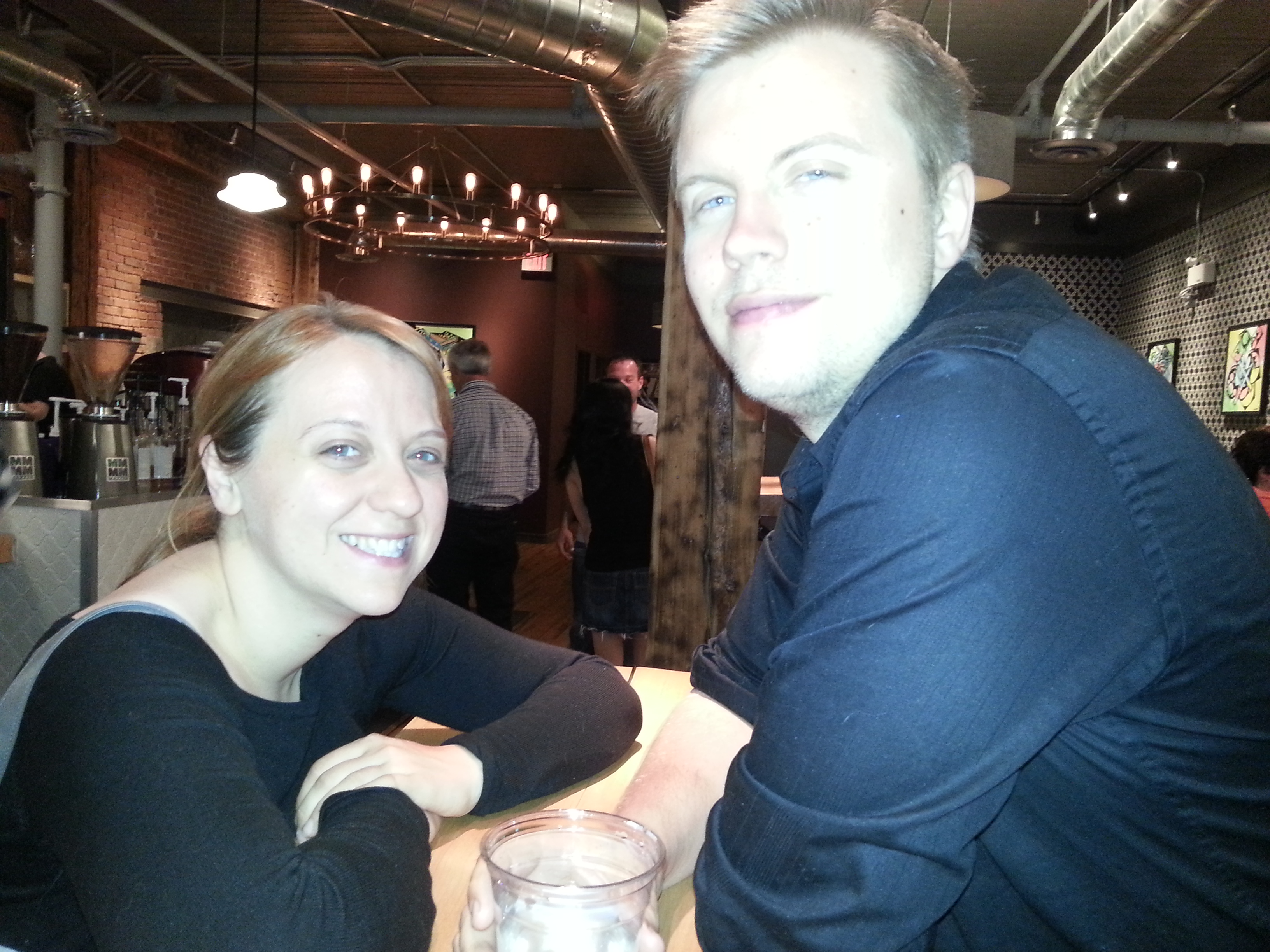
Emily MacKenzie and Allan Taylor -- you know, from the Hunt and Gather blog

Emily MacKenzie and Allan Taylor — you know, from the Hunt and Gather blog

This is my extremely helpful and supportive brother-in-law and my baby sister.

[You mean the nursing professor sister? No.  The millionaire business tycoon sister? No.  The ultra-marathon runner sister? No.  The Edmonton slow-food lady sister?  Yes, that’s the one.  I am gifted with lots of gifted sisters.]

NeWest was holding the launch in a downtown coffee house housed in a restored brick building.  By the time we arrived, it was humid-warm and crammed with people and hot beverages.  Its name – Roast – couldn’t have been more apt.

The only place left to sit was in a dim, empty corner.  This was exactly how I had pictured myself here – dark and peripheral.

As we waited for the readings to start, I kept accidentally making eye contact with a lady sitting along the wall perpendicular to me.  I’m awkward and silly so I kept making sure I politely turned away every time we looked at each other.  But if I’d checked my Twitter feed at that moment I would have found this:

@JennQuistAuthor hi, I’m sitting at the next table over #creepytweets

The message was from one of my Twitter/blogger buddies, Laura Frey.  She was the woman I kept looking at across the crowded room.  I’d never met her in person and I was too stupid to recognize her until later when I overheard her name.  This is fairly typical.  Sometimes we joke (because brain injuries are hilarious, I guess) that I have prosopagnosia – brain damage that makes it hard to recognize faces.  I probably don’t.  It’s the kind of disorder that usually only comes on in survivors of horrendous no-helmet motorcycle accidents.

The time came for us to stop whispering in our corner and start listening to the readings.  The first was poetry from Jenna Butler’s Seldom Seen Road.  Her work is set on the central Alberta prairie but it isn’t the usual  western Canadiana.  In the selections she read, there was a longing and loneliness that didn’t just arise from the physical struggle to subdue a harsh landscape while maintaining human relationships.  It rose instead from the decline of the communities that had originally been built on the land.  The first wave of prairie settlers is ebbing away as their posterity rejects their way of life.  And the second wave of settlers, like Butler and her family, is arriving without a script for how to connect themselves to the crumbling social and physical landscapes left behind.

I hadn’t heard of Butler before the launch but the second reader was someone I’d already been admiring on the Internet.  She’s Rebecca Campbell, author of The Paradise Engine.  I know it’s sexist and vapid to comment on a woman artist’s appearance but I have to mention how impressed I was by Campbell’s height.  There’s nothing I’ve seen on her website to reveal the fact she’s at least six feet tall once she puts on shoes (yes, I asked her).  Her book was the one I used my launch party budget to bring home.  The section she read – a gorgeous picture of a Cold War kid’s night frights over nuclear war – could have been a narration of my own childhood.  Campbell writes about crows and Apocalypses – things I love.

Marguerite Pigeon – yet another author I’ve stalked on the Internet – read from her central American thriller Open Pit.  It’s about a hostage taking and a fictitious open pit gold mine.  This was the book Emily brought home after Pigeon tantalized us with a crafty cliff-hanger ending.  Em and I are going to trade books once we’re finished reading – which, knowing me, will not happen soon.

The fourth reader was novelist Corrina Chong.  I’ve quoted her insightful ideas about the influence of authors’ realities in their fiction in an earlier post.  Any girlie-ness that might have been implied by her pinkish book cover is offset by pencil sketches of squid in all their tentacled loveliness.  The selections she read from her book, Belinda’s Rings, felt a lot like real family life to me – especially real life with a demanding little boy who needs his caregivers to be everything and nothing to him all at the same time.  She nailed it – nailed it right to my Goodreads to-read list.

Roast was roasting and my home was over 100km away so we didn’t stay very late into the night after the readings were finished.  I got to meet a few people but not as many as I wanted before my wing-people and I stepped out into the fresh-enough inner-city air.

On the sidewalk, with Emily and Allan, I indulged in lamenting my missteps.  When I groaned at myself for demanding to know how tall Rebecca Campbell is Emily said, “It’s okay.  I figure as long as you’re still talking, it’s all good.”

And for my first outing, maybe she’s right.  The mix-and-mingle concept is not a big part of my current skill set.  Maybe it never will be.  Under the high wooden beams of the old coffee house, maybe we were all just a bunch of bookish writer-types lurching out of our comfort zones, trying to recognize each other’s faces from tiny Twitter and blogger head-shots, forgiving each other for not being as smart and shiny in person as we are in print.

Linda Leith Publishing, Montreal QC

A Note from JQ:  I admit I’m jealous this blogger, Erinne, has met my publisher, Linda, in person while I have not — jealous of her and grateful to her for the look inside the far away company. Hooray for the interwebs!

esevi's avatarThe Great Canadian Publishing Tour

(April 21)

The drive to Montreal from Toronto, at five hours, seems quite short after northern Ontario. For the first few hours, things are great. The sun is out (dare I call it… spring?), the tunes are blaring, and I just snagged one of the last Roll-Up-The-Rim cups from the Tim’s.  (Please Play Again…sigh.)

But as soon as I drive past the Quebec border sign I’m hit with a wave of anxiety.  I’m in Quebec. I’m probably going to have to speak French. Here’s the deal: I’m an editor. I HATE making mistakes. In French, I KNOW I’m making mistakes.

And my vehicle, oh my vehicle. I’m not good at cars, but I can feel something wrong. I place both my feet on the floor (cruise control) and can feel grindy vibrations through my flats. I’m terrified that at some point a seam beneath the car will…

View original post 648 more words

How I (Almost) Botched My Writing Career

IMG_7226

Writing in bed on a tea tray — like a boss

Last night I attended my very first writers’ group meeting – a “writers’ salon” at the home of a local wire-tap-transcriptionist turned edgy poet.  And I’m realizing now that my late entry into a writing group is yet more evidence that I have gone about my writing career the wrong way – the hard way, the backwards way.

Let me explain exactly how I’ve botched it – so far.

1)      I should have joined a writers’ group years and years and years ago.  All you kids at home, don’t wait until the advance reading copy of your first novel arrives in the mail before joining a writers’ group.

I’m in the habit of not showing my serious writing to anyone – not my husband, not my sisters, no one.  My utter lack of writing colleagues meant I mistook my work-in-progress manuscript for a finished book, started submitting it too early, and inadvertently ended up work-shopping it with the few gatekeepers at literary agencies and publishing houses who were thoughtful enough to jot a line or two (never any more) about why they were rejecting it.  It was a traumatic, slow, costly, and stupid way to get feedback.

Don’t be like me.  Before anyone in the business reads your work, make friends with writers with similar interests and better abilities than your own.  Read each other’s work and offer feedback.  Share contacts and news.  Learn to be gracious.

2)      I’ve never taken a creative writing course.  When my publisher and I were looking for a “blurb” for my book, Linda suggested I consider my former creative writing teachers.  It would have been a good suggestion if I’d had any.  It’s not that I didn’t take university-level literature classes.  I took them and I did well.  But I never took any courses dedicated to creative writing.  I’ve never had my work assessed and graded in an academic setting.

It’s not a fatal mistake.  Many writers spring up outside post-secondary creative writing programs — but not as many as I used to think.  So far, most of the people I’ve met in the working writing community have some past or present connection to writing as an academic field.  They don’t talk about writing as a vocation merely in a romantic, figurative sense.  They mean it the same way plumbers talk about their vocations – as papered credentials and regular, paying gigs.  There is middle ground between an institution-centred career in writing and never enrolling in a class.  And I should have spent some time there.

3)      I haven’t read much of the current literature in my field.  Instead of keeping up with the industry, I’ve used my precious reading time to polish off classics and to survey the YA books my kids are reading.  By now, I’m pretty well-versed in Dostoevsky and Dickens.  And I know my way around J.K. Rowling and Daniel Handler.  But I don’t know much about – whoever the heck has been important in literary fiction since the 1990s.

This was a bad move.  Stay tuned to the tone and the content of the industry.  Don’t raise your head only to when the mainstream media starts clamouring about yet another wave of erotica.  And don’t worry about being unduly influenced by other artists.  It’s the post-modern age – a time when humans have been reading and writing long enough for all of us to be a little derivative.  There’s no way to avoid it and the best we can hope for is to be able to admit it when our work looks like a freaky chimera of Carol Shields, Emily Brontё, and Napoleon Dynamite.

4)      I don’t have a physical space set aside especially for writing.  I write on my lap, sitting on my pillow, leaning against the head-board of the bed where I sleep at night.  It started as a desperate play for peace and quiet in a large, busy household.  I guess that’s still what it is.  It’s bad for my mattress, my spine, my wrists, and my temper.  Get a desk – or at least a chair.

That’s a short list of a few of my most obvious missteps.  I won’t repeat them during my next project — except for the bed-desk.

But there’s something like irony at work here.  I failed in all these ways yet I continued to publish anyway.  All my stumbling around with an unsuitable manuscript served to match my timing up with Linda’s and we found each other at just the right moment.  There’s no fail-safe formula for good fortune.

And on top of all these errors, I did do something right – something vital.  I finished the dang book.  I took good advice when I was finally given it.  I kept revising and submitting.  I kept fighting.  Of all the things I’ve heard people name as the undoing of their literary ambitions, not finishing their projects has got to be the most common.

Maybe that’s the biggest, most valuable lesson of all the ones I’ve learned so far — the one I’d leave with everyone, the one I kept repeating like a holy mantra at the writers’ group last night.  Finish it.  Keep going.