Lo, the First Foreigner on “The Good Word” Podcast

After writing, my favourite medium is radio — no make-up, all talk. Podcasting is a lot like radio — radio without all the “ums” edited out, long-form radio where guests can really cut loose and do some damage. This is a podcast I recorded last month with Nick Galieti, a book industry guy in Utah.

We talk about my accent, my family, Mormonism, literary elitism, the Republican Party (a first for me in an interview, for sure), my marriage and the lighter side of death schtick, and the mysterious geography of the second largest country on the globe.

Nick: So how is Canada today?

JQ: Canada is — is enormous.

Nick was a fine interviewer and it turns out he served with my cousin-in-law when they were missionaries.

Check out the podcast if you’d like to hear some unfortunate, spontaneous voice acting, a little bit of Mormon jargon, and my six-year-old coughing through a door. Must have been a good time; my final word was “Woo hoo!”

Jennifer Quist Interview with Nick Galieti

Our Fairy Godmother is the Queen of England

The Lieutenant Governor of Alberta Emerging Artist Award

The Lieutenant Governor of Alberta Emerging Artist Award

It wouldn’t be true to say I chose an arty career just to impress my kids. But I was definitely gratified this week when, right before my kids’ eyes, the unglamorous sitting and typing I usually do was fairy-godmothered into a morning of sandstone balustrades, live harp music, and canapés garnished with purple pansies.

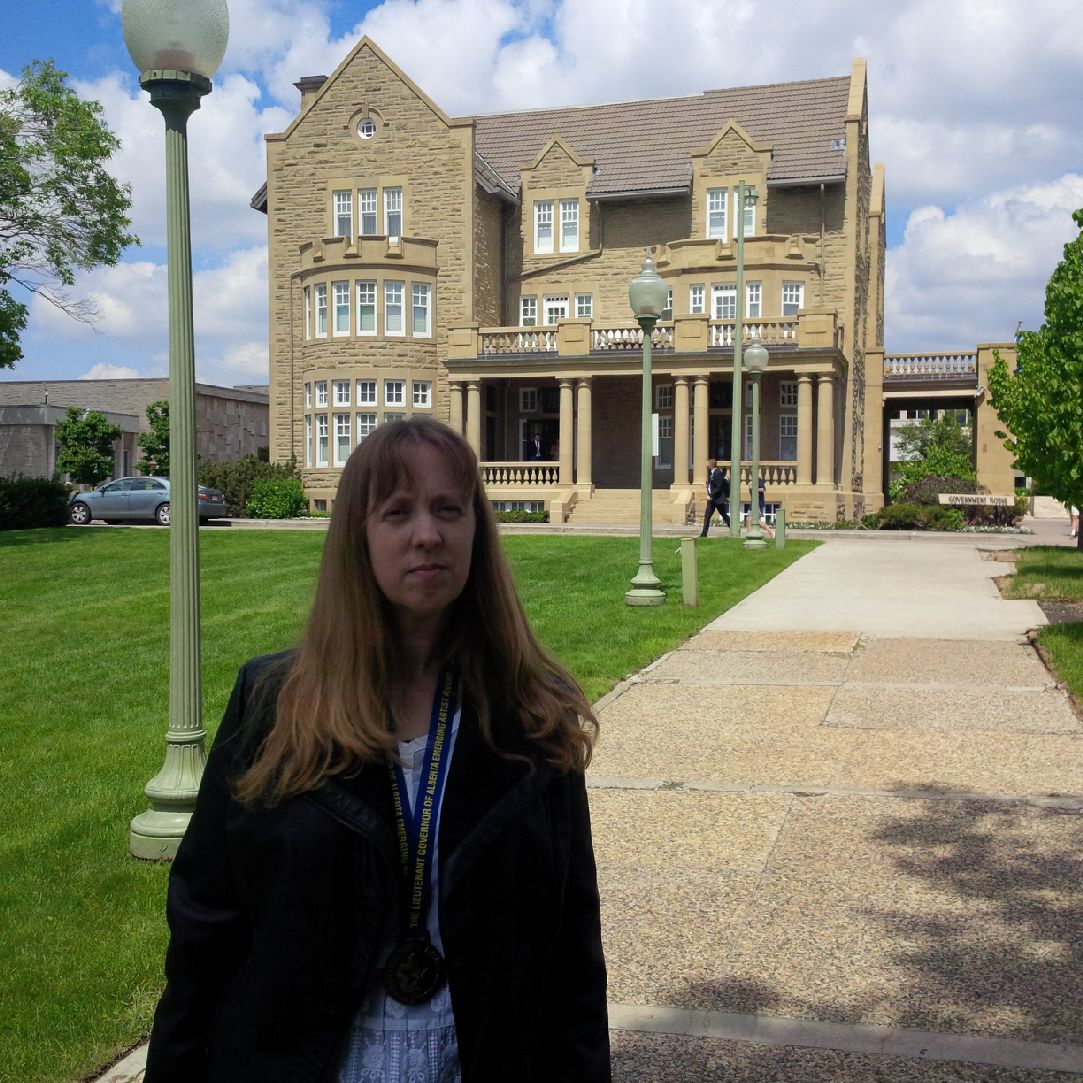
Me at Government House , Edmonton, Alberta

Me squinting in the daylight at Government House , Edmonton, Alberta

The fairy godmother who conjured this fantastic morning for my kids and me was actually the Lieutenant Governor of Alberta. I’m one of the recipients of the 2014 Lieutenant Governor of Alberta’s Emerging Artist Award. It’s a fabulous, generous programme and I’m thrilled and honoured to be included in it. Canada is a constitutional monarchy and some of our traditional royalist sensibilities, like art patronage, provide vital support and recognition for artists – a term it’s probably high time I stopped apologizing for applying to myself.

The award was presented to me and seven other recipients – accomplished singers, filmmakers, poets, visual artists – in a private ceremony. I was able to invite five guests so I brought my parents, my husband, and my 17-year-old and 15-year-old sons – the kids of mine least likely to turn the whole thing into a brawl.

I arrived at the Government House mansion before my family and waited in the green room until we were ushered upstairs where our guests were already seated. We all rose when the “viceregal salute” was played on the harp and Queen Elizabeth II’s local representative, the Honourable Donald Ethell (who is more like an impressive great-uncle than like the queen of anything), entered to officiate from a throne made of dark wood and green velvet.

How cool is that?

Each of the eight of us was formally presented to the gathering as our bios were read. It was the first time I’d heard the adjudicators’ remarks about my work. They said, “Her writing is extraordinarily strong, powerfully handled, and evidence of a rarely encountered original voice.”

Thanks!

We then came forward to greet His Honour and receive a medal – and a discrete folder containing our prize money. (Apparently, Government House lacks a giant novelty-sized cheque printer.)

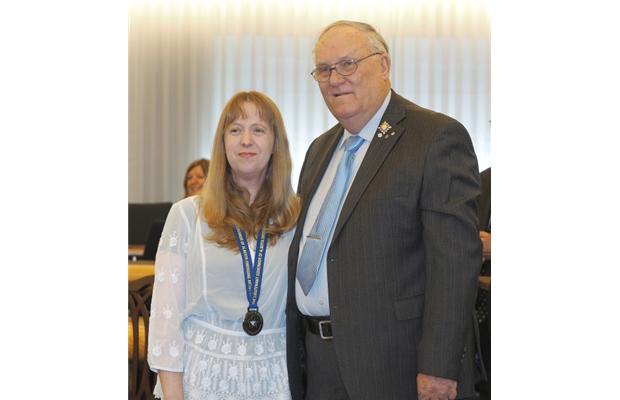
Me and the Honourable Donald Ethell, Lieutenant Governor of Alberta

Me and the Honourable Donald Ethell, Lieutenant Governor of Alberta

Just like the day years before when I was in this same room watching my extraordinary husband receive an award from the Department of Justice for his service as a prosecutor, the line from the bio that drew an audible murmur from the crowd was the one reporting our roster of sons. Lawyers, artists, everyone has something to say about a large young family.

Even His Honour mentioned it as he slipped my medal over my head. “With all the writing you do how did you find time to have so many children?”

“They were thrust upon me,” I said.

My mum loved that.

He recognized the pair of my boys sitting the audience. “Where are the other ones? In school?”

I shrugged. “I sure hope so.”

At the luncheon afterward, my boys didn’t fail to appreciate the never-ending platters of dainty sandwiches and sweets. No matter how nice they are, I have a hard time stomaching refreshments at events and it was good to see someone from the family eating my portion.

My sons met His Honour, Her Honour (his wife), their red-uniformed aide-de-camp, the Minister of Culture, the Mayor of the city of Red Deer, and a real live professor from the University of Alberta — the school my oldest boy will be attending in the Fall. The professor, Douglas Barbour, was there as a guest of one of the other artists but he also happened to be the instructor of the only senior-level English course I ever took.

My Family and the Lieutenant Governor

A Bit of My Family Meets the Lieutenant Governor

Several times during the boys’ fancy morning out, I overheard strangers asking them if they were proud of their mom. It can be an eye-roller question — even for me, someone who prefers the term “pleased” to “proud” since it travels without the negative baggage and misunderstandings that can come with “pride.”

People in their late teens aren’t renowned for being gracious. They don’t efface themselves like I do but they scoff and sigh and shrug. And the truth is, my accomplishments have meant the boys’ childhoods have been lean on motherly touches like homemade baking and chauffeur service to school.

I kept smiling but I braced myself as I listened to my boys make their answers at the Lieutenant Governor of Alberta Emerging Artist Awards luncheon. In replying to kind strangers who wished us nothing but the best, the boys set aside any cynicism, bitterness, or semantic fussiness to answer with pleasant enthusiasm – enthusiasm for me and the tumultuous, demanding arts career that may have affected their lives as much as mine.

“Award-winning” at the Last Minute: I Am No Paul Henderson But…

My dad has shown me enough inspirational sports movies and documentaries for me to know it’s best to wait until right before the buzzer sounds at the end of the game to score a big goal.

That’s the way the literary awards season for my debut novel has unfolded. The book was released in August 2013 and I sat here quietly and morosely ticking off each of the season’s awards as their short-lists were announced without my name on them. I got to watch kind well-wishers saying it was too bad I was overlooked and while that went a long way in buoying my spirits, it didn’t give me and my novel any grounds to be called “award-winning.”

Near the end of the season, I was named on one shortlist but, while I appreciated the honour, the award was a bad fit for me and I didn’t win it.

Since it’s Fathers Day this week, I’ll tell the rest of the story with a Canadian hockey history analogy.  Let’s just say it was the final seconds of the third period of the literary award season…

“Henderson made a wild stab for it and fell”

… when I got a phone call…

“Here’s another shot right in front of the…”

…congratulating me on winning the 2014 Lieutenant Governor of Alberta’s Emerging Artist Award.

“Score! Henderson!”

It finally happened. I won the last award I was a contender for this year – scored on my last chance to claim the “award-winning” designation, right before the final whistle. Along with the rights to “award-winning” it comes with a prize, a medal, media coverage, and a fancy ceremony with His Honor. I’m one of eight recipients chosen from a wide range of artistic fields to get the award. I’ll find out who the rest of them are at 10am today at Government House in Edmonton.

I couldn’t be more pleased or more grateful to the board for selecting me. Yay!


[Thanks (and apologies) to hockey legends Paul Henderson and Foster Hewitt.]

Morbid in the Mountains

April and Chris Demes’s guitar birdhouse in Hill Spring, Alberta as posted on canadiangardening.com

My May began with a literary festival in a world class city and ended with a book club in the village of Hill Spring, population not quite 200.

This book club was hosted by my friend and fellow writer April Demes.  Years ago, when we first met, April was an arty, precocious teenager and I was a newly married 21-year-old who knew EVERYTHING.  Now that we’re older, we have more in common: gardening, bird watching, CBC Radio, pretty blond children, and writing.

Despite their idyllic Rocky Mountain surroundings – a white house on the side of a green hill where a repurposed guitar is nailed to a tree as a birdhouse – April’s family hasn’t been luxuriating in a quiet simple life.  (Quiet simple life is a myth.  If we think we know someone living this way, it’s a sure sign we don’t know them very well at all.)  While still in his 30s, her husband was afflicted with cancer, right inside his skull. They nearly lost each other.  That my novel strikes any kind of chord with April is a great honour.

The Hill Spring book club was one of my favourites.  It was peopled with bright, interesting women of varied ages and backgrounds – some of whom may be distantly related to my well-connected husband.  They came prepared with questions and we had a great discussion about love and death and the writing process.  But it wasn’t because everyone unreservedly loved the book.

One of the ladies who enjoyed the book described her grownup daughter’s reaction to it.  They’d been reading aloud and the daughter stopped when the narrative got too “morbid.”  There is a fair bit of death and death paraphernalia in the novel.  It begins in the title and never really lets up.  It can be tough for some readers to see through it to the tenderness that is the real point of the book.  Sometimes, they dismiss it as “morbid.”

Strictly speaking the word “morbid” means sick, unhealthy.  I flinch when I hear this word used to describe my book.  Writing in frank, practical terms about loss is not something I consider unhealthy.  Not everything that’s uncomfortable – exercise, pelvic exams, insulin shots – is unhealthy.  Willfully ignoring the difficult and complicated process of dispatching our loved ones until we’re devastated by a crisis is what seems unhealthy to me.  As I wrote the book, “morbid” was not my aim – quite the contrary.

While I’m no longer surprised to hear “morbid” spoken at book clubs, I was surprised to hear which part of the book made the lady’s daughter squirm.  It was the chapter where the main female character is cutting up a grocery store chicken, making dinner.

I hate cooking more than most people.  I wrote about cutting chicken honestly, flaunting but not exaggerating my perceptions of it.  “Take that, cooking.  You’re gross.”  But even someone who abhors cooking as much as I do probably doesn’t find her own kitchen a morbid place.

Please enjoy this photo of a butchered chicken

Maybe death is the same.  Life on Earth means eating and it means dying.  Both are messy, inevitable, and natural.  It doesn’t matter how healthy or vibrant or “morbid” any of us is, we all have to eat and we all have to die.  It remains true even if we don’t want to know anything of the finer points of how either is done.

I don’t make money on book clubs but I did sell two books in Hill Spring.  One was to a lady who came to the meeting without finishing the book.  It was morbid, she said, but after hearing the rest of us talk about it she’d decided to give the book another chance and invest in her very own copy (personally defaced by me) instead of borrowing April’s.  She was willing to question her sense of what’s morbid and consider changing her mind.

It may have been the most gratifying book club comment ever.

Down the Rabbit-hole, or, Jenny’s Adventures in the American-Mormon Book Scene

I’m churchy, okay.  I’m not even sorry.

I wrote a novel about people who quote the Bible at funerals, have a large family, and conspicuously don’t drink coffee.  I wrote a book with the words “Joseph Smith” printed in it.  In case anyone missed it, my characters are Mormons and so am I.

Like all writers, my goal is for everyone to read my book.  Everyone includes my fellow Mormons.  The Church is active throughout the world but its densest concentration of members is in the American state of Utah.  By the time my book was released, I had only been to Utah once.  It was when I was twelve years old and caught in one of my parents’ horrifically hot transcontinental summer road trips.

As a grownup author with a book to promote, I didn’t know how to begin to infiltrate the Utah market.  I picked through the Internet until I discovered the Whitney Awards.  They were invented to recognize fiction produced by Mormon writers.  It was a longshot but a few months later, a panel of judges selected my book as a Whitney finalist – one of the top five in the general fiction category.

And that’s when I tripped down the rabbit-hole.

I’m still a novice when it comes to understanding fiction considered “Mormon.”  I haven’t learned all its terminologies and talking points.  Please forgive any rookie misconceptions here.  As far as I can tell from outside the scene, “Mormon fiction” means several different things.  It has to since the Church is large and varied enough to include all kinds of people with all kinds of tastes and reading and writing levels.  Contrary to nasty, simple-minded fairy tales, there is no monolithic Mormon person.  Insisting there is would be calling on a stereotype and it’s as unfair to apply a stereotype to a religious group as it is to apply it to any other bunch of humans.whitneysepia

Far from being a unified movement, the Mormon book-scene is multi-faceted.  Within it there are writers who craft books intended solely for Mormon audiences.  They produce mainly historical fiction, kissing-only romance, inside jokes, and heartwarming lessons.

There are also Mormon authors – big commercial names like Brandon Sanderson and Stephanie Meyer – who write mass market speculative and young adult fiction.

When it comes to literary fiction, much of the book-length Mormon-y stuff is written from the negative perspectives of disaffected members – people who don’t like church anymore.  Some of these writers – no one famous or influential enough for me to spontaneously remember their names – loudly reject the idea that there can be a “Great Mormon Novel” that combines good literary fiction with Mormon orthodoxy.

I didn’t know this a year ago, but I’ve heard there comes a time in most Utah-Mormon writers’ careers when they must ask themselves if they’re going to work within the Mormon niche or in the mass market.  I have never asked myself this question.  Until recently, the Mormon book-scene hasn’t been part of my consciousness.  I’ve missed out on some good contacts and mentors because of that but I’ve also been spared some self-consciousness and second-guessing – the burden of a complicated, value-laden artistic and intellectual drama.

It was when my novel was named a Whitney finalist that it started to get traction in the Mormon book-scene.  At first, it was received with enthusiasm.  Kind reviews started to appear.  People were happy to read my book.  It unwittingly defied critics and filled a literary void in the 2013 Mormon publishing calendar.

What I didn’t understand was that all this goodwill was coming from just one corner of the book-scene.  I hadn’t counted on the larger, sometimes more petulant corner that prefers to have its heart warmed, flipped over, warmed again, flipped over, warmed again…  From that corner, literary work often seems risky and dangerous and pretentious.

I was about to learn this in an episode I’ll call “Off With Her Head.”

There’s a newspaper in Utah called Deseret News.  It’s not run by the Church but it is owned by the Church.  A freelance book reviewer assigned by Deseret News – a woman the same age as my mum — really, really hated my novel.  I can’t find a way to say this that doesn’t sound like bragging so I’ll just blurt it out.  I don’t have much experience with bad reviews.  The fact that this reviewer didn’t like the book was strange and disappointing.  But that wasn’t what made me sick about it.

The reviewer didn’t actually say much about the book – nothing that can be traced back to the text, anyways.  Instead of offering an analysis of the story, she chose to denounce it via the lowest road there is: the one that ploughs through my quality as member of the Church.  In this review, my book — and by extension myself — was pronounced “not the perspective of the Church.”

A complete stranger had called out my work in a Church-owned publication as bad Mormonism.  I don’t know how other churches work but in my Church, book reviewers aren’t supposed to have the authority to say what or who is or is not doctrinally orthodox.

Now, the last thing a novelist should do upon getting a bad review is challenge the reviewer and her editors about it.  Everyone knows that.  We are aloof artistes.  We ignore and move on.  But the reviewer had raised issues outside my book.  She’d attacked my integrity and fidelity.  It was so far offside I blew the whistle.

I complained first to her immediate editors.  They ignored me (though the reviewer showed some shocking hegemony when she wrote back telling me it is indeed her role to warn innocent readers when books “don’t match up” to good Mormon doctrine). Fuming, I wrote to the president of the newspaper.   Within half an hour of sending that email, Deseret News apologized, took the offensive comments out of the review, and asked me to forward the email where the reviewer voiced her absurd self-appointed mandate to judge my orthodoxy.

My novel had become controversial and polarizing.  When the controversy wasn’t terrible publicity, it was great publicity.  In the days after the review, people defended my work.  This included an old family friend who is actually an ecclesiastical leader in the Church. He likes the book, doesn’t find it doctrinally subversive, and when he read the review he wondered, “What book did she read?”

After all this, I decided to travel to Utah to attend the Whitney Award ceremony anyway.  I’d been tumbling down the rabbit-hole of the Mormon book-scene long enough to start to examine my surroundings and the other objects falling with me.  I was curious – perhaps morbidly so – and wanted to land in that world and move through it in the physical universe for a little while.

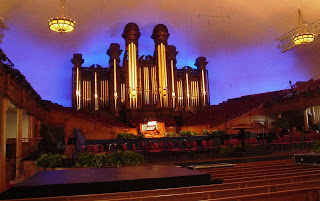
Once again, my parents were my traveling companions in Utah.  We had the good fortune to be in Salt Lake City’s Temple Square during a quick, free concert played on the massive pipe organ inside the big church that puts the “Tabernacle” in the “Mormon Tabernacle Choir.”  We all agreed this was the highlight of the trip.  Instead of indulging himself with a fussy highbrow organ piece, the organist played accessible songs – organ pop-songs with swelling choruses and big finishes like sonic tsunamis.  They were loud and fancy – songs meant to show us what the old pipe organ could do, sounds that vibrated through our chest cavities as if we were part of the instrument ourselves.  The organist was playing to the hearts and souls of musical Philistines like my parents and me – and we loved it.  It was exactly what we wanted.  There are times and places to play to more subtle and discriminating tastes but this was not one of them.
Back at the Whitney Awards, things weren’t going so well.  I’d brought books to sell and in an entire day, I’d sold one.  Sure, it was to the fiction editor of Sunstone magazine but – come on.  At the banquet I accidentally flung my tough cut of sirloin into the front of my dress and, of course, I did not win a Whitney Award.  I’d been nominated alongside three romances and a buddy-road-trip novel.  The best and most literary of the three romances won.  For the overall best book award, another romance – self-described as Bronte inspired — was the winner.  I was a little offended when, in her acceptance speech, the winner made comments that could have been construed as her claiming to have won because she had prayed harder over her book than the rest of us (again with the beside-the-point piety rankings) but other than that, the award made sense.

See, the final round of the Whitney competition is a popular vote.  It’s like a free, quick concert on an ostentatious pipe organ.  It’s got to be a crowd-pleaser, an easy, emotionally satisfying romp.  That’s just what it is.

What I do appreciate is that someone in the previous selection round, one or more of the Whitney judges, had stuck their necks out and brought my novel – a literary piece, a critic-pleaser by an obscure foreigner – to the Mormon book-scene’s attention.  The Whitneys aren’t really the time or the place to celebrate a novel like that – not yet, anyways.  But someday they might be.  This year, maybe they came a little closer.  Maybe someday that mythical “Great Mormon Novel” will appear on the scene and by then even the most guarded reviewers in the Deseret News will have learned not to be angry and afraid of it.

Until then, take my novel, Mormon book-scene.  Take it into your Wonderland and let it wear away some of the harshness of the hegemony still lurking there.  Grind it up, add its few small grains to the foundation being built for something better than what’s there now.
If Looks Could Kill: Why My Characters Have No Eye Colours

In preparation for an upcoming multi-author book event, I’ve been reading novels outside my usual range of Can-lit and literary fiction.  The atypical reading choices I’ve been making have been eye-opening – literally.  So far, what’s struck me most in my venture into crowd-pleasing commercial fiction is the diligent reporting of characters’ eye-colours.

Maybe everything I know is wrong but for me, all on its own, the colour of a person’s eyes determines nothing about how they experience life.  Okay, I admit my blue-eyed family may do more than the average amount of squinting in bright light.  And if I ever produce a brown-eyed child while married to my fellow blue-eyed husband, it would add some horrible drama to our home-life.  But most of the time, iris pigment is not the crucial narrative factor a random sample of Western pop-fiction might lead us to believe it must be.

Mentioning eye colour in literature can be a nice touch — like writing at length about a sunset or the ocean or whatever. (Writers can get away with a lot in the name of world-building.)  And in the right context, eye colours can be important story elements.  In Irving Berlin’s Easter Parade, Judy Garland closes her eyes and tests Fred Astaire’s devotion by challenging him to remember her eye colour.  Even as a kid watching the old movie on TV with my mum, I knew this was an important moment.  It advances the plot, reveals something about each of the characters, and it’s hecka sweet.  Well done, 1940s film-makers.  Look at you, making eye color genuinely relevant and letting it arise organically from the narrative.  That’s how it’s done.

The same could be said for any detailed description of characters’ looks.  Descriptions can work to propel the story, motivate actions, explain character traits.  But sometimes they’re dumped into a story apropos of nothing.  It’s as if we’re driving along an icy street and someone yanks up the parking brake and we’re flying in a circle for a moment, calling out eye and hair colours, spinning out of the true direction we’d been traveling.  Or it’s like the story has deteriorated into a junior high school Language Arts lesson and we’re now outside the narrative reading a “character sketch.”  At their best, character sketches are just exercises meant for the writer’s purposes.  They’re notebook scribbles, not even first drafts, and certainly not good reading.

I hope all of that sounds technical and reasonable.  Here’s a personal reason why I write without bothering to explain the minutiae what everyone looks like: I don’t care.  I honestly do not care what people look like.  That’s not to say I’m any less shallow than anyone else – I care far too much about how people smell – but it is to say that when I’m choosing what to pay attention to, a person’s looks aren’t all that compelling.

When I’m acting as creator of a book-world, I let everyone look the way readers want to imagine them.  That’s done by forgoing physical descriptions I don’t need for plot and thematic reasons.  Giving up the creative control that comes with dictating everyone’s colour palette is worth the sacrifice if that’s what it takes to keep physical traits from interfering with everything else I’m trying to say.

Describing a human being’s looks – even a fictitious human being’s – is actually not like describing a sunset.  It might feel idle and innocuous but it’s not.  Sunsets don’t come with politics.  People do.  Spelling out physical descriptions can introduce prejudices and tropes that distance readers.  If that’s what an author wants (and sometimes it is), carry on, I guess.  Descriptions also run the risk of fueling male gazes and other sources of negative stereotypes. They can end up assuring readers certain appearance-based prejudices are right and fair.  I have a revulsion to abetting that.

In the novel Eleanor Rigby, Douglas Coupland deliberately withholds the information that the narrator, a woman, is overweight.  He allows the reader to discover her through what she does and says and only later introduces what she looks like.  The delayed fat-reveal is brilliant.  I was surprised at how it affected me.  I am not a fat-shamer.  I’m not fat myself (she rushed to say) but during my most intensive baby-raising years I was a bit of a chubby-chick.  It runs in my family.  I love fat people.  I understand on a deeply personal level that they are not lazy or greedy or bad.  And it meant I was shocked at how my vision of Coupland’s character unwittingly changed for the worse after I read she was fat.

To add another layer of complexity, Coupland’s narrator challenges the reader, saying we must have been able to tell she was fat before the reveal, as if something so fundamental must have been visible all along.  Of course, it wasn’t.  Her looks don’t make her any less human or relatable as a character.  But it’s only through withholding a physical description and showing us our own reactions to it that Coupland demonstrates the depths of our appearance-based prejudices and how easy it is for writers to be complicit in maintaining them.

By the way, Judy Garland’s eyes – they were brown.


Love and the Library

My husband got me chocolates just like I ordered for Valentines Day today. And, by playing muse to my novel’s “Brigs,” he also indirectly got me this: a recommendation from the Edmonton Public Library’s “Great Stuff” curator, Diego Ibarra. See?

Really needed that today.  Thanks, fellas.

Nothing Comes from Nothing: Reading Eric Freeze’s “Dominant Traits”

Dominant Traits, by fellow “Ridgeview” High School Alumnus, Eric Freeze

I never read faster than when I’ve found a short book written by someone I know.  It’s especially true when that short book by someone I know is also a good book.

That’s the experience I had blazing through Dominant Traits, a collection of short stories by Eric Freeze.  Eric and I went to the same high school – the one I came to in grade eleven and into which I never became fully socially integrated.  He was in the show-choir/theatre scene and I was an egghead poor-girl whose only extra-curricular pursuit was a part-time job.  We were not close.  But in a small school where everyone had some knowledge and experience with each other, Eric and I had good will between us.

This good will, our high school, writing fiction, and seeing it published aren’t the only things Eric and I share.  We have both set stories in the same southern Alberta town where we went to school, the place that inspires his “Ridgeview.”  We both write fiction deeply rooted in real life.  I read his collected stories out of sequence and noticed real life first in “A Prayer for the Cosmos” when the narrator refers to an infamous pep rally where dear old Ridgeview High School made a casual racial slur against an exchange student basketball star playing for a rival school.  Something like that really happened.

Then there was the story about the awkward white rural kid who thought of himself as a rapper.  When I first came to Ridgeview, I assumed this kid must have been playing a character, trying to be funny.  He wasn’t.  It was excruciatingly embarrassing.  I tried to ignore him.  I guess it worked.  I hadn’t thought about him for decades.  He’s probably grown up and put his rapper days behind him.  But then, in Eric’s “Francis the Giant” story, there he is again, not grown up at all, falling down on-stage in this MC Hammer act, and I can’t look away from him.  Eric’s fiction folded the kid’s story into the accordion fan I hadn’t realized it had always been for me.  There was the real kid, his act, my initial confusion about the act, the fictional character arising from the kid, and then the hallucinated transformation the character makes within the story, changing from a scrawny teenager to a giant, leech-flinging monster.  We are everyone around us.  We’re folded into accordion fans with everyone we know.  Their stories are rightfully ours, the opposite sides of our own folded surfaces.

“He’s doing it,” I thought as Eric’s stories started to bend into my own experiences.

I do it too.  Last night, at a literary event in Edmonton, I read one of the chapters from my novel that is crafted very much like an event from my family’s real story.  Afterwards, as I signed her book, a nice lady asked if the book was fiction or not.  I grinned, “Yeah, it’s fiction.  But it cheats.”  She seemed pleased.  Readers love cheating.

Though I’ve been on the giving end – force-feeding my family, friends, and high school classmates doses of our histories, fictionalized, printed, bound between the brittle, narrow margins of my perspective — I don’t think I’d ever been on the receiving end of this kind of storytelling in so direct a way until I read Eric’s book.  Seeing it from the other side had a much greater impact on me than I expected.  I didn’t just smirk knowingly and say, “Ah, yes, it’s this.”  Instead, my heart lurched inside me when I realized Eric’s “Torched” – a piece about a roofing crew grappling with the tenuous mortality of men early in adulthood — includes the story of a boy from our school who suffered an oddball head injury riding a bike in the dark.  Even though he seemed to recover from the accident, he suddenly died from the injury a few years later.  It’s weird but true.  There’s a monument to it in Eric’s book.

It was good for me to read Dominant Traits.  It ambushed me even after a mutual friend, the eye on the cover, and my cursory grasp of ancient Ridgeview gossip warned me the book was closely connected to things I had seen and heard for myself.  Reading it helped me consider my own writing in a new way, with greater empathy, with more tenderness and patience for what I demand of everyone.

Here was another writer not only playing my game but playing much of it on the same field – the same place and time.  Sure, his “Ridgeview” is different from mine.  He lived there as an insider (compared to me, anyways) and as a boy.  Unlike Eric, I would probably never attempt a story about cattle castration.  That is not my Ridgeview.  But I knew the convenience store, the comically wide roads, even the squeak of the gym floor, though I usually only heard it through closed doors.

Closed doors – that brings me to the point where I prove I don’t give old high school classmates free passes in book reviews.  The collection, in many ways, is men’s fiction — if the prevailing literary privilege will allow me to talk of such a thing.  It’s smitten with the male problem of imagining erections and ejaculations are far more salient in the world outside their own pants than they actually are.  The other half of humanity rolls its eyes, scoots to the cold side of the bed, and tells those Very Important erections to just go to sleep, for crying out loud.  I’d like to see a man my age write a meaningful, earnest, literary love story without any penises in it.  I’m not protesting out of stodginess.  I’m protesting because I’m tired and disappointed with male (and often female) writers taking the slimy, easy shortcut to writing about intimacy.  Work at sex and intimacy in a different medium once in a while, fellas.  Feel free to prove me wrong with examples in the comments.

In the age of “post-fiction,” writing from life is accepted and understood, sometimes preferred.  Maybe it’s not considered cheating anymore.  I don’t believe in creation ex nihilo – that everything we know must have been created by some kind of magic out of emptiness.  I don’t believe in it physically or artistically.  Ex nihilo nihil fit.  I’d wager Eric Freeze doesn’t believe in it either.  Everything created is organized out of pieces of things that are here already – Big Bangs exploding whenever someone or something comes crashing through us.

Writing Without a Grant: Girl in a Post-Shteyngart World Tries to Feel Smug About It

If Can-Lit is subdued by government grants it’s got nothing to do with me.

Between spurts of productive work on my latest just-keep-swimming short writing project, I indulged my bad habit of listlessly scrolling through my Twitter feed.  The Canadian literary community – for all you normal folks out there – is ravenous for controversy.  We love and hate to have a focal point for cheeky, gleefully indignant tweets and blogs.  This winter, controversy flared up around comments 2012 Giller Prize judge Gary Shteyngart made while drinking with a reporter in New York City.  He said something about Can-Lit lacking risk-takers.  His now notorious explanation was that Canadian writers “all get grants” and therefore “they want to please the Ontario Arts Council, or whatever it is.”

Now, anyone who follows this blog knows I came to be a working writer through unconventional channels.  I don’t have an MFA from any of the creative writing programmes where Canada’s up-and-coming literary talent is usually hot-housed.  I live in a rural area where the local literary fiction circle includes me and my lovely neighbour.  I have never worked in publishing.  And, I have never received any grant money.  No arts council – certainly not the faraway Ontario Arts Council – has ever funded my work.

In the spirit of Can-Lit-Da’s relentless self-reflection, I considered what Shteyngart’s comments (which he later joked should be taken in the context of his “drunken stupor”) say about me.

For one thing, there isn’t much room in his comments for me.  I disprove his over-generalization.  I wrote a manuscript and sold it to a traditional literary publishing house without applying for, let alone getting, a government grant.  Maybe I can ignore everything Shteyngart said and join the cheerleaders tweeting titles of great, “risky” Canadian books which may not have been (but probably were) written by grant recipients.

Or, I could feel robbed.  How fair is it that I work in a country that seems to have an international reputation for being glutted with arts grants of which I’ve never been paid my share?

Or, I could embrace Shteyngart’s assumption that writing needs to be somewhat staid in order to get the bureaucratic rubber-stamping of a government grant.  I could try to spin my grant-free-working-writer status as a sign that my stuff must be subversive and edgy — the kind of thing lucidly drunk, chatty New York City hipsters might find interesting.

There might be a bit of support for the third option – the fun, cocky, unlikely option.  We haven’t had a bad review of my novel but we’ve seen it described over and over again with words like “odd, strange, surprising” or “unusual.”  I knew when I was writing the book that it was peculiar and I had to keep writing it that way regardless.  And now — if Shteyngart is right — I have the distinction of writing it without a grant and thereby proving what a weirdo I am.  I should revel in that, I guess.  There’s not necessarily anything wrong with it.  There could be a whole lot right with it.

Yeah, all this reasoning is a bit of a stretch.

I don’t know if what I do is at all risky.  Frankly, it’s 2014 and I’m not even sure I’d recognize a new literary risk if I saw one.  And I can’t deduce a risk by whether there’s anything entered on the grants line of an income tax form.  Like most people, I just write what I want to write, whether anyone wants to pay for it or not.