Facing Up to Poetry

What the poets are doin’ – 2013 Poetry Prowl in Red Deer, Alberta. Photo by Grant Ursuliak

There’s an old Jerry Seinfeld joke rooted in a dubious claim that more people fear public speaking than fear death.  Seinfeld’s punch-line (in case anyone out there missed the 1990s) is “to the average person, if you have to go to a funeral, you’re better off in the casket than doing the eulogy.”

It’s probably a better joke than it is a reliable piece of social science but there is a glimmer of truth in it.  Speaking in front of a crowd can be scary.  However, we all know a lot of scary things are also fun.  And while I don’t enjoy thrill-rides like sky-diving or giving high-strung driving lessons to my kids, I do enjoy public speaking.  I might even be good at it.

So I was surprised at myself when I realized late in my 30s that since I’ve started writing professionally, I have never stood up and read my work out loud and in public.  I’ve done some radio work but those productions were easy and chatty — not much like careful, literary writing where even tiny prepositions are weighed against something vague and dynamic called “art.”

Art is another one of those things that’s frightening and beloved at the same time.  It needs to be worked out with reverence and caution and that can make handling it in front an audience an intimidating prospect.  But I don’t think the gravity of art is what kept me from finding venues for reading my work to strangers.

The first obstacle was simply time.  With a larger than average sized family, my mommie gig is a larger than average sized time commitment.  That’s the easy excuse.

The more complicated excuse is full of traumatic memories from junior high school – some adolescent persecution over the fact that the perfectly fine face I inherited from my grandfather didn’t play so well on a young girl.  I’ll spare all of us a recital of the harrowing details.  It’s enough to say that the long-term effects aren’t simple and superficial.  They’re not the kinds of things that can be undone by Dove soap commercials.  And it means that I mistrust my face – the one that has stayed happily hidden on the radio and in print.  My face has sabotaged me before and, even though junior high was long ago, I still look like my grandfather and it makes me wonder if his lady-fied face might distract and disturb my presentation of my art.

Of course, all of that’s nonsense and it’s time for it to end.  And it did, a few weeks ago.  To celebrate poetry month every April, a group of poets from Calgary (the big city two hours south of my neighbourhood) travels through what is invariably terrible weather to spend an afternoon in the small city of Red Deer meeting those of us toiling in obscurity.  The event is known as The Poetry Prowl.

It’s fabulous – far better than I expected it to be.

The other poets at the event were high quality artists.  They were editors and writing instructors as well as artists – educated, experienced, and highly polished.  The chief organizer, Emily Ursuliak, even managed to bring along the city of Calgary’s current poet laureate.  The local contributors — all men except for me — were delightful too.  Performance after performance, I was pleased and surprised and honoured to be included.

What was nearly as impressive as the poetry was the personable warmth of the poets themselves.  Despite the haughty ring to his official title, Calgary’s Poet Laureate, Kris Demeanor, backed up some of his work by playing the pink acoustic guitar strapped around his back with a lace from a hockey skate.

The more educated and decorated the poets were the more humble and decent they seemed to be.  The man who’d written articles on “the philosophy of death” for academic anthologies gave me his program when he saw I didn’t have one and apologized that his bio in it sounded so much like a CV.  I pointed out that mine sounded like one too only it wasn’t nearly as impressive.  And my bio wasn’t just a CV it was also a plug for my upcoming novel.  So, yeah – there’s nothing to apologize for here.

Since re-entering arty society, I have no proof that the cold-hearted, self-involved, hipster jerk stereotype actually exists in real life.  So far, everyone I’ve met is lovely and collegial.

And by the time I was introduced and called to the microphone to read my work – the small collection of short poems I’d written during the Dark Ages of my artistic career when “creativity” was more literal than literary and meant blood and amniotic fluid and breastmilk – I wasn’t afraid to match my work to my face anymore.  I owned my physical appearance.  I joked about it, referred to myself with all irony as a “trophy wife” and let everyone laugh with me.

It had to happen.  I’m glad it did.  I can now say I’ve put all of myself into my work – even my face.

Carbon Copying Vulcan – Shreds of Reality in Fiction

The Roman God Vulcan, smashing stuff

If my youngest brother-in-law was a Roman god, he’d be Vulcan.  Wait — let’s not let Star Trek confuse us.  I’m not trying to say he’s cold and hyper-rational and his sleeves are too short.  He’s like the original, Classical Vulcan — fiery and powerful and smart.  Like Vulcan, he makes his living building things out of metal with torches and hammers.  When he’s having fun, he still likes to yell and hit things.  I adore him.  And if I was a goddess, I’d be Juno, the shrill but scary wife of the boss-god Jupiter (Zeus, to all you Greek fans).  I also like to yell and hit things.  It’s a sign of enthusiasm and love.  Both Vulcan and I understand that very well.

In the years and years I’ve known him, Vulcan has not been a voracious reader of contemporary Canadian literary fiction.  It’d be out of character for him to rush out and buy my novel when it’s released this August.  But I hope he will.  In order to encourage him, I did what Juno would do: I got up in his face and bullied him about it.

“Hey, are you going to buy my book when it comes out?”

He paused.  “Uh — how much money will you get from each one?”

It wasn’t the response I expected.  “I don’t know,” I said.  “About two dollars maybe?”

He reached into his pocket.  He said, “How about I just give you two dollars right now?”

“What?”

The Roman goddess Juno

He was laughing at me.

“You have to read it!” I bawled at him.  “You have to.  Because…”

This is where my Juno started to lose her nerve.  Even with my loved ones, I am a shy, apologetic promoter of my work.  I tell my friends and family where to find it and then I leave them alone.  There’s no follow-up – no awkward audit of their patronage of my art.  My loud, bossy questioning of Vulcan was not about getting him to cough up a twoonie.  It was about something much more delicate.

He was standing in front of me, towering over me, one hand still in his pocket.  He was looking down with his big brown face, waiting for me to finish.

I began again.  This was important – something between a warning and a gift and a confession.  “There’s this character in the book – and – he might seem like he’s kind of like you.”

Vulcan’s eyes got a little bit bigger.

“But he’s not you,” I hurried.  I explained there’s a scene in my novel where a woman meets her in-laws for the first time.  That meeting is written a lot like the time I first met Vulcan, when I was twenty-one and he was not quite ten years old.

“They’re not us.” I said again.  “They just look like us for a minute.  The little boy grows up and does things you don’t do.  He’s not you.”

“But someone might think he’s me.”

“Yeah.”

“Would he be in the book if you didn’t know me?”

Strictly speaking, it’s an impossible question.  How can I say whether I could have imagined someone so much like my brother-in-law ex nihilo now that I already know him?

What I could say was this.  “If I hadn’t lived the life I’ve lived, I wouldn’t have written the book the way I have.”

This was honest and fair to both of us.  The fact is I could have this same conversation (hopefully without the offer to pre-emptively buy me off) with dozens of people.  There are sparks and shreds and sometimes even long swaths of all sorts of real people in my work.  It feels inevitable.  Even if I switched genres and started writing hardcore science fiction, the spaceships and alien planets would still be full of traces of my friends, family, neighbours – everyone.

I’m certainly not the only writer who’ll admit this.  In an excellent essay, novelist Corrina Chong reflects on “writing as thievery.”  She says, “here’s the truth behind the fiction: as a writer, I am a thief…My writing is a collage of the bits and pieces I’ve stolen.  Once your piece is glued on, it’s no longer yours.  Finders keepers, I say.”

She sounds flippant but writing real life into fiction isn’t something done lightly.  We agonize over it.  We weigh the benefits of doing it against the risk.  And we understand the people unwittingly serving as our literary models might not agree we’ve struck the balance right.  Frankly, it’s scary.

Chong goes on to acknowledge that this theft is actually more like an exchange – a swap.  She says, “the very act of writing a story and releasing it out into the world assumes that readers will be able to see something of themselves in the characters, thereby stealing their own little pieces as keepsakes…any idea that rings true in your universe becomes your own.”

Maybe that’s what makes it possible for my self-consciousness at my own thieving audacity to be outweighed by my sense that it’s important for my reluctant, metal smashing baby-brother-in-law to read my novel – the one with a scene rooted in our shared history.  It’s not about the two dollars.  It’s about us.  Maybe that’s why I want all of the poor souls I’ve pilfered to read it.  I want to complete the second half of the exchange.  I want them to take something from me now – something bigger than my thanks for the inspiration.  Take yourself back, I say, and with it, take a piece of me.

Weekend in Girlstown

Two of my sixteen nieces, lookin’ super girlie — and a little cranky

I was once pregnant with a child I hoped was a boy.  He was — so were his four younger brothers.  It’s been a long time since I’ve lived with any other women.  And it’s been even longer since I’ve lived with any girls.  It shouldn’t matter.  I was once a girl myself and there’s nothing about being sequestered with my sons that can alienate me from that part of my identity.  It should be true.  I believe it’s true.  But I still keep having awkward collisions with little girl culture years after little girls stopped being part of my daily life.

Some collisions are secret and subtle.  I’m not a very big woman.  Shopping for clothing can be frustrating for me.  One of my girl-friends, a lady born in the Philippines who’s learned how to deal with over-sized western clothing, gave me a tip: do some shopping in children’s departments.  It’s brilliant.  The first time I tried it I was like Homer Simpson at clown college turning around in front of the mirror saying, “I’ve never had pants that fit so well.”

Then the saleslady noticed me out on the floor, picking through the kiddie-jeans.  “No daughter with you today?”

“Uh – no,” I said.

“That’s okay,” she allowed.  “If they don’t fit her you can always bring them back with the receipt.”

“Great.  Thanks.”

I skulked away.  I felt furtive and a little ashamed.  I am not a girl.  That’s supposed to mean I don’t belong in the store, let alone in their merchandise.  I don’t know.  Maybe it’s a bit like what closeted transvestites cope with when shopping for clothes outside the ones socially prescribed for them.  I am not a boy but since I have sons, I feel perfectly natural stomping around in the boys’ section stocking up on jeans and navy blue sweatpants for my kids.  But in the girls’ section, in the company of the specter of my fake daughter, I am a pretender – unfit and unworthy.

This weekend, girl culture and I collided again.  My sister was staying at my house while her daughter, my most glamorous ten-year-old relative, competed in a dance festival.  I counted four costume changes – peacock feathers, rhinestones, ruffles, crinolines.  She was plastered in makeup and hairspray.  And my sister – a nursing instructor who can thread a tube into a trachea – struggled to glue false eyelashes to her lids.

My niece is warm-hearted and adorable and had no idea Auntie was eyeing her dance gear with the detached skepticism of a smug anthropologist.  I shouldn’t have been surprised when she asked me to come watch her dance.  The invitation rattled me.  Accepting it meant detachment was not an option and I was being drawn into her culture – one I had abandoned ages ago.

I arrived at the auditorium all by myself.  It felt awkward enough to make me wonder if I was in the right place.  I  asked the ticket seller, “Is this the little-girl-dancing-thingy?”

Inside the theatre, I found my sister.  The lights went down and the first ballerina came out.  She was a sixteen-year-old dressed like a fairy princess.

“Look!  She’s seriously wearing a tiara!”

My sister smirked at me.  “Yes.”

The next number was a whole troupe of teenaged ballerinas.

“They’re all wearing tiaras!”

My sister smirked again.  “Yes.”

“If they’re all wearing tiaras, isn’t that the same thing as none of them wearing tiaras?”

“Shh.  You have to stop laughing or the other moms are going to get really mad.”

“What?  I’m just delighted.”

It was not completely true.  I was vaguely delighted but it was a patronizing outsider’s delight – amused but not quite charmed by the spectacle.  I stuck to my social scientist persona.  The dance numbers – with all their kitschy props and maudlin narratives – had names like “Imagine” or “Grace” or the risky “Images of Grace.”  Even my sister laughed when the lyrics of one of the songs earnestly crooned, “If I could put you on top of a cake I would ice you.”

If there’s a perfect age for amateur dancing it’s got to be the one my niece is at right now.  She’s technically good enough to actually be dancing but not so old that she’s starting to look silly and lumpy in her fancy leotards.  If I was ever going to be able to enjoy this part of her life, it was now.  Her first number was supposed to be a sad commentary on class divisions – at least, that’s what she told me.  But she couldn’t stop smiling while she performed.  The adjudicator complained about it but Auntie loved it.  And by the end, in the dark, up at the top of the auditorium, awkward Auntie became sappy Auntie had to wipe her eyes.

No one gets to be a girl for very long.  And some of us – like me and maybe like my niece too, depending on what the future brings her – end up moving farther away from girl culture than we ever imagined we would, back in the days when it meant everything to us.  Honestly, I don’t miss it.  It was silly and distracted from much of what is truly important.  But maybe there’s no need to be embarrassed about celebrating it every once in a while.  Maybe there’s no need to grudge the breasty teenaged ballerinas for spinning and tip-toeing through their final days in tiaras.  So what if we’re all wearing one from time to time?  We’ll have to set it aside soon enough.

Confessions of a Slow Reader

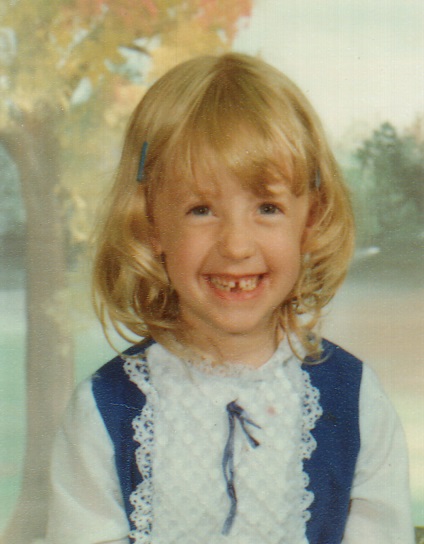
If this old picture of me could talk it would say, "What?"

If this old picture of me could talk it would say, “What?”

I am a slow reader – painfully, tediously slow.  It’s been true since I was in grade two and it’s still true today.  Whether I’m reading aloud or not, I can’t move through a book any faster than the speed of speech – not nearly quickly enough.

If you’re one of the people who’s surprised to learn this about me, thank you.  Most people assume writers are also accomplished readers.  I am not.  I have read and understood a lot of very good books.  But it’s taken me a long time.

Why am I talking about it now?  I just read book blogger Laura Frey’s Can-Lit confessions – a list of hard truths about her experience with our country’s literary canon.  She admitted to not liking, not reading, and being slow to hear about a few of the authors and books considered Canadian classics.  I enjoyed her candor so much I made my own confession about getting through my entire adolescence without reading a single word written by Farley Mowat (as proof of my ignorance, I think I even misspelled his name in my comment).

And then I started considering the short-comings in my own career as a reader.

Early elementary school – the learn-to-read years — was a hard time for me.   In grade one, the fluid left behind my eardrums by a streak of bad ear infections made me mostly deaf.  For about a year, nobody noticed.  That’s how it is with hearing loss.  No one’s to blame.  The loss meant I spent my time at school listening to the dull tides of my pulse moving through all that fluid – fwum, fwum, fwum.  I didn’t realize there was anything more to hear and I thought school was just really boring.  It seemed like we sat in our desks or on the carpet doing nothing at all.

In the second grade, I had surgery, the deafening fluid drained away, and I came back to the land of the hearing to find I’d been bumped from my place in the reading group meant for the best readers in our class.  After all the loud reprimands I remembered little deaf-me getting for not paying attention and not following directions, I figured I deserved the demotion and slunk away with my mediocrity.

Indignant current-me isn’t so sure I deserved it.  I have always understood and retained what I read.  But I will concede this: if we were being ranked based on our reading speed alone, mediocre was a generous assessment of my skills.  Grade two is when I remember Her coming.  She’s this voice in my head – an adult woman’s voice, I don’t know whose – that spoke every word I saw with my eyes.  I couldn’t read any faster than she could talk.  I still can’t.

After grade two, we moved to a new school where my teacher was just as interested in our writing as our reading skills.  She told me I was talented and I became her unofficial language arts protégé – the student invited to the front of the class to read creative writing out loud, at the glorious pace of speech.  No one ever mentioned my reading speed again.  It was my secret to keep.

And I did keep it.  I never cheated but I did learn how to read enough of a book to be able to sound informed about it and no more.  During my Arts degree, I learned how to wade through enough of the material on a course reading list to still get an A.  It was risky and stressful but I simply could not complete all the “required” readings.  There wasn’t time for someone moving at my pace to finish it.

Thanks to the years and years I spent pinned under nursing babies, forced to sit down and hold still and listen to Her, I have ended up fairly well-read.  It was another unexpected irony of motherhood – the way the babies who were supposed to stifle and suppress me ended up being what made it possible for me to become what I wanted all along.  Eventually, I did read everything on the lists from my university classes.  I’ve read hundreds of pounds of thick, daunting prose, poetry, and non-fiction.  And I’ve loved it.

Now that I’ve finished my reading lists — now that the Bachelor of Arts degree hanging in my kitchen doesn’t seem so much like a sham anymore — I can freely admit to anyone that I’m not what people might think I am.  I am a working writer but I am not what my early elementary school teachers considered a gifted reader.  I am not incorrigibly bookish.  I’m still poking my way through the literary landscape, warning my friends I’ll just drag their book clubs down with my sluggish ways.  But I’m working in this field anyway, in spite of my nature.  I’m reading and writing anyway. Maybe it’s true for anyone who tries to write as a vocation.  We’ve probably all got something deep-seated and shame-laden that we had to overcome before we could do this.

I know, it reads like a sports cliche.  But that’s the thing about cliches — they’re tired because they’re usually true.

Review: “The Shore Girl” by Fran Kimmel, NeWest Press

Fran Kimmel’s new novel, “The Shore Girl”

I’ve had my head down, raising my kids, for a long time.  It meant that, when my publisher asked if I knew any well-known writers who could provide “blurbs” (that’s fancy-shmancy publisher talk for short reviews) to put on the cover of my book, I had to confess I didn’t know anyone.

It was a revelation for me.  The silly mystique of writers toiling away in thoughtful silence and social isolation really is a sham.  People who hide by themselves have nothing to write about – except maybe science fiction.  I’ve done all my writing in crowded, noisy houses.  The only thing I’ve been isolated from was other people doing the same thing.  And the time had come to find them.  My publisher was able to take care of the book blurb herself but I still needed to lift my head out of my laundry pile and meet my colleagues.

I didn’t expect it to be easy.  Canada is huge and sparsely populated and its artistic communities are densest in urban areas.  What were the odds there would be another literary fiction novelist living in my obscure little town?

Apparently, they were amazingly good.

After about two minutes on the Internet, I discovered Fran Kimmel.  She’s the author of The Shore Girl, a novel released in Sept 2012 by NeWest Press.  And she’s also my neighbour.  We had “coffee” at our local library’s café where she signed my brand new copy of The Shore Girl.  I liked Fran right away.  She’s closer to my mom’s age than to mine but, thanks in part to my big sister complex, I felt comfortable and happy to be with her.  She was gracious and generous with her encouragement and advice.  I came away scolding myself for not finding her sooner.

There was just one lingering worry for me.  I hadn’t yet finished Fran’s book.  By page eighty-eight, I liked it.  But would I keep liking it all the way to the end?  Not knowing any writers personally meant I could always say whatever I wanted when I finished a book without any fear that the old authors from pre-revolutionary Russia, or wherever, would get their feelings hurt.  What would it mean for our new friendship if I got to the end and realized I didn’t like it?

I read Fran’s book anyway.  I trusted her.  I trusted her publisher.  I read.  And I thoroughly enjoyed The Shore Girl.

It’s told in polyphony, through the voices of half a dozen different first person narrators.  They vary in age and gender but they all have two things in common: a girl named Rebee and the question of whether surrendering power to other people by loving them is worth the burden it brings.

I won’t risk trying to write a detailed plot summary.  I’m afraid I’d botch it and make the book with its unstable mothers, homelessness, and all that alcohol sound like an old after-school television special bemoaning the effects of dysfunctional families on developing children.  That’s not what this is.   Somehow, Fran has taken a set of circumstances that are usually treated in sentimental, tiresome terms and knocked the cloying clichés off them.  The clarity of the details of everyday life – the fingernail clippings and the insides of refrigerators – along with the stoic resignation with which the characters negotiate their difficult landscapes allow a story that could have been mired in gratuitous melancholy to become a story told with sincerity, warmth, wisdom, and even hope.

“It’s not a happy story,” Fran warned me.  She’s right.  But that doesn’t mean it couldn’t leave me feeling hopeful about the resilient, resourceful people who can grow out of tumultuous home environments.  Imperfect, incomplete love is still love.  And maybe — miraculously — it’s enough.

It was with perfect sincerity that I emailed Fran the morning I finished The Shore Girl and congratulated her for writing a very fine novel.  Just one more thing remains unsettled between us: Fran has yet to read my still unreleased novel.  Now that’s scary.

Speaking the Unspeakable: Sex in Books

Anna Karenina – Literary Sex and Death without the heebie-jeebies

It’s an odd talent.  I can stand at a shelf, pick up a book I’ve never read before and, if there’s a sex scene written in it, I can instantly turn right to it.  It’s a mixed blessing, I guess.  Books don’t come with parental guides so if I’m trying to see if a book is “appropriate” for my kids, my amazing talent saves me a lot of time.  But it also means I inadvertently end up looking at book-sex when I’d really rather not.

There are a lot of reasons why I’m not a consumer of the new wave of erotica that’s flooding the book market right now.  I keep away from it even though it’s leveled squarely at my demographic – the settled lady with a mortgage demographic.  I keep away from it even though, thanks to ereaders, it can be indulged in more discreetly than ever before.  I am not involved in erotica either as a reader or as a writer.

But stay with me.

This isn’t a polemic about obscenity.  I won’t bother outlining all my reasons for opting out of erotica here.  Instead, please bear with some thoughts about why, despite its popularity, sexual content is so challenging for writers.

Sex is a bit of a mess.  Attempts to write about sex tend to be messes too.  It’s a problem so notorious Literary Review has been doling out an annual award for bad sex in literature since 1993.  The award began as an indictment of “crude, tasteless, and often perfunctory use of redundant passages of sexual description in contemporary novels.”  Despite the threat of receiving an award like this one, raunchy writing – or at least its profile in the mainstream – seems to be at a cultural high mark.  Since I still only read it when I stumble across it with my magic dirty-book opening trick, I can only wonder if this latest proliferation of book-sex means writers are getting any better at composing it.  But the lively competition for the bad sex in literature award seems to suggest that writers are just as inept at depicting sex as ever.

In the past, writers’ attempts to deal with sex in the context of books may have read as prudish and evasive.  The language used to cloak sex was often so oblique it sounded awkward and far-fetched.  We can’t relate to it and end up laughing and scoffing at it.

On the other hand, more recent attempts to write about sex are ridiculous in a different way.  Conventional smutty romance writers tend to mete sex out with silly jargon and clichés used only in their own genre.  More literary books – especially, as some commentators have noted, ones written by men – offer graphic book-sex that reads like nature film narrations filtered through the imaginations of teenaged boys.  It’s crippled by a detached matter-of-factness, dwelling on body parts and fluids.  The very realism of it makes it alienating for readers and we end up laughing and scoffing at it all over again.

Why doesn’t it work?  This might sound maudlin, but there’s a quality to real-life sex that’s ineffable and transcendent.  It goes without saying that it’s hard to talk about what is by its nature unspeakable.  A good writer can write about a transcendent phenomenon but it’s usually done by writing about everything the phenomenon touches and influences rather than by dissecting the actual phenomenon itself.

Think of some of the very best death scenes ever written – like the scene in Anna Karenina where a man dies of tuberculosis.  The reality of the impending death comes across most clearly for me when a servant attending the sick man mirrors his motion of pulling at his own clothes to try to get more air.  The dying man’s body – including the physical mechanisms that are actually killing him – isn’t the central object of the scene.  A lesser writer might have thought he had to make it so.  But even without a narrative full of nothing but choking and coughing, the gravity of the situation – the fear and hopelessness, the final collapse — is still crushing.

I think the same kinds of principles that helped Tolstoy express the impact of death need to be used when authors want to genuinely and sincerely invoke sex in literature.  Sexual content resonates better when it’s barely there – when it’s offered with a reticence that highlights the power sex has to exceed what it physically touches and pervade all the spaces in between everything in its domain.

To write about sex in graphic detail is to demystify it.  Some writers might crow that this is exactly what they intend.  But once sex is demystified, it’s probably not true to our most meaningful and powerful experiences with it anymore.  Real sex should have a mystical element to it.  Without one, it’s just another mess.

Korean Boy-Bands and Their Feminist Sub-text

I have never actually touched an issue of Tiger Beat magazine – or anything like it.  Even though I was a teenage girl in the days of New Kids on the Block and the Corey phenomenon, I was never into the boy-idol scene.  At the time, it all just seemed totally embarrassing – totally.

But that was before I started raising boys of my own.

Years before I had any kids, I already knew I would try my best to raise them as feminists.  Since it was a decision about my own behavior, it was a promise I could keep and control.  What I couldn’t control was my kids’ genders.  All of my children turned out to be boys.  The utter lack of peer females in our family makes teaching feminism more challenging than I expected.  At the same time, living with my boys has come with some surprising lessons for me about my own feminism.  I’ve found I learn how to be a better girl by raising my boys.

But it doesn’t always happen easily.  I need help.  And sometimes it comes from unlikely places – like East Asian pop-culture.

One night, when the boys were away learning manly things, camping at a mountain lake with their father, I was left alone, wandering through the Internet when I stumbled across this.  This was Super Junior – a staple of the recent East Asian boy-band movement.  It was spectacular and surreal and staggering — thirteen young South Korean men dressed up, made up, dancing, singing and posing while I sat transfixed, half a world away.  At the time, I couldn’t understand a word of anything they said – not even their English.  But that just made the group more charming.  Where the Coreys had failed, Super Junior succeeded.  I was an instant fan – an Anglo-Ahjumma.

When my menfolk got back from the wilderness, I didn’t show them what I’d discovered right away.  I guess I was a bit embarrassed.  Eventually, I showed them anyway.  And their reactions surprised me.

Based on the boy-band trash-talk of the male peers of my youth, I expected my family to hate Super Junior.  I expected to hear echoes of the hostile jealousy of male journalists who still write scathing critiques of boy-bands – rants about not playing their own musical instruments or writing their own songs, gravely benevolent warnings about how their charm is actually a corporate tool meant to exploit the hopes of real girls.  But that wasn’t how my boys reacted at all.  Instead, they seemed just as delighted with Super Junior as I was.

After watching the “Mr. Simple” music video a few times, my husband pleased the heck out of me by announcing it was time for each of us to pick our favourite group member.  Most of our boys chose Eunhyuk.  He’s the one with his hair dyed blonde, like theirs.  He’s the lead dancer who stands at the front of the formation doing tricks.  My husband chose Siwon, the one who comes across as masculine and powerful.  And my favourite was Heechul, the one heckling the rest of the group, being careful not to be caught trying too hard.  I found out later he’s also the one most likely to perform dressed as a woman – a very pretty woman.

Even when not in drag, there is an androgynous quality to all the group members – Siwon’s formidable eyebrows notwithstanding.  Their features are clean and delicate and enhanced with plenty of guy-liner.  Their hair is long and perfect and does not grow out of anywhere but their brows and scalps.  Their outfits are tailored and generously embellished with fancy accessories.

And we all loved it.  There was no shame in our enjoyment of it – no sense of competition, no stupid homophobic self-loathing.  There was just earnest admiration for the amazing show the young men and their stylists and producers put on for us.

The conventional wisdom of social theories about boy-bands usually talks about the pretty-boys as risk-free love objects we girls can cast in fantasy rehearsals of our earliest romantic relationship scripts.  I’ve always found this interpretation kind of sad and patronizing.  There might be some truth to it but I think it misses an important point – a point my heterosexual husband and teenaged sons demonstrated for me.  I could sense it in my own completely non-sexual fascination with the flower-boys too.  We didn’t choose our favourite Super Junior members based on characteristics we’d like to find in a romantic partner.  That wasn’t it at all.  We chose our favourites based on which members had characteristics we’d most like to see in ourselves.  My sons saw themselves in the hot-shot at the front.  My husband saw himself in the self-assured masterful one.  I saw myself in the bossy sophisticate.

Maybe our rationale can be extended to other boy-band fans – even the typical fan-girl who thinks she ought to be in love with them.  Maybe, on some level, she doesn’t admire the member she’d most want to date.  Instead, she might admire the one she’d most like to become.  Apart from being some pathetic attempt to prepare themselves for romance, maybe following a boy-band lets girls try on a male role – a fabulous one.  They’re reaching past the limits of their roles as girls – roles that are usually more constrictive when they’re young than at any other time.  They’re experimenting with being someone else, someone who is a boy.

Is that what male critics of boy-bands truly fear?  Are they afraid the gorgeous androgyny of boy-bands, the generous offering of their fabulousness, opens a breach in the brotherhood?  Maybe the biggest problem some men have with boy-bands has nothing to do with creative integrity or even with jealousy.  Maybe it’s that boy-bands are too dangerously easy for girls to relate to.  They make being a boy – looking like boys look, acting like boys act, controlling what boys control — seem like a role any of us could fill.

And who would want that?

Update: After reading this, a good friend of mine, the biggest Donnie Osmond fan I know, sent me a birthday present.  I am now the owner of a copy of Tiger Beat magazine dated September 1974.  The Tampax ads are spectacular.

The Finder: Neuro-Sexism and Super Heroes

hero

Salon .ll., an online literary magazine, just posted a two-part piece I wrote on trying to keep neuro-sexist fantasies out of my family life.  Neuro-sexism — the belief that men and women are helpless to biological structures that determine our neurological strengths and weaknesses — is a peril for every family but it’s a particularly galling issue in mine.  In my household there are six males and one female.  (And I mean human males.  I’m not cheating and trying to count a bunch of male pets in that ratio.)  The lone female, of course, is me.

One conversation-starter that comes around frequently in our house is, “If you had a superpower, what would it be?”  It’s an easy question for me to answer since I already have a superpower.  And I maintain, no matter what anyone else says, that my superpower has nothing to do with my sex.

Check it out at the links below.

Part 1:  http://www.lindaleith.com/posts/view/256

Part 2:  http://www.lindaleith.com/posts/view/257

An Adapted Novel Excerpt Kindly Published by “Filling Station”

http://www.fillingstation.ca/archive/contributor/jennifer-quist-725

A couple of years ago, while my lonely literary novel was still soaking in publishers’ slush piles, I adapted one of its chapters into a short story and submitted it to a cool, experimental literary magazine  based in Calgary.  (Yes, there’s actually a very fine literary scene in Alberta.)

I called my novel-chapter-posing-as-a-short-story “Pterodactyl Egg” (I still have to spell check “pterodactyl” every time I type it).  The title is a pregnancy reference, obviously.  I don’t like pregnancy but I love this story.  It’s almost completely autobiographical — which means, of course, that I had to tone it down or it would have seemed too far-fetched.

Reality seems so contrived sometimes.  Like the time I went to visit my old lady friend in the hospital where she was trying not to die of some ridiculous infection and I found her unraveling a hand-knit sweater — that was way too real.

And no, that’s not my face on the cover of the mag.

Urban Dork’s First Sleigh Ride

sleigh-fixed

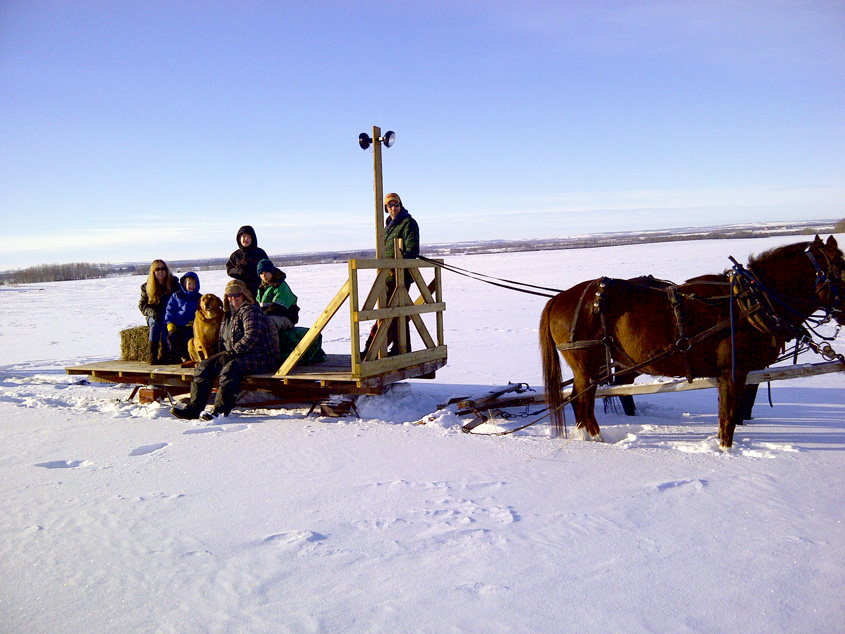
Hey, guess what? Sleigh rides — like the ones in “Jingle Bells” — they’re real. We fell in with some awesome, hospitable cowboys and ended up invited on our own, private sleigh ride earlier this month. I’m the cold blonde chick. The horses are “Zeus” and “Okra.” Why the heck not? The awesome cowboy-people are Darcy and Renee.  And that dog is the laziest non-human mammal I have ever met.