Betty, Veronica, and My First Book Club

When looking back far enough to recall our teen years, it can be hard not to see them as a little mythic.  It’s not just athletes forced into retirement upon their high school graduations who’ll do it.  Adolescent psychology is marked by egocentric tropes like “personal fables” and “imaginary audiences.” To some degree, all kids believe they play a lead role in a Very Important drama staged before an audience of Everyone Ever.  This was true even before kids could tally their tumblr followers and Instagram likes.  I guess it was true for me too.

I went to two high schools.  The first was a huge school in an urban centre on the east coast.  While I was there, it made the national news for a racially motivated brawl.  It wasn’t a place known for school spirit.  We spent our days clustered in cliques, trying not to bother anyone, and then scuttled home.

My second high school was in a small prairie town founded by Christian farmer teetotalers.  The school was an Archie comic.  It came complete with pep rallies, junior prom, football players in lettered jackets, and a fight-song meant for sports events, not in-school race-riots.

The school culture was richer but it was also simpler.  Unlike my eastern school which demanded a slate of all-around stellar achievements from the kids selected for valedictorians, my western school had only one criterion: grades.  Ever since our class had been in elementary school, the contenders for valedictorian were clear.  By grade twelve, the contest had been narrowed down to two very smart girls.  In a closed system like an Archie comic, all the factors were familiar and easily tracked.  It was as if the two smart girls were Betty and Veronica and the object of their affection was the role of valedictorian.

Things stayed that simple until a friend of mine – the high school’s valedictorian from the class senior to ours – told me, “You know, there’s no reason you couldn’t be valedictorian too.”

I scoffed.  In grade eleven, I’d been a solid but lacklustre student.  A combination of the harder, faster, stronger Alberta math curriculum along with that dang mandatory gym class had torpedoed my average.  Archie didn’t even know I was alive.

Still, by the end of the first semester, the name at the top of the school’s honor roll was mine.  If nothing changed, I was on track to unseat the hometown smart girls.  The town’s competitive culture was closing in on me.  I was getting called an underdog, a dark horse.  Adults I didn’t even know personally were talking about me.  I had hype.  I had critics.  I had rivals.

The idea of rivals would play well if my high school drama was nothing but a story someone made up.  But it really happened.  And in real life, Betty and Veronica were more my helpers than my rivals.  If it wasn’t for Betty being my study partner in math, I never would have done well in the class.  I spent the whole course turned around in my chair with my elbow on her desk while we worked together.  The competition between the three of us was real but it was friendly and collegial.  I took it as a compliment when I came through the door of our social studies class in time to hear Veronica complaining, “What do I have to do to get a decent mark on an essay around here?  Pass it in with Jennifer MacKenzie’s name on it?”

Eventually, Archie ended up with me.  No one likes it when a non-canonical character is tacked on to blast away the integrity and continuity of an old story-line.  What made it worse was I didn’t deserve him – everyone knew that.  I was proof that the valedictorian criterion was flawed.  Betty and Veronica were much more accomplished and deserving than me.  Veronica was elected the equivalent of Homecoming Queen and Betty played so hard on all the sports teams she broke her cute nose.  All I could do was schoolwork.

I accepted the certificate, the cheque, the page in the yearbook, and the speaking gig at our graduation ceremony anyway.  And truthfully, I’m still glad I did.  There were grumbles in the crowd when I gave the speech at our graduation.  I couldn’t hear them but my parents sitting in the audience could.  I have a cousin-in-law who still talks about it to this day.

That was the last big drama of my teenaged years – the noisy, public finale.  But, as they say, high school never ends – not completely.

A little over twenty years later, I made my first appearance at a book club.  Because I’m such a slow reader, I’ve never belonged to a book club myself.  My first experience with one was as the author of the book in question.  I’d stepped out of turn again, just like I did in high school.  And I did it in the same town where that school from the old Archie comic still stands.  Hosting the club was my little sister’s best friend from our school days.  One of the members was Veronica herself.

“You invited my Nemesis?” she joked when she heard I was coming.  The rivalry was still just a myth – an exaggeration, a literary device working within the saga we and the people who still remember us tell about our teen years.

I’m always nervous when someone I know is reading my book.  My writer friends say that feeling never goes away.  It turns out I’m even more nervous when that person is the smart girl I spent a year chasing all over our high school.  If I’m actually a phony and my writing career is just a stupid pretense, Veronica would be able to tell.  If anyone in my history is justified in calling me out, it’s probably her.

Of course, this was all silly.  I was very moved by the things Veronica said about my book.  They were so gracious and thoughtful and earnest I can’t bring myself to repeat them but I will never forget them.  The questions she posed were piercing.  When she asked them, she cited the page numbers and read quotes directly, still the thorough, diligent student.  And out of everything else I felt upon seeing her again for the first time this century, what struck me was her voice.  It was pitched a little higher than I remembered it – prettier and kinder, not a Veronica’s voice anymore.

Regional Bestseller!

Edmonton Journal’s Bestseller List, Nov. 15, 2013

Our book was number 5 on the Edmonton Journal newspaper’s list of best-selling fiction yesterday. It was fifth after the Giller Prize winner, two collections by the Nobel Prize winner, and a Giller Prize nominee. I am very please and extremely grateful to everyone who has ever picked up a copy of Love Letters of the Angels of Death. Enjoy!

Dishin’ It Out: My Debut as a Reviewer

A fairly new literary magazine, The Rusty Toque, put out a call for book reviews last spring and I responded with this, a review of fellow Canadian Cold War kid author Rebecca Campbell’s debut novel The Paradise Engine.  Check it out:

http://www.therustytoque.com/review-jennifer-quist.html

Sign Seeker

There I was, walking across the University of Alberta campus in 1992 – stupid, lonely, horrible — and at my feet on the concrete outside the Central Academic Building was a playing card, face down.  I’m a believer is signs and wonders (and I was thinking seriously about dropping out of my statistics class) so there was no way I could walk any further without drawing the card – a wild card, free-range, occurring naturally in the earth.

A Card in the Wild

A Card in the Wild

The back of it was printed with some tiny, uniform pattern, white and blue.  And I wasn’t so bad at statistics that I could fail to know the odds were ten to thirteen – excellent odds — that the side of the card still pressed against the ground would bear a number, pips.  There was a three out of thirteen chance it would be a face card with eyes and hands, a crown and a weapon, footless.  There was only a one in thirteen chance it would be a queen.  As I stooped to flip it over, I decided that if the card was a queen – just lying here, at this precise time — it would mean something.

It was a queen – the queen of clubs.  It’s the lowest suit, the flower queen, dark-robed, white-faced, grim.  No one writes songs about her.  And what is that clover thing of hers supposed to be good for anyways?

I picked the card up, right in front of everyone else walking by, as if it was mine.  No one asked.

I took the card to the library, found some kind of book – I have no idea anymore what it was called or even what term I would have typed into the clunky database to find it.  All I remember of what the book said about the meaning of the queen of clubs is one word: worry.  That was my sign.  Worry — it wasn’t good but it was true.

I kept the queen of clubs, took it home, taped it to the wall beside my bed, right next to a colour print of a detail from a painting of the Virgin Mary that had fallen out of a different library book and landed on the desk, as if it was a sign too.  This Mary was languid, brown-haired like she’s supposed to be.  My hair is yellow.  They always said it would turn brown but it never did.  That’s why it was never me but my sister who they got to play Mary in the pageants at Christmas.  They told me to be the angel – which was embarrassing because, in the book, the Christmas angel is clearly a boy, a white-haired boy.  Little, neuter, dirty-blonde me, the fake Christmas angel standing on a kitchen chair.

The signs stayed posted on my wall until I moved.  The first time I unpacked, I hung them up again.  When I moved for love, they stayed in a box.  They’re still here somewhere – I think.  I could probably find them again if I wanted to but – signs change.

And today, as I walked over the wet ice and traction sand on the road in front of the mailbox, I stepped over a single playing card, face down in the freezing, dirty water.  Its back was printed in a pattern called “bicycle,” white and red.  I’m more of a believer in signs and wonders than ever and I did end up with an improbable A in that statistics class so there was no way I could walk any further without drawing one more wild card.  Signs may change but odds don’t.  The odds were still just one in thirteen that the card would be a queen.  If it was a queen, I would have no idea whether it meant anything.

I stooped in the middle of the road and picked it up.

I’m not stupid, okay.  I know that if this was fiction, I’d have to write this story so that the card was not a queen.  It would have to be something else or we’d all hate this story.  It would be silly.  We’d be right to sneer at it.  But this is a real story – the kind that doesn’t need my permission to be a little bit perfect.

Here I was, on a Tuesday in November, two hours before my kids got home from school, with a new sign,  a real sign — the queen of hearts.

Reading In Toronto, Traveling Some Unexpected Full Circles

The first time I was in the Pearson Airport in Toronto this year, 4000 km from home, I was on a stop-over on a cross-country flight with all my immediate family members.  There were seven of us but, suddenly, only six boarding passes.  It made for some exciting air-travel fun.

The second time I was in Pearson Airport this year, I was by myself.  It was a bit too quiet but at least my passenger to boarding pass ratio was a solid one to one.  This time, I was stopping in Toronto, staying for a book event at the venue my publisher calls “the bookstore of our dreams.”  Maybe it’s a good thing I didn’t bring along anyone to pinch me.

The view – When I sent the pic to my husband he thought it was of the inside of an empty vending machine.

I booked a room downtown, not realizing until I saw it jutting out of the skyline, that I’d be staying two blocks from the CN Tower.  In the hotel lobby, I wondered if I’d be able to see the tower from my tenth floor window.  Not so much…

The book event – which was for all five of the 2013 authors of Linda Leith Publishing — was on Bay Street at Ben McNally Books.  In every city, long-established, well-known stores are sometimes called landmarks but Ben McNally Books really is picturesque – pillars, carved woodwork, chandeliers, and books, even my book.

In the shop were people I’d been working with for the past year whom I had yet to meet in real life.  What puts the “Linda Leith” in Linda Leith Publishing is a real person: a lovely, bold, accomplished writer, teacher, editor, and publisher.  She’s a fellow mother of boys, the eldest daughter of a large family, a survivor/beneficiary of her parents’ many relocations during her years at home.  It’s no wonder she was the publisher to look at my work and “get it.”

The ceiling in Ben McNally Books on Bay Street

The ceiling in Ben McNally Books on Bay Street

Here’s something I know about myself.  I love doing readings.  I love audiences and microphones and voice-acting my way through my story for people to hear.  The storytelling part of a book event is always my favourite part.

Meeting the other LLP authors was another pleasure.  I already knew they were formidable people.  They’ve written multiple books, worked in publishing and academia, lived and studied abroad, eschewed car ownership.  They’re multi-lingual and speak with cool accents.  They don’t get lost traveling on foot in downtown Toronto.  And they are very kind to the dippy little sister figure in their midst.

The consensus at the casual dinner after the event was that I should spend the time the next day, before my return flight, visiting the Royal Ontario Museum.  It was a long walk to get there – one that kept getting interrupted by women about my size asking for directions I couldn’t give.  In a big city, little girls gotta stick together.

Even after the rave reviews, the museum far exceeded my expectations.  It was vast and fascinating.

And up on the third floor, in a dim room with stone mortared to the walls, was a mummy taken from Egypt.  There he was, as the narrator of my novel would say, “caught in a bad funeral that threatened to go on until the end of the world.”  Dry and brown and desecrated with his face, neck, and toes exposed from the bandages — dead people, there’s no one more helpless.  Take that zombie garbage and grind it into compassion.

Canopic Jars at the Royal Ontario Museum

Canopic Jars at the Royal Ontario Museum

The book I wrote – it’s small and it’s only paper, but it’s a museum for the dead too, complete with all the ambivalence pent up in the display cases.

“I’m sorry,” I told the dead man from my side of the glass tomb.

Sorry but standing there anyway, seeing, knowing I would go away and tell.  This mummy and I – we were in my book together, part of the original art that brought me here, and made me this.

The circle closed.  It was time to go home.

Bon-Bons and Soap Operas and Other Stories

Stop asking me what I do all day.

I’ve been wanting to say that since 1996 when my sister arrived at my apartment during one of the fifteen-minute intervals when my ravenous newborn baby was asleep and found me standing in my living-room flipping through a board book about farm animals.  My reply to “what do you do all day” used to sound noble – the kind of thing that gets championed on Facebook by mothers in need of recognition and respect and, heck, some social justice.  When I was raising my little boys I would have been justified in replying with something like, “I spend all day making human beings from my own guts and mettle, you ignorant boors.”

Oedie, the blue lineolated parakeet. She’s nuts.

1996 was a long time ago.  It’s been ages since that original farm animal board book fell into the toilet and passed out of our lives.  But questions about what I do with my daylight hours remain.  In fact, I’m getting questioned about them more than ever.  My youngest son started full-day school last month.  From 8:25am to 3:40pm, no one has any business being in my house except me and my deranged parakeet.  When my last son left the building, so did my best “excuse” for being at home full-time.

Sometimes I admit my life is now all soap operas and bon-bons, all day long.

But when I’m not feeling sarcastic, I’ll go on and on about how when I’m not doing all the cleaning, errands, shopping, and emergency interventions my family of seven still needs during the day whether any of them are inside the house or not, I’m at home working on my writing career.

These days, enough people work from home that we should all understand it’s not a sham for lazy folks.  Working from home may not be slick and pretty but it’s real.  And it’s an especially common practice for people working as writers.  Still, claiming I’m working as a writer just triggers more questions.

“Working?  But you already wrote your book, didn’t you?  What’s left to do?  What do you actually do all day?”

As far as occupations go, writing is pretty flaky.  I get that.  There’s no tool belt, no lunch kit.  And sometimes working as a writer means looking out the window, driving around crying, or using all the hot water zoning out in the shower.  Yeah, it’s pretty flaky some days.  But in between all those black-box creative cognitive processes there is real work to do.  We write at our big projects but we also write smaller pieces, read and review other people’s books, scour listings for new places to send our work, and manage systems for tracking what’s been submitted to where and how long we should wait before we give up on getting a reply.

For new writers, publicity is vital to success.  It doesn’t come naturally for most of us and it takes a lot of time and energy.  In addition to doing spoken and written interviews (if we’re lucky), we maintain social media presences on three or four different platforms and most of us write blogs.  Sure, some people do this stuff for fun.  I happen to thinking mowing lawns is fun.  But that doesn’t mean people who get paid to mow lawns aren’t really working.

In many ways, writers bring the perception that our jobs are jokes upon ourselves by talking about our work in terms of a lot of goofy, mystical claptrap.  It might help us feel gifted and precious in our own minds but if we’re going to indulge in silly, fanciful claims that make our skills sound like dubious super-powers, other people aren’t going to relate to our work the same way they relate to their own jobs.  People don’t really believe in super-powers – and frankly, neither do writers.  So let’s stop it.

If we catch ourselves beginning sentences with “Only a writer would…” or “You know you’re a writer if…” we ought to know we’re being pretentious and throwing away our professional credibility.  We’re begging people to ask us what we do all day.  I know it may be fun to think we’re doing the opposite – getting people to take writing seriously by astounding them with the “specialness” of it.  But it doesn’t work.  Stop it.  Let’s get off the “Memes for Writers” Pinterest boards and Tumblr blogs and grind our way through some word processor software instead.  That’s what writers do all day.

Reeling with Reviews

I assumed the new Facebook message was going to be another invitation to an in-house-selling-stuff-party from one of my girlfriends (events for which I have a lot more sympathy ever since I started hawking books out of the back of my car).

It was actually a message from — you guessed it — my high school boyfriend’s dad, a man I have not seen in over twenty years.  Even so, he had sought out and read my novel.  And he liked it — said he wished the book was longer.  He’s not a professional literary critic but he is someone I admired so much as a teenager I always made myself into an idiot in front of him.  His review of my book — short, private, informal, encouraging – meant as much to me as a printed page in a prestigious publication.

That’s real-me talking.  Pro-writer-me can’t be so sentimental.  Amassing reviews in established, well-known publications is serious business.  It’s no place for getting mushy and indulging in adolescent vindication.  For some of us, book reviews — those columns bundled in newspapers and obscure literary journals, those afternoon public radio programs I listen to while folding laundry — are not idle entertainment.

I treasure all the professional reviews I’ve got.  It’s a huge honor to see half a page of a national newspaper devoted to discussing a story I made up.  In return, I’ve started writing long-form book reviews myself.  The first will appear this winter in a new Canadian literary journal called The Rusty Toque.  Writing a review is time consuming and intellectually demanding.  But I owe it to my community to do it anyway.

Book reviews are also controversial.  Some of the nastiest squabbling in the writing world today revolves around the state and fate of book reviews and literary criticism.  Authors of commercial fiction complain about reviewers being snobs fixated on “serious” literary work and ignoring popular books.  Reviewers who write for established, bookish publications have been known to sneer at other reviewers who start book-blogs and write about whatever they want.  Even more casual than book bloggers are blurb-length reviewers on websites like Amazon and Goodreads.  Some authors denounce these hobbyist reviewers who sometimes off-handedly and ignorantly judge their work — and their private lives.  At the same time, the hobbyists complain about website policies they feel are muzzling them.  In the world of book reviews, everyone’s threatened, no one’s completely happy.

Reviews for self-published books are an even murkier morass.  Most publications still won’t review self-published books.  Among whatever high quality work might be out there in self-publishing, there are literally millions of sub-standard products glutting the system.  Being shut out of the traditional review pool leaves self-publishers to create their own systems for evaluating each other’s work – systems vulnerable to abuse where real reviews can be hard to distinguish from ones that have been bought or swapped for reciprocal but meaninglessly gushy reviews.

All of this might be very important but I’m still newbie enough to just be thrilled anyone is reading and talking about my work.  I’m grateful for any airtime or column space or bandwidth I can get.

And that includes coverage by book bloggers.  I’m not moved by arguments from those who worry bloggers are cheapening and proletarianizing literary criticism.  I think there’s definitely room for plain-spoken, personal reflections on books and reading.  In my experience, there’s some very good writing in book blogs, like Daniel at The Indiscriminate Critic who described the narrative style in my book as “a mental Mobius strip.”  This is exactly what I hoped to achieve even though I didn’t see it that way until he said it.  Authors who’ll agree to interviews are being asked thoughtful questions on book blogs too.  Laura at Reading in Bed came up with a list of questions that excavated the roots of the themes I write about just as well as any professional has done to date.

Book bloggers can read earnestly and critically.  They take their work seriously.  And they can write from a personal angle that more formal reviews can’t approach.  They’re doing for literary criticism what book clubs are doing for publishing – keeping it relevant and accessible to people not professionally invested in the industry.  That’s a great service to all of us.

Kleines Mӓdchen: Little Girls on a Book Tour

Reading on the Road

Reading on the Road

I never meant to cram a month’s worth of book promotion into seven days.  It just happened — an unforeseen consequence of good luck, good will, and good publicists.  I was so busy last week my kids actually noticed and mentioned how little time I’d been spending in my pumpkin shell.

I told them, “Look, I took a seventeen year mat-leave.  You’ve got nothing to complain about.”

Sure, it was a maternity leave full of freelance work and “will-you-just-let-me-finish-this” but I was here, in the house with them, for almost all of it.

The week started early Monday (because, that’s when it always starts) when I went into my closet — the room in the house most like a radio booth — and did a telephone interview with a talk-radio station in Edmonton.  It was a “top-line” interview meant to promote an appearance I’d be making in the city the next day.  It went well until the very last question.

“So,” Mr. Radio asked, “who’s taking care of the kids while you’re [in Edmonton]?”

Instead of musing, “You know, when my husband gets interviewed by the media, on the courthouse steps, no one ever asks him who’s looking after his kids,” I laughed it off.

“That’s their problem,” I told the interviewer.  “The oldest is seventeen so it’s Lord of the Flies over here when I’m gone.”

So far, no visit from Child and Family Services.

By bedtime that evening, I was gone.  I was at my sister’s house in Edmonton, getting ready for another “top-line” interview on the most terrifying of all media: television.  I haven’t watched television for years and I was scheduled to appear on a morning news show I’d never seen before.  What I remembered from TV was mostly how it’s been used to make “real” people look foolish and grasping.

In the morning, I got dressed while it was still dark — high black boots, skinny black pants, white top, black jacket.  Looking in my sister’s mirror, I finally saw it: I had subconsciously dressed myself to look like the black and white magpies on the cover of my book.

After a breakfast of Diet Coke with the coolest girl in Yellowbird Elementary School, I was on the freeway.  I got to the studio early enough to meet the other author being interviewed that morning.  In the green room was a man my age wearing a raspberry-coloured suit with a peach handkerchief tucked into the breast-pocket.  This was self-proclaimed over-dresser and Edmonton literary institution, Todd Babiak.  I thought I might run into him here.

“Don’t get nervous and start making fun of him,” one of my little sisters had warned me.  “That’s what I’d do.”

This was good advice.  It turns out Babiak isn’t a TV watcher either and we sat in the green room puzzling at the monitor on the wall as the program wound its way toward our segments.  He nodded at the anchor-lady on the screen.  “She’s actually read my book,” he said because, in a top-line interview, this is remarkable.

Left alone in the green room, I watched Babiak’s interview.  Of course, his raspberry suit had to be acknowledged on-air, just like my five kids at home had to be acknowledged on the radio on Monday morning.  The boys — they’re my raspberry suit.

Walking the hallway to the studio, I asked the producer with the pixie-cut hairdo, “There aren’t going to be any questions about who’s taking care of my kids, are there?”

She smirked.  “Any what?”

I told her about the radio station and we all scoffed together.  The anchorman who interviewed me was sweet in a clean-cut-captain-of-the-football-team kind of way.

I spent the rest of the day in the city, visiting family, calming the frick down before I went to a reading in a bookstore downtown.  The guests at this reading included some old friends I hadn’t seen in this century.  One of them reintroduced herself in case I’d forgotten her — which I certainly had not.  A wonderful thing about a book tour is the way it’s also a time machine.

After two days of massaging social media, the time came for another reading.  This one was closer to home, in the city my husband commutes to for work.  The Red Deer venue was warm and cozy and the time machine coughed out a long lost aunt and cousin.  There was a question from a woman — a fellow artist — who earnestly and innocently wanted to know how I “do it” with so many kids in my life.

I shrugged, “By being a crap mother, I guess.”  This might be my new pat-answer.  Put it right in the press kit.

fmroad

Get your kicks on Route 63

The last event of the week was the most ambitious one of all.  The person stepping out of the time machine this time would be me.  The  machine took the form of my black pickup truck — the kind they issue everyone crossing into Alberta’s borders.  I picked up my sister (the third sister in this story) and we went north, to Fort McMurray.

I’m no carpet-bagger, no oilsand opportunist.  For five years during the early 2000s, the city was my hometown.  I bought my first house, repaid my student loan, met bears, planted trees, and had two magnificent babies in the city.  An entire chapter of my novel is set in the Wood Buffalo region.  To get there, we drove for five hours — me boring the heck out of my sister with all my “Wow, this is so different.”  I alternated between, “I can’t believe all this is here” and “I can’t believe all that is gone.”  No matter what the Old Man says, the region is not Hiroshima.  It’s not a wasteland.  But it’s not like it used to be either.

In seven years, the city’s service industry hasn’t changed.  We arrived at 2:45 pm but we couldn’t get into our hotel room to change our clothes.  It was still a mess.  I’d be appearing in public looking like I’d spent the day in a pickup truck.  We hadn’t had a meal all day and we went to a fast food restaurant with milk and grease smeared all over the sky-blue tabletops.  This was familiar too.  The restaurant couldn’t hire enough staff to have anyone to clear the tables.  Customers go there knowing they’ll have to do it themselves.

At the event — a launch party for the latest edition of NorthWord: A Literary Journal of Canada’s North  I was invited to read first.  I chose the chapter set in the neighbourhood where I now stood reading.  And when I got to the part about the trees along the highway — the ones that now exist only in my imagination — I choked into the microphone.  Maybe it’d sound noble and Neil Young would pat me on the head if I tried to say I was having a fit of environmental conscience.  It wasn’t that.  It wasn’t the trees.  It was me.  There was some kind of awful longing rising in my throat with the words I read.  The whole time machine idea — it’s wrong.  This place that I love had moved on without me.  I was abandoned.  And I hadn’t even known it.

Part of the NorthWord event was in impromptu poetry contest.  The theme was contrast.  I jotted some lines and signed my sister’s name to them.  The poem was about the dirty tabletop at the restaurant.  It was silly and pretentious right down to the lines I wrote in German.  The judges got the joke and it won a prize in the contest.  But my sister was too embarrassed to let them announce it.  Fair enough.

Sister-Sleepover

Sister-Sleepover

When we were finally let into the hotel, we put on pajamas, got into one of the beds, put our heads together, and watched YouTube on my sister’s tablet — a sisters’ sleepover, just like old times, only not at all like old times.  Neither of us had wi-fi or a credit card or an ex-husband or a book to tour when we were little girls.

Still, those German words — the refrain from our winning poem — they were these:

Kleines Mӓdchen.

Return of an Edmonton Cleaning-Lady as an Audreys Author

The best thing about being from nowhwere is being from everywhere.

I lived in thirteen different houses by the time I moved away from my happy, nomadic family at age eighteen (only to have them move right along after me a few months later).  That counts as growing up everywhere doesn’t it?

When I made my first solo move, the place I went was Edmonton, Alberta.  Don’t know Edmonton?  It’s a metropolitan area of about a million people at 54 degrees latitude.  If anyone’s thinking, “That must be a pretty great city for people to put up with living that far north,” they’re right.   I went there to get an education at the University of Alberta.  I met my husband on Whyte Avenue, earned my degree, published my first guest column in the Edmonton Journal, and my two eldest children were born in Edmonton.  I was there for eight years — longer than I’ve lived in any city.  My Edmonton days were happy but not glamorous.  Most of the time, I lived in Strathcona walk-up apartments like this:

The Apollo Apartments, just off Whyte Avenue

The Apollo Apartments, just off Whyte Avenue

Even this place was only affordable because I worked as the resident manager and cleaning-lady. I don’t live inside the city limits anymore but if the weather is good, I can get to them in under an hour.  Edmonton is still one of my many hometowns — part of the everywhere I’m from.  In fact, several of the chapters of the book I wrote are set in city — University of Alberta campus, the High Level Bridge, Cloverbar Waster Transfer Station — all Edmonton.

This coming Tuesday night, I’m bringing my book home to Edmonton.

A few weeks ago, my novel was nicely reviewed by Edmonton Journal book columnist (and fellow newly debuted local author) Michael Hingston.  He called it, “A surprising, thoughtful and captivating debut that uses death to illuminate all that’s at stake in life itself.”

The good local review sets the stage for my author reading hosted by Edmonton’s indie bookstore mainstay, Audreys Books. (No, there isn’t supposed to be an apostrophe in the name.  It refers to more than one Audrey and is grammatically above reproach.)  Audreys is a place little girls slogging away at their Arts degrees, and young-mother-cleaning-ladies writing indignant guest columns keep in their minds as the setting for scenes from the futures they want for themselves.  The store is a landing-pad for Edmonton writers in traditional, book-length publishing.  I am beyond happy to be appearing there.

And since my publicist, Sarah, is a total animal, I’m getting right up in Edmonton’s face about my homecoming.  I’m doing a radio interview with talk radio station 630 CHED on Monday, Sept 23, at around 7:20am.  The morning of the reading itself, Tuesday Sept 24, I’ll be interviewed outside the safe, blind box of radio on television with the CTV Edmonton Morning show.  I’ll be on for just a few minutes at around 8:40am.  So crazy!  And if I botch it, remember that we must never speak of this again.

Marriage Tips of the Angels of Death?

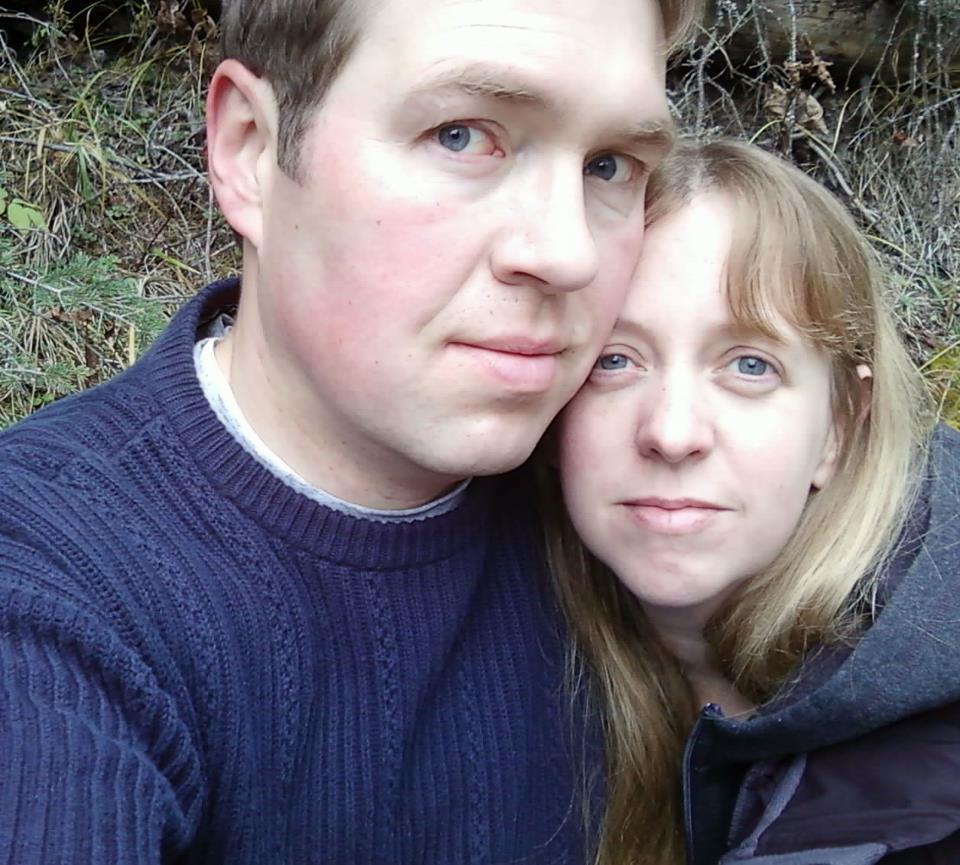
My Mr. and Me

My Mr. and Me

I wrote a novel about marriage.  It’s a novel, not a manual.  It’s meant to start conversations about love and relationships, not necessarily to resolve them.  Recently, I had one such conversation.  It was a discussion about whether the marriage I wrote is truly a happy one.  Would my main characters actually love each other if they had to live in the real world?

My position, of course, is that they would.  Most of my reviewers agree — but not all of them.

I’m not a marriage counselor.  When I’m writing, my job is not to lecture but to describe what I see in life and in my imagination.  That’s where the marriage I wrote came from – not from relationship theories but from inspiration found in things I’ve seen, heard, felt, and (as one reviewer pointed out) smelled.  And, since this is the Internet, I’ll write some of what I see in happy marriages in a list.  Maybe everyone’s list would be different.  But this list is mine – and ya won’t find anything on it about toothpaste caps or crapping with the bathroom door open.

Quick Disclaimer: I’m speaking of marriages where both partners are fairly healthy emotionally and socially.  I don’t mean situations of abuse or flagrant craziness where self-preservation demands a different list entirely.

What a Good Marriage Looks Like To Me:

1)      It’s Not Dating.  And thank goodness.  During his dating days, I had a miserable conversation with one of my brothers.  He didn’t want to live alone but at the same time he was worried marriage meant being trapped in a never-ending date – having to keep up a stream of witty conversation, fussing over the etiquette of opening car doors or not, orchestrating lavish events – all those company manners stretching on and on until someone in the couple mercifully dies and the other can relax.  Married people can go on dates but we are not dating.  Even if we aren’t holding hands at the movies every night, romantic moments can arise out of daily life – moments much more natural and genuinely loving than stunts copied out of hackneyed, soap-opera-inspired cultural scripts.

2)      It Maintains Physical Contact.  Look, it’s hard to stay mad at someone when she’s sitting in your lap.  The power of physical affection shouldn’t be underestimated.  Between people who love each other, it can take the edge off just about anything.  It can change fighting into flirting.  And it’s easy to use.  Slather it on.

3)      It’s Generous With the Benefit of the Doubt.  Everyone makes mistakes.  In a good marriage, mistakes are handled by thinking, “There is no way he meant that to sound so awful.  We must be missing something.”  When attributing motives to a spouse, it’s best to use a deductive approach – one that begins with the premise that the loved-one truly loves us.  From there, we assume the most basic motive is love.  We may be clumsy and unsuccessful in showing love but we try to see it underlying behaviours anyway.  We use humor and affection and warm, open communication to let partners know when there’s a glitch. We also use tenderness.  Frankness is not always a virtue.  Sometimes, it’s just laziness, malice, and thoughtlessness dressed up in a goofy costume made of 1970s self-help mystique.  Ironically, frankness can sometimes foster more misunderstanding especially when an issue calls for slow, delicate defusing to keep it from detonating and devastating the relationship.

4)      It Doesn’t Keep Score.  A good marriage has no tally sheet.  It doesn’t worry about “love banks” or throw down rules about how love must be proven or earned.  Marriage isn’t a corporation.  Instead of keeping balance sheets weighing good deeds against bad behaviours it just forgives and forgives and forgives.  It’s like a soccer game for 5-year-olds.  Try your best, have fun, concentrate on teamwork, forget the score, and it’s okay if everyone wins.

5)      It’s Not Preoccupied With Boundaries.  Individuality is the human condition, okay?  We’re all different and separate from one another.  Nothing anyone tries to do to us can change that.  For a romantic sap like me, the greatest challenge of our lives – including our married lives – isn’t to find ourselves but to find someone else and make them as much a part of ourselves as possible.  Marriage is one of those transcendent paradoxes about losing ourselves in order to find ourselves.

6)      It’s Open to Miracles.  This item on the list is important enough for me to break the Internet convention of limiting lists to five points.  Like I’ve said before, I don’t really know what makes marriage work.  It just does.  I have a good one.  Without much effort, I’ve been happily married to the same man for eighteen years.  But it’s not because we’re any better or smarter than anyone else.  There’s got to be a lot of luck – or something like it – involved.  A good marriage is not unlike a miracle.  And a miracle, by definition, demands faith that something unlikely can actually happen.  So believe in marriage.  Hope in marriage.  On many levels, marriage in the twenty-first century doesn’t make much sense.  But here we are.