This is not a Eulogy: Un-Useful Tips at the End of My Degree

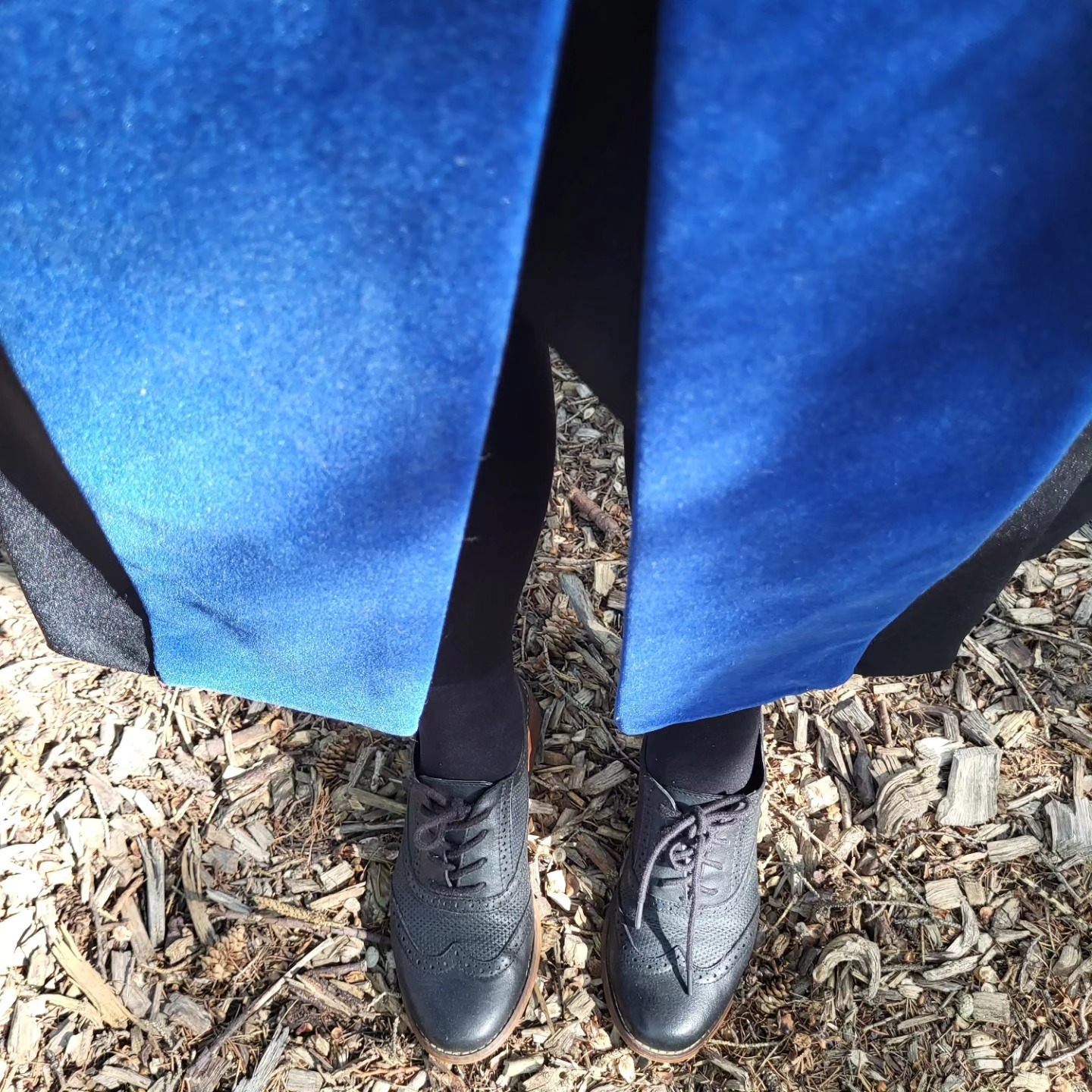
My regalia and my sensible shoes.

I keep trying to write about the seven year project of earning a doctorate in my 40s, but it keeps lapsing into a eulogy – a sober retrospective, a farewell, a melodramatic coda. And though a melodramatic coda wouldn’t be false, it’s not what I want to say. 

What I want to say is that I’m grateful, still tired, changed, etc., and that I was happy all along. My bff gets it, and she sent me a McDonald’s gift card (I love this girl) and a note about the “joy” I took in all of this. Well said, my dear.

So I’m marking the end of my degree with the same kind of written tribute I published on this site when husby and I celebrated our 25th wedding anniversary. It’s not really a list of advice, not exactly tips anyone could use, but it does note some of the things that went into my successful PhD program.

As always, no guarantees expressed or implied.

  • During your program, you’ll be given deadlines, not power over death. Ask for extensions. Go to the doctor. D.A.R.E to say no to Ibuprofen and mindfulness and get prescribed some proper drugs.
  • If your program has a language requirement, don’t fulfill it with two more semesters of a perfectly good language you’ve studied in the past. Start from nothing with a new-to-you language. Does it use the same alphabet as your primary language? Hm. Different alphabet? Hm, naw. No alphabet? Yeah. Yeah, that’s the one.
  • Your best friends are now twentysomethings. If you fail to befriend them, you may very well fail everything else about this. Eat lunch with them, go to hot-pot, room together in China, don’t let the embarrassment of them knowing how often you go to the bathroom hold you back.
  • The straight-middle-aged-woman/young-gay-man pairing is a power-friendship.
  • If you’re a lifelong anglophone, your privilege comes with a responsibility to help colleagues with their questions about English grammar and usage. Give it up.
  • Enjoy a student social life liberated from dating. No matter what Hollywood says, if you don’t understand you aren’t at school to date twentysomethings, you’re not fit to be there, you hecking creeper.
  • Involve your own kids in your schoolwork. Grind through what the YouTube essays don’t tell them. Oh, and remember to take them to the doctor too.
  • Never end your comment with “if that makes sense.”
  • Say “I don’t know” right out loud and with your ego intact. No one here is under the delusion that you know everything. Believe me.
  • Print the article so you can write all over it and then hoard it in a binder like a little rat.
  • Don’t spend the whole conference trip in sessions. Your talk will be sparsely attended and someone else is going to take up most of your time, so enrich your education with the chaos of a foreign municipal transit system.
  • Don’t panic when someone at your candidacy exam tells you their hubby thinks the dissertation you’ve proposed is a waste of time. 
  • Don’t convert to a philosophical theory. Study isn’t discipleship. Theory exists to serve your intellect, not the other way around.
  • There’s no need to wait until you’ve finished the dissertation to start writing another book. 
  • Yes, you have ADHD. Diagnosed or undiagnosed, it’s an unspoken job requirement in academia and, for us, a superpower. Congratulations. Where did you leave your keys?
  • Never say no to a teaching assignment. You may not be an expert in the fine details of the class material the day they offer you the job, but you’ve got the theoretical background, the skills, and the support to be everything anyone in the class will need in the end.
  • Don’t try to teach or research contemporary pop culture like video games, tiktok, fanfiction, ChatGPT, etc. without experiencing them as a user, you hecking poser.
  • Take the nightwatch at the deathbed. You’ve got a lot of reading to do anyway, even if all you can handle is that fanfiction.
  • Tell your students they’re your kids’ ages and you already like them. Don’t apologize to them if your lectures make you cry a bit.
  • When there’s a global crisis and you need to lecture from your home office which is also a laundry room, don’t hide the electric clothes dryer that’s always in the shot. Maybe move the pile of ironing.
  • Don’t fight changing ideas and technologies. They are on our side, even if we’re not sure how just yet.
  • In the same vein, end the denial and get the bifocals.
  • Ask your Chinese Studies professor about the feng shui of the exam room before you choose where you will sit to defend your dissertation. If he tells you to sit where an emperor would, you’re going to do just fine.

Things to Hold at the End of the World – Health, Faith, Family, Work, Art

Me, “chewing through” my medication

I got good news this week. 

My doctor is doing appointments over the phone for now, and he called early, catching me in the bathtub to let me know the scope and the scan I had this summer, almost two years after a life-changing flare of Crohn’s disease, showed I have scar tissue but no actively diseased tissue in my colon. 

He was so proud of us, genuinely happy. 

Not everyone experiences Crohn’s the same way, and the damage I suffered was particularly gruesome and dangerous. Based on that, some setbacks this winter, and a natural drug tolerance that had me, in his words, “chewing through” my fancy IV medication, he didn’t expect the results he found. He expected to be increasing my medications, and the possibility of surgery remained a live one. He was not only proud but openly surprised none of this will be necessary.

I was the opposite of proud. I’m a spiritual person and I embraced the good news as an exchange of grace I don’t deserve or understand, something connected to my father’s faith as he did his dying this spring. It’s a religious person thing, meaning made in the best of faith…

Anyways…

I need to keep taking IV medication to stay this way. The bowel isn’t the only part of the body affected by Crohn’s, and many other symptoms — typical auto-immune garbage — are still with me. The side effects of my medication remain too, a lesser evil but evil all the same, one which leaves me immune compromised during a pandemic. Yes, I am part of the “it’s only the…” population so many are willing to make into human sacrifices. Into the volcano with us. Cheers.

Still, nothing ruins my good news. This year has been astoundingly bad all around. As the year I lost my father to a long illness, it certainly includes some of the worst days of my life. But there have also been moments in the pandemic that bring goodness home to me, not always unlikely remissions, but things worth remembering.

Like…

  • My kids – It became obvious that my programmer son could work anywhere, so he moved 3500km from head office, back to the city where the rest of the family lives. Bonus is that, according to his youngest brother, “he is nice now.”
Home Office
  • My sibs – The sibling group chat (seven of us) has been a lifeline. As we work out Dad’s death, there isn’t much that needs working out between all of us. At the end, my sisters and I (five of us) moved into my parents’ tiny house for two weeks under the most stressful of circumstances, and we couldn’t have loved each other better or more. It was a great testament to my dad’s gift for making families. Elton John’s “Your Song” and Keane’s “Somewhere Only We Know” — basically any bittersweet Brit-alt-pop covered by a woman with a sweet voice — is about them.
  • Love – My husband will still kiss me goodbye for the day, even if I’m in a zoom classroom with twenty teenagers.
  • The earth – My modest yard is dominated by a pair of huge white spruce trees. For the six years we’ve lived here, we dismissed their corner as a black hole of sharp needles and mad insects. But this year, we took the time to see that many of their lower branches had died off. Once we pruned them away, it left the perfect spot to hang a hammock. The bugs hated it and left in a huff. We spent hours out there, in a fake boreal forest, like a place from my childhood. In this spot, I read reams of heavy philosophy that might have been unbearable otherwise. And yeah, it’s close enough to the house to get wifi.
  • My work – I’m a writer and a PhD candidate and this late in my degree, I would continue to do my work whether I was paid for it or not. But I do get paid for it. Months into the pandemic, the government of Canada continued to award funding for research in the humanities, and I benefit directly from that. Clearly, culture and art have been comforting and sustaining people through this crisis. And even as people I know and like fall for anti-intellectual, anti-humanities conspiracy theories, unaware of the irony of the parallels to Maoism in what they repeat, ill- and misinformed about what we do and how and why, I’m still in a place where I can keep working and creating.

Grief is work — grief for what we lose in global disasters, what we lose from our families, from our bodies. 

Grief is collaborative work done with my family, my medical team, in publishing, in research, in social media posts of my feet in my hammock. 

Grief is creative work. Writing my dissertation and my creative projects under newly pruned spruce trees dripping with sap is the same work as making sense of Dad’s death, which is the same work as healing my colon, which is the same work as taking care of my husband and siblings and long lost children, which is the same work as all of this.

“Crotchetty, De-Crappity, Schnappity:” Goth Red Green and How My Summer is Going

I know two things about cleaning gravestones:

  • Don’t use bleach
  • Don’t use a big freaky gas-powered pressure washer

I learned this watching grave restoration clips on YouTube—an activity that’s turned out to be my preferred mental break during a summer spent in a very strange headspace, fighting to finish reading the 61 books and articles I will be tested on in November to see if I can continue in my doctoral studies. Ideally, I’d be done reading in two weeks, but as of right now, I still have ten partly finished books and one I haven’t even started. I love everything about grad student life except this and funding applications so it’s been a rough summer of paying my dues and trying to get paid for my dues.

Clearly, gravestone restoration videos were the answer.

Most of the videos are narrated by biocide salesmen (the crud on gravestones is generally biological–algae, moss, lichen, all of it alive), earnest professional conservators, or amateur genealogists who are just so disappointed. They use soft-bristled brushes, approved cleaners with PH levels matched to the stones, and rinse it all down with a gentle slosh of plain water out of a bucket.

“That’s not tap water is it?” a heckler calls from off screen. “There’s chlorine in that!”

Welcome to Gravestone-Restoration-Tube.

But then there’s Bill.

From what I can gather, Bill is a senior groundskeeper-handyman working for a municipality in eastern Ontario. His personal YouTube thumbnail image is a John Deere themed open casket and his YouTube channel chronicles the maintenance he does in around the town cemetery (at least, it did until a board of directors banned him from filming anything past the cemetery’s front gate).

He’s like a goth Red Green (something for non-Canadians to Google), letting a slightly affected Canada-hick accent fly as he welds an old tank still full of diesel fumes without blowing himself to bits, and, yes, pressure washes the “friggin crap” out of gravestones, even a soft white marble one he begins the video by showing us that it’s a good exfoliant for his dirty thumbprint, improvising a tripod function out of the bucket of his skid-steer. He likes puns, mocks Nazis, gets distracted by interesting bird calls, and works the graveyard humor with quips like, “K, we’re here, live on location—well, least I’m live on location.”

And I can’t help thinking, but for a few decisions, maybe if I wasn’t so chicken when it came to the welding unit of my junior high industrial arts class, I could have been Bill. It’s a good life—creative, inquisitive, self-aware, brilliant in its Jack/Jenny-of-all-trades makeshift-ery. Dang, for all the lives we don’t get to live, languages we don’t learn to speak, people we never have “coffee” with, books we write that might never be read, books other people write that we might never finish reading.

I need these exams to be over. Until then, rock on, Bill.