Found Art for Fathers Day

IMG_7375IMG_7373

In the clay and rock fill that keeps getting piled up to make a park behind our house, we sometimes find these eggshell-coloured rocks with rusty markings on them. We’ve never asked anyone if we could collect them and add them to our garden but we’ve never been told we couldn’t take them either. The local rock-expert-dude who sells necklaces and healing crystals in the mall is unimpressed with them — says the marks are scraped onto the stones by the heavy-duty, dirty-metal equipment used to quarry and carry them. They’re machine-made which means they’re human-made — and that makes them art.

One of them is nice but it’s just an eagle, or whatever — something anyone could see in any skid-mark.  The other is some kind of winged, jaunty, sub-terranean devil-man on his way to work at some hellish mine.  Look, he’s got a pick-axe slung over his shoulder.

We used to have a rock that looked like a picture of Don Quixote on horseback.  But over the last winter his rust-smudged head wore away, or the stone healed itself, or I lost the power to see the image properly, or something. If I was someone else, maybe I might prefer the new headless horseman to the old non-knight.  If I hadn’t gone looking for the rock so close to Fathers Day after spending years telling everyone Don Quixote was my father-in-law, maybe I would be glad.  But I miss them — the stain on a rock and my not-quite second dad — I miss them both.

Selfhood, Motherhood, Childhood and How They’re All the Same

My son says this Fever Ray video reminds him of me. Is it the hair, the skinny legs, or all the going off to do weird stuff by myself?

I’m in a thrift store with my sixteen year old son.  (Anyone who doesn’t have a sixteen year old son should get one someday.  It’s kind of like having a stupid, darling high school boyfriend again only without all the icky tension.)

We get to the furniture section of the store – the part set-up like a dozen crummy little living rooms butted against each other.

“It’s like some old grandpa’s house,” my boy says.

And then, as I often can, I track of his train of thought.  It’s passing through the stop called “grandpa,” chugs in and out of the station called “the only dead person I know well” before it screeches to a halt in the busy rail yard labeled “death.”

“This is where they bring people’s stuff after they die,” my boy says.

“Yup,” I agree.  “This is where you’ll bring my stuff after I die.”

He doesn’t choke or get maudlin but he does say, “I won’t bring your stuff here.  I’ll keep it.  I’ll take your computers and find everything you ever wrote and print it out and save it.”

I tell him he’s sweet and we leave the store, bound for another thrift shop.  So far, we’ve bought a 1970s era Charlie Brown paperback and a discarded copy of a book I contributed a couple of essays to but we still haven’t found the t-shirt with the graphic of a killer robot with a Korean speech bubble that will be my son’s find of the day.  We get into the car, tune the radio to one of our favourite CBC shows – the one I work for a few times a year, – and we back into the Saturday afternoon traffic.

See it?  My life – including my life as a writer – forms a part of my son’s life.  It’s something he sees as enduring and inseparable from the imprint I leave on the world he is in the process of inheriting from me.

A recent article in The Atlantic entitled “The Secret to Being Both a Successful Writer and a Mother: Have Just One Kid” assumes motherhood and a stellar career as a writer are irreconcilable competing interests. The article’s hook of a headline (which was was not written by the author, Lauren Sandler), is beside the point.  This isn’t so much a piece about family size as it is about the level of personal investment it takes to write for a living.  On its way, it looks at mother-writers like Susan Sontag and Joan Didion to examine whether these women’s single-child families are the compromise that made it possible for them to excel at their careers while raising children – er, a child.

Of course, there are writers who do have more than one child and Sandler suggests that some of these women preserve their careers by hiring someone else to look after their kids.  Her other suggestion is that women writers can thrive in families willing to invert traditional gender roles and cast men as their children’s primary caregivers.

Sandler doesn’t seem convinced that any of these strategies is necessarily enough to transform an artist into something considered a good parent.  The article presents examples of writer-mothers being absent, self-involved, and dismissive – sending their lone children away with “Shush, I’m working.”  By the end of the piece, it’s acknowledged that there’s a difference between motherhood and “momish-ness” and artists often set the latter aside.

Right now, weeks before my debut novel is even released, I’m not what The Atlantic would consider a successful writer.  But I’m still free to fret over my own experience raising five children while writing.  Am I devastatingly dismissive?  Am I “momish?”  Do I have to be?

I admit I’m missing some of the traits of momish-ness – especially in the kitchen.  If my sons want cookies, they bake them for themselves.  I might make something special on holidays but I always garnish it with demands for praise and thanks.  “Hey, I made cookies.  Aren’t I good?  Look at how good I am.”  Honestly, I don’t even cook dinner very often.  My husband usually does that, without complaint, after a full day of demanding non-domestic work.

But is neglecting cooking enough of an an explanation?  Why do I still get prickly when I’m asked how I find time to write?  No matter how kindly it’s meant, the question seems to imply neglect and self-centredness – a lack of understanding of my own situation that misleads me to believe I can do two incompatible things at once.  I must be either willfully negligent of my kids or witlessly oblivious to reality.

Sometimes, I do put my kids off with my own version of, “Shush, I’m working.”  But there are reasons why being shushed by their writer-mother isn’t a developmental disaster:

1)      When my sons leave home, they will not be met with people who jump to satisfy all their wishes for food, attention, money, housekeeping, technical support, etc.  If I raise them to expect instant service, I do them and the other people who will live and work with them a disservice.

2)      By ignoring traditional areas of housework, I help the boys see distinctions between housewifery and motherhood.  They are not the same, they are not the same, they are not the same…

3)      Because I work inside the house where my kids’ lives are centred, they get plenty of “quantity time” so there’s not as much need to orchestrate fancy “quality time.”  I don’t arrive in the house as a celebrity here for a limited engagement.  I’m not a special attraction so I can relax and forgo behaving like one.

4)      All mothers have interests that eat up time they could spend with their children.  It might be paid non-writing work, making fancy scrapbooks, training for marathons, stoking reality television habits — anything.  When it comes to maternal attention, my kids aren’t that different from anyone else’s.

5)      My sons are not strangers dropped here at random.  They’re very much like me.  They are writers, artists, and creative people themselves.  Maybe they understand better than other people the importance of this kind of work.  They know it makes me happy because their own similar projects make them happy.  Maybe my self is overbearing enough to convince them to value in themselves what I value in myself.

The self – that’s the core of the problem I have with Sandler’s approach to writer-mothers.  She writes of our need to “negotiate a balance between selfhood and motherhood.”   I don’t know how these two -hoods could be separated, let alone set on opposite sides of a scale and balanced.  The self is far more like a casserole than a bento box.  (Hey, it’s a cooking simile – aren’t I good?)  Motherhood hasn’t effaced my self but it has been integrated into it.  A healthy self is a pliable one, not a brittle one.  It’s dynamic and able to accept how impressionable it is to powerful forces including – or especially — kids.

Linda Leith Publishing, Montreal QC

A Note from JQ:  I admit I’m jealous this blogger, Erinne, has met my publisher, Linda, in person while I have not — jealous of her and grateful to her for the look inside the far away company. Hooray for the interwebs!

esevi's avatarThe Great Canadian Publishing Tour

(April 21)

The drive to Montreal from Toronto, at five hours, seems quite short after northern Ontario. For the first few hours, things are great. The sun is out (dare I call it… spring?), the tunes are blaring, and I just snagged one of the last Roll-Up-The-Rim cups from the Tim’s.  (Please Play Again…sigh.)

But as soon as I drive past the Quebec border sign I’m hit with a wave of anxiety.  I’m in Quebec. I’m probably going to have to speak French. Here’s the deal: I’m an editor. I HATE making mistakes. In French, I KNOW I’m making mistakes.

And my vehicle, oh my vehicle. I’m not good at cars, but I can feel something wrong. I place both my feet on the floor (cruise control) and can feel grindy vibrations through my flats. I’m terrified that at some point a seam beneath the car will…

View original post 648 more words

Crybaby Reads Her Book

Me and my advance reading copy, taken from my good side.

Me and my advance reading copy, taken from my good side.

The sight of a thick, yellow envelope postmarked from Montreal usually means a happy day for me.  It’s mail from my publisher, Linda Leith.  The most recent envelope was closed around an advance reading copy of my unreleased novel,  Love Letters of the Angels of Death.  I was as happy to see it as I can get without crying.

The same week, my brand new writers’ group had its first meeting.  Each of the members was invited to bring “one or two pages” of work to read aloud.  The timing was perfect.  Here was a small, low stakes environment where I could make an early attempt at reading my novel in public.

It sounded easy.  As long as it’s all talk — no singing or yodeling involved — I’m comfortable with my own vocal performance skills.  I already had the chops I needed to do a reading from my novel.  All that was left for me to do was pick a short section out of the book, read through it once, jam the pretty new book into my purse, and show up at the meeting as if I do this kind of thing every day.

The first step — choosing a selection — was harder than I thought it would be.  I’m ginger with other people’s time so I wanted to be sure I read something I could end neatly when I reached the equivalent of the roughly two 8.5×11” sized pages I’d been invited to share.  It meant simply reading the first chapter of the book wasn’t an option.  I also wanted to avoid spoilers, which meant the last third of the book was off limits and I had to be careful about what I chose from the middle.

And then there was one more consideration.  I wanted to read something gripping.  But it also had to be something that would not make me cry.  If you know me, you know that’s asking a lot of myself.

I may have held it together the day I found the ARC of my book in the mail, but I can still call myself an easy crier.  It’s awful.  I hate it.  Everyone hates it (especially my teenaged sons).  I am such an easy crier that my own novel – a story I wrote myself – still makes me sniffle two years after I’ve finished writing it.  The last sentence in it is only two words long and it makes me choke into tears almost every time I look at it.

Don’t misunderstand.  I am not emotionally delicate.  I react with appropriate sorrow when something terrible happens but I’ve never struggled with enduring feelings of depression or anything crippling or frightening.  Alarming as it may be, I simply relieve tension best by crying.  And it’s not just negative tension.  It’s the positive too.  When a stranger stopped on the Alberta Autobahn and helped me change my flat tire last month, I was so touched by his kindness I could hardly speak to him.  I knew if I loosened up, I’d start crying.  Stupid crying – or even just the dread of ending up crying — it taints most of my best moments.

I guess I should be grateful my emotional depressurization system isn’t any more complicated than simply opening the valves of my tear ducts.  It’s a fine mechanism in private but in public it’s an embarrassing mess.

Back to the book: chapter nine was where I found what I was looking for.  I chose a main character’s quick flashback to a bad teenaged romance.  That was my selection – the very first part of my novel I would ever read aloud in public.  I’ve always thought the passage was strong.  It has everything except something to cry about.

Still, when the time came to read it to a room full of friendly, un-threatening writers, I felt shaky and unnecessarily emotional anyway.  And when I was finished, I was a little mad at myself for being too high strung to read it exactly the way I had wanted to.  I’m experienced in speaking about many things.  But my novel isn’t one of them – not yet.  I’m still cagey and protective when it comes to my book and the secret well inside me that it sprang from in the beginning.

Here is yet another aspect of this career as a novelist that I hadn’t anticipated.  Once again, writing the book wasn’t enough.  I guess I need to become slick, smooth, and professional at reading my novel out loud.  Even though its opening chapter is a little long and a lot emotional, I need be able to chew up it until I can recite it with a fluent, steady voice.  I need to hone my reading until those two tight passages where it’s easy for me to get overwhelmed don’t squeeze me anymore.  I will transform myself into a flesh and blood book-on-tape.  There – I’ve decided.

“No,” one of the nice Nancies (there are two of them) from the writing group gently protested, “the fact that your book means so much to you made it mean more to me.”

And with that, I’m weeping all the way back to where I started.  Dang it, Nancy.

How I (Almost) Botched My Writing Career

IMG_7226

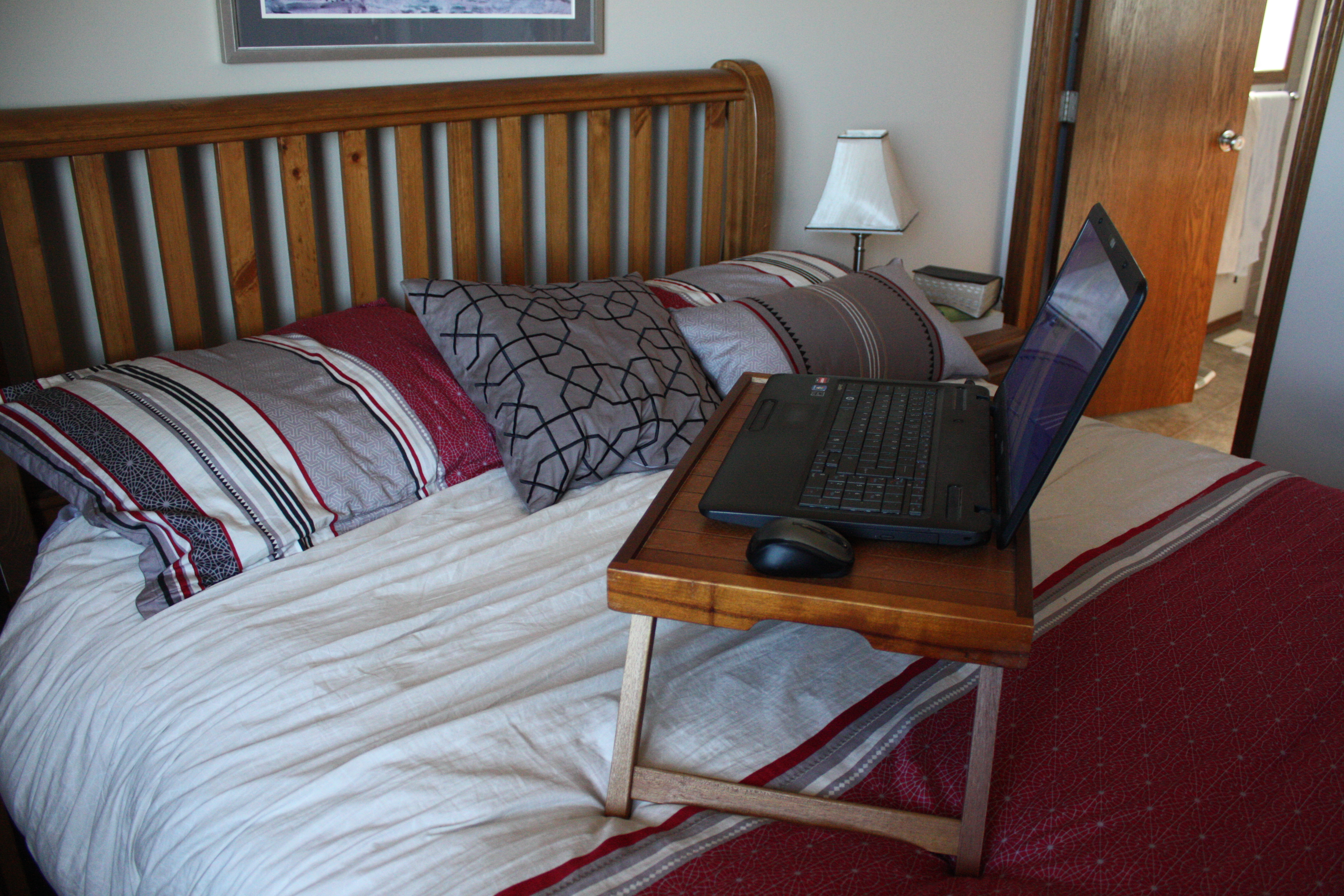
Writing in bed on a tea tray — like a boss

Last night I attended my very first writers’ group meeting – a “writers’ salon” at the home of a local wire-tap-transcriptionist turned edgy poet.  And I’m realizing now that my late entry into a writing group is yet more evidence that I have gone about my writing career the wrong way – the hard way, the backwards way.

Let me explain exactly how I’ve botched it – so far.

1)      I should have joined a writers’ group years and years and years ago.  All you kids at home, don’t wait until the advance reading copy of your first novel arrives in the mail before joining a writers’ group.

I’m in the habit of not showing my serious writing to anyone – not my husband, not my sisters, no one.  My utter lack of writing colleagues meant I mistook my work-in-progress manuscript for a finished book, started submitting it too early, and inadvertently ended up work-shopping it with the few gatekeepers at literary agencies and publishing houses who were thoughtful enough to jot a line or two (never any more) about why they were rejecting it.  It was a traumatic, slow, costly, and stupid way to get feedback.

Don’t be like me.  Before anyone in the business reads your work, make friends with writers with similar interests and better abilities than your own.  Read each other’s work and offer feedback.  Share contacts and news.  Learn to be gracious.

2)      I’ve never taken a creative writing course.  When my publisher and I were looking for a “blurb” for my book, Linda suggested I consider my former creative writing teachers.  It would have been a good suggestion if I’d had any.  It’s not that I didn’t take university-level literature classes.  I took them and I did well.  But I never took any courses dedicated to creative writing.  I’ve never had my work assessed and graded in an academic setting.

It’s not a fatal mistake.  Many writers spring up outside post-secondary creative writing programs — but not as many as I used to think.  So far, most of the people I’ve met in the working writing community have some past or present connection to writing as an academic field.  They don’t talk about writing as a vocation merely in a romantic, figurative sense.  They mean it the same way plumbers talk about their vocations – as papered credentials and regular, paying gigs.  There is middle ground between an institution-centred career in writing and never enrolling in a class.  And I should have spent some time there.

3)      I haven’t read much of the current literature in my field.  Instead of keeping up with the industry, I’ve used my precious reading time to polish off classics and to survey the YA books my kids are reading.  By now, I’m pretty well-versed in Dostoevsky and Dickens.  And I know my way around J.K. Rowling and Daniel Handler.  But I don’t know much about – whoever the heck has been important in literary fiction since the 1990s.

This was a bad move.  Stay tuned to the tone and the content of the industry.  Don’t raise your head only to when the mainstream media starts clamouring about yet another wave of erotica.  And don’t worry about being unduly influenced by other artists.  It’s the post-modern age – a time when humans have been reading and writing long enough for all of us to be a little derivative.  There’s no way to avoid it and the best we can hope for is to be able to admit it when our work looks like a freaky chimera of Carol Shields, Emily Brontё, and Napoleon Dynamite.

4)      I don’t have a physical space set aside especially for writing.  I write on my lap, sitting on my pillow, leaning against the head-board of the bed where I sleep at night.  It started as a desperate play for peace and quiet in a large, busy household.  I guess that’s still what it is.  It’s bad for my mattress, my spine, my wrists, and my temper.  Get a desk – or at least a chair.

That’s a short list of a few of my most obvious missteps.  I won’t repeat them during my next project — except for the bed-desk.

But there’s something like irony at work here.  I failed in all these ways yet I continued to publish anyway.  All my stumbling around with an unsuitable manuscript served to match my timing up with Linda’s and we found each other at just the right moment.  There’s no fail-safe formula for good fortune.

And on top of all these errors, I did do something right – something vital.  I finished the dang book.  I took good advice when I was finally given it.  I kept revising and submitting.  I kept fighting.  Of all the things I’ve heard people name as the undoing of their literary ambitions, not finishing their projects has got to be the most common.

Maybe that’s the biggest, most valuable lesson of all the ones I’ve learned so far — the one I’d leave with everyone, the one I kept repeating like a holy mantra at the writers’ group last night.  Finish it.  Keep going.

Judging My Book by Its Cover

The Cover of "Love Letters of the Angels of Death"The book itself won’t be out until August 2013 but this week my publisher released the image that will be the front cover of my debut novel, Love Letters of the Angels of Death.   And I couldn’t be happier with it.

Before the cover was created, my publisher, Linda Leith was generous enough to ask for my thoughts.  She asked me even though visual design is not a talent of mine.  It’s the same with me and music.  I know what’s good and what I like when I actually encounter it but creating something from my own imagination is a dodgy venture.  Not surprisingly, my first few suggestions were way off the mark.  But Linda still didn’t dismiss me from the process.

Finally, I said, “I wouldn’t mind a pair of birds as long as they weren’t too maudlin.”

It seemed risky to me — the possibilities for sentimentality putting two birds on the cover of a book about a marriage could inflame.  It’s not that I actually feared I might end up with a book cover with a pair of pastel, cartoon lovebirds canoodling on it.  But just to be sure we all understood what I meant, I did an image search and came up with a picture posted on a British wildlife photography website called Warren Photographic.  As time went on, we agreed we didn’t just want something like this photograph.  We wanted this photograph for the cover of the book.

The birds – with their long tails and iridescent blue-green plumage — are magpies.  Even though this pair has probably never set foot on the North American continent, western Canada, where most of my book is set, is teeming with their far-flung cousins.  They don’t migrate with the seasons.  They stay here all winter long making noise, scavenging food, and cleaning up the remains of other animals naturally selected out of the harsh environment.  They’re the most beautiful carrion birds I know — especially when they’re quiet.

The first time I noticed magpies – as an angry teenager newly arrived in southern Alberta from Nova Scotia – they were perched on some statuary outside a Lethbridge cemetery.  I assumed the city must have planted them there – like the swans in the Halifax Public Gardens – to make the urban landscape more exotic and elegant.  Every Albertan I’ve ever told this story laughs at me.

Like other corvids – ravens and crows and jays – magpies live in mated pairs.  And what I love about the pair on my book cover is the way they’re facing different directions but looking at the same thing.  The smaller one (which my prejudices tell me to call the female) is closer to what they see and the male is watching her as part of what he sees.  It’s like the narrative structure of my novel where the male narrator addresses his vision of the world directly to the female – the “second person” to whom he is narrating, the one individual who’s included in everything he sees.

I love the rest of the cover too.  I’m thrilled to have a blurb by Padma Viswanathan as the header.  Even after seeing it in print, I didn’t have a fit of self-consciousness and start hating the title (something that would not have been uncharacteristic of me).  And I’m grateful the surname I lifted from my husband when I married him is distinctive (unlike my first name and my McMaiden-name) while still being short and easy to say.  Hooray for my fine, Swedish in-laws, doggedly justifying the existence of the little-used “Q” section at the dry-cleaner’s – and now, hopefully, at the bookseller’s.

Review: “The Shore Girl” by Fran Kimmel, NeWest Press

Fran Kimmel’s new novel, “The Shore Girl”

I’ve had my head down, raising my kids, for a long time.  It meant that, when my publisher asked if I knew any well-known writers who could provide “blurbs” (that’s fancy-shmancy publisher talk for short reviews) to put on the cover of my book, I had to confess I didn’t know anyone.

It was a revelation for me.  The silly mystique of writers toiling away in thoughtful silence and social isolation really is a sham.  People who hide by themselves have nothing to write about – except maybe science fiction.  I’ve done all my writing in crowded, noisy houses.  The only thing I’ve been isolated from was other people doing the same thing.  And the time had come to find them.  My publisher was able to take care of the book blurb herself but I still needed to lift my head out of my laundry pile and meet my colleagues.

I didn’t expect it to be easy.  Canada is huge and sparsely populated and its artistic communities are densest in urban areas.  What were the odds there would be another literary fiction novelist living in my obscure little town?

Apparently, they were amazingly good.

After about two minutes on the Internet, I discovered Fran Kimmel.  She’s the author of The Shore Girl, a novel released in Sept 2012 by NeWest Press.  And she’s also my neighbour.  We had “coffee” at our local library’s café where she signed my brand new copy of The Shore Girl.  I liked Fran right away.  She’s closer to my mom’s age than to mine but, thanks in part to my big sister complex, I felt comfortable and happy to be with her.  She was gracious and generous with her encouragement and advice.  I came away scolding myself for not finding her sooner.

There was just one lingering worry for me.  I hadn’t yet finished Fran’s book.  By page eighty-eight, I liked it.  But would I keep liking it all the way to the end?  Not knowing any writers personally meant I could always say whatever I wanted when I finished a book without any fear that the old authors from pre-revolutionary Russia, or wherever, would get their feelings hurt.  What would it mean for our new friendship if I got to the end and realized I didn’t like it?

I read Fran’s book anyway.  I trusted her.  I trusted her publisher.  I read.  And I thoroughly enjoyed The Shore Girl.

It’s told in polyphony, through the voices of half a dozen different first person narrators.  They vary in age and gender but they all have two things in common: a girl named Rebee and the question of whether surrendering power to other people by loving them is worth the burden it brings.

I won’t risk trying to write a detailed plot summary.  I’m afraid I’d botch it and make the book with its unstable mothers, homelessness, and all that alcohol sound like an old after-school television special bemoaning the effects of dysfunctional families on developing children.  That’s not what this is.   Somehow, Fran has taken a set of circumstances that are usually treated in sentimental, tiresome terms and knocked the cloying clichés off them.  The clarity of the details of everyday life – the fingernail clippings and the insides of refrigerators – along with the stoic resignation with which the characters negotiate their difficult landscapes allow a story that could have been mired in gratuitous melancholy to become a story told with sincerity, warmth, wisdom, and even hope.

“It’s not a happy story,” Fran warned me.  She’s right.  But that doesn’t mean it couldn’t leave me feeling hopeful about the resilient, resourceful people who can grow out of tumultuous home environments.  Imperfect, incomplete love is still love.  And maybe — miraculously — it’s enough.

It was with perfect sincerity that I emailed Fran the morning I finished The Shore Girl and congratulated her for writing a very fine novel.  Just one more thing remains unsettled between us: Fran has yet to read my still unreleased novel.  Now that’s scary.